New Hampshire is the only New England state that doesn’t recognize any Native American tribes. Here’s what else often gets left out of the state’s Native history.
Native Americans have played an integral role in our collective history for thousands of years. Through colonization and the whitewashing of facts, their significance is often severely downplayed, if not outwardly rewritten. This is true across the United States, including right here in New Hampshire.
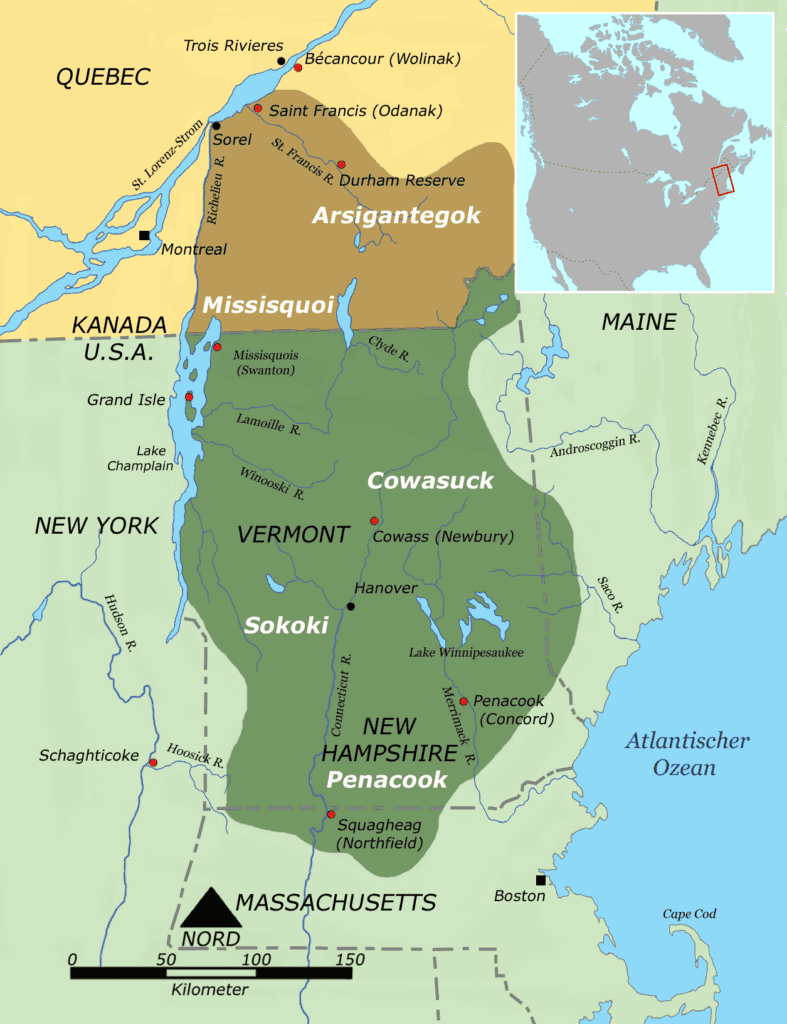
Paleoindians were the first to call this state home, settling along the river in what is now known as Keene. The greater Monadnock Region would later become the sacred homeland of the Abenaki. New Hampshire Magazine notes that this group of people and their ancestors have direct ties to the Granite State dating back over 12,800 years.
Three unrecognized Abenaki tribal groups and two intertribal groups still live in New Hampshire. They, along with numerous other tribes, were forced to acclimatize to white culture due to hateful anti-Native American policies, which led to their general erasure from society.
As Chief Paul Bunnell of the Ko’asek (Co’wascuk) Traditional Band of the Abenaki Nation explained to the Granite State News Collaborative, “Especially in the Northeast, we were driven underground during the extermination attempts, the scalping bounties, the eugenics out of Vermont. A lot of us that survive today are predominantly white, and we were able to hide within the census” because of that.
It’s a complicated, bloody history told through countless stories recalled by New Hampshire’s Native American tribes—tales passed down from ancestors to keep their lives, culture, customs, and suffering from being further erased. These four lesser-known facts show how New Hampshire’s rich Native American history surrounds us every day, yet often remains hidden in plain sight.
New Hampshire doesn’t recognize any Native American tribes
New Hampshire is the only New England state that does not recognize any Native American tribes, either federally or on the state level. There isn’t even a formal process for tribes to follow to seek this recognition. While being recognized on the state level “doesn’t really get the tribes very much at all,” according to Dartmouth College’s professor of Native American studies, Bruce Duthu, federal recognition does.
Being a federally recognized tribe or group allows people to receive services (such as housing), as well as funding and support from the Bureau of Indian Affairs, otherwise known as BIA. Professor Duthu explained why this is significant and how it differs from merely existing as a tribe within the state of New Hampshire.
“It activates their authority to enact laws—tax laws, zoning laws, criminal laws, civil laws—in other words, to be engaged in government activities. Without that authority, tribes can certainly do a whole host of cultural and social things, but what they cannot do is engage in government actions that will be respected by the Feds or the states. That is the brass ring,” he said.
Anne Jennison told the Granite State News Collaborative that it also goes a long way toward receiving the respect tribes deserve from other members of the community. “On the surface it would appear that these are little things, but they’re not. They change the entire public’s perception. If you can wake a few people, that becomes a ripple effect,” she said.
Several groups have filed petitions over the years and are still actively fighting for recognition from the state of New Hampshire and at the federal level, with little progress.
Denise Pouliot, the head female speaker of the Cowasuck Band of the Pennacook Abenaki People, told the Keene Sentinel, “Literally, it could take lifetimes—unfortunately, we’re relying on the federal structure, and that can be extremely slow.”
Previously, former governor Chris Sununu said in 2022, via his spokesperson, that he was “committed to supporting NH’s indigenous residents,” but he never pursued a path toward tribal recognition or even toward establishing a program that might make that possible.
In 2025, a bipartisan bill, HB 161, proposed changing who could serve on New Hampshire’s Commission on Native American Affairs. It would have limited membership to enrolled members of state- or federally recognized tribes, and given those tribes’ leaders the power to nominate commissioners. Because New Hampshire recognizes no tribes, the state-recognized groups that would have gained that power are all based in Vermont, and members of New Hampshire’s own self-identified Abenaki groups who currently serve on the commission would have become ineligible.
The bill also landed in the middle of the identity dispute. Critics who question whether Vermont’s state-recognized Abenaki groups have Indigenous ancestry urged lawmakers to kill it, pointing to Vermont as a cautionary tale. A House committee voted unanimously against the bill, and the full House rejected it in March 2025.
Some of New England’s oldest dwellings were uncovered in Keene
Keene holds significance for New Hampshire’s Native American history in numerous ways. In 2009, an archaeological survey ahead of construction of the new Keene Middle School found traces of four dwellings radiocarbon-dated to about 12,600 years ago, among the oldest in New England.
Dr. Robert Goodby, who was the lead archaeological consultant on the project, said they found four different types of Paleoindian tools, burned bone fragments, and specific stones in the area that helped his team make this determination. They also estimated that, during that time, the settlement would have likely been found along the high banks of the Ashuelot River, as this would have been the most advantageous place to live.
Because it naturally evolved over the years into swampland, it hadn’t been built up or farmed and remained completely untouched until Dr. Goodby’s team began their assessment. It was placed on the National Register of Historic Places because of this.
The Swanzey Fish Dam was built by Native Americans roughly 4,000 years ago
The Ashuelot River was especially meaningful to Native American tribes in New Hampshire, and another example of its importance to everyday life is the 4,000-year-old fishing dam still visible in Swanzey. It was constructed to help catch fish more easily and consistently for those who relied on the river as a food source.
It’s found close to Sawyer’s Crossing and was built in a V-shape using a variety of stones during the Terminal Archaic Period. As with the Keene dwellings, researchers were able to determine the age of the dam by examining the remains of three hearths in the area and fragments of stone and burned wood recovered nearby. It’s estimated that Native Americans used the fishing dam for thousands of years until European settlers arrived in the area.
Manchester’s Amoskeag Falls used to serve as a seasonal gathering hub for Indigenous tribes
Much like the Ashuelot River, the Merrimack River served as a resource for tribes around Manchester. In addition to providing Indigenous people with shad and salmon, the area near Amoskeag Falls was also a seasonal gathering place where they would meet once the frost and thaw had subsided.
As author C.E. Potter wrote in his 1856 book, “History of Manchester,” Native Americans were drawn to the area because it was easy to fish there. “The salmon and shad were taken by nets at the falls. In the basins below the falls, where the fish would rest after futile attempts to scale the falling water, they were scooped out with nets and weirs,” he said. Potter added that other Indigenous peoples “glided upon the surface of the pool and took the entrapped fish with spear or net as suited their convenience or fancy.”
According to archaeological records and oral storytelling, several places around Amoskeag Falls and the Merrimack River were particularly essential to the tribes gathering there, including the Neville, Eddy, and Smyth archaeological sites. These have provided insight into what their lives were like, how they functioned, and how they stewarded the land before European settlement.