Utah’s history is full of real-life mysteries, and if you read on, you can learn about some of the most notorious ones.
While no Utahn likes to learn that something unsavory has happened in the state, there’s also something undeniably compelling about a good mystery. And when it comes to mysteries, it turns out that Utah’s history is full of them. From slayings to heists to out-and-out disappearances, the Beehive State has seen its share of mysterious crimes worthy of Agatha Christie.
But what, exactly, happened in these curious cold cases? Do Utahns have a good idea of “whodunit,” but lack definitive evidence? Or are these true mysteries, lacking even a suspect? Could the crimes have been solved using modern forensics, even if the limited technology of the past made that impossible?
These are all excellent questions. And what you make of the answers will vary. But to help get you started, here are five of the most mysterious, strange, and surprising unsolved true cases from Utah’s history.
1. The controversial killing of Peter Lassen
Whether Peter Lassen’s murder counts as a piece of Utah’s history is actually debatable. While his mysterious death almost certainly occurred in what is now part of Nevada, at the time of the murder in 1859, the area was part of the Utah Territory. And that’s not the only debatable thing about this infamous pioneer murder.
Peter Lassen, also known as Don Pedro Lassen, lived in what is now California, but was then part of Mexico. He was a Danish immigrant who’s best known for the trails he established, which were later followed by emigrants, across the West. Lassen, who worked as a traveling blacksmith and later as a rancher, became a well-known pioneer figure throughout the Utah Territory and beyond. But all that came to an end with his murder, which occurred while he and two companions were prospecting for silver. One of the companions was also killed by a “hidden sniper,” according to the third, who survived. But who was this mysterious sniper?
Suspicion has fallen on different groups of Native Americans, and on emigrants who were dissatisfied with Lassen’s trails. Of course, the third man in the prospecting group, Americus Wyatt, is also a serious suspect. Today, Peter Lassen’s grave lies in California, and there is a monument to him near his birthplace in Denmark. But his killer (or even killers, plural) remains a mystery.
2. The crimes and vanishing of Jean Baptiste
When it comes to the life and disappearance of Jean Baptiste, the crimes are thick on the ground from the start. Jean Baptiste, who had moved to Utah from Australia, worked as a gravedigger in 19th-century Salt Lake City and had a longtime sideline as a grave robber. It’s estimated that he desecrated and robbed hundreds of graves before, in 1862, he was discovered having stolen the burial clothing of a recently-deceased outlaw.
When Baptiste was tried for his crimes, he confessed to robbing graves in both Utah and Australia, and was found guilty. For his sentence, rather than a more conventional punishment like imprisonment in a Salt Lake City jail, Baptiste was sentenced to banishment on Fremont Island in the Great Salt Lake itself. It was from there, after only three weeks, that he vanished.
At the time, Fremont Island was used for cattle herding, and herders discovered that Baptiste had, since he was exiled, killed and butchered a cow for food, found a source of lumber…and disappeared. Theories suggest that he built a raft, and either drowned in the Great Salt Lake or made it to shore and fled to parts unknown. The 1893 discovery of a mysterious skeleton near the Jordan River led to rumors that the remains of Jean Baptiste had at last been discovered—but the state of the skeleton made the results inconclusive, and so the mystery remains.
3. The gold train loot of Utah Canyon
There’s gold in them there hills! Well, possibly. This is less a single unsolved crime and more a series of crimes that have led to one of Utah’s most enticing and mysterious legends. Throughout the middle of the 19th century, during and after the Utah War, stagecoaches carrying gold and other valuables, and mail coaches on the Pony Express routes, were at risk from bandit gangs scattered across the state. Stagecoach robberies were common, but the bandits often faced a persistent problem: what to do with the stolen gold?
Some, it turns out, never really found an answer to that question. Many of the caches of stolen gold were never seen again, recovered, or discovered to have been spent. And that’s where the mystery comes in. Legends abound across the state that stolen gold is hidden in Utah Canyon. And the legends may well have some truth to them—not only have abandoned stagecoaches been found on the Utah/Arizona border, but legends of hidden gold in Utah, whether it’s a lost mine, Aztec treasure, or bandits’ loot, seem to persist. Surely, they must be so popular for a reason?
4. The notorious killings at Pelican Point
One of the most notorious cold cases in Utah history, the Pelican Point murders took the lives of three Utahns, including a teenage boy. In 1895, three cousins, young men Albert Enstrom, Andrew Johnson, and 15-year-old Alfred Nelson, were killed in Pelican Point, Utah County, near the ranch where the trio was working. While initially the three were suspected to have left town, the eventual discovery of their bodies confirmed that they had been shot at close range.
The case sparked outrage, and a massive investigation ensued. Suspicion initially fell on Harry Hayes, Enstrom’s stepfather, who owned the ranch and was initially convicted of the murders. However, enough evidence emerged post-conviction that Hayes was pardoned, and suspicion fell on a local cattle rustler, George Wright, who was found to have stolen items from the ranch. Wright was never convicted (although he would later be tried for a separate murder elsewhere), and a confession in Los Angeles from another man decades after the killings leaves even more doubt as to who the Pelican Point murderer actually was.
5. The missing treasure of the Castle Gate Robbery
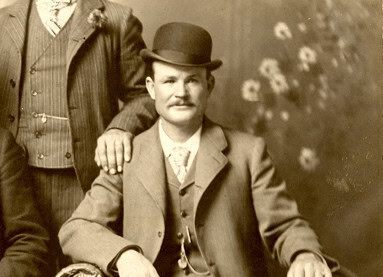
This one is another case of a vanished treasure that may or may not still be hidden somewhere in the Beehive State, this time having been placed there by one of the Wild West’s most notorious outlaws. When Butch Cassidy and his associate Elzy Lay stole a cache of silver from the Pleasant Valley Coal Company in Castle Gate, Utah, the hunt was on to find the outlaws—and recover the silver. While Cassidy was likely killed in a gunfight in Bolivia, his grave has never been definitively identified. The fate of the silver from the Castle Gate robbery is even more questionable.
Where did Cassidy and Lay hide their loot? Did they spend it? Or is it still buried, somewhere in the Utah hills? Unless an enterprising treasure hunter hits an extraordinary run of good luck, Utahns may never know.