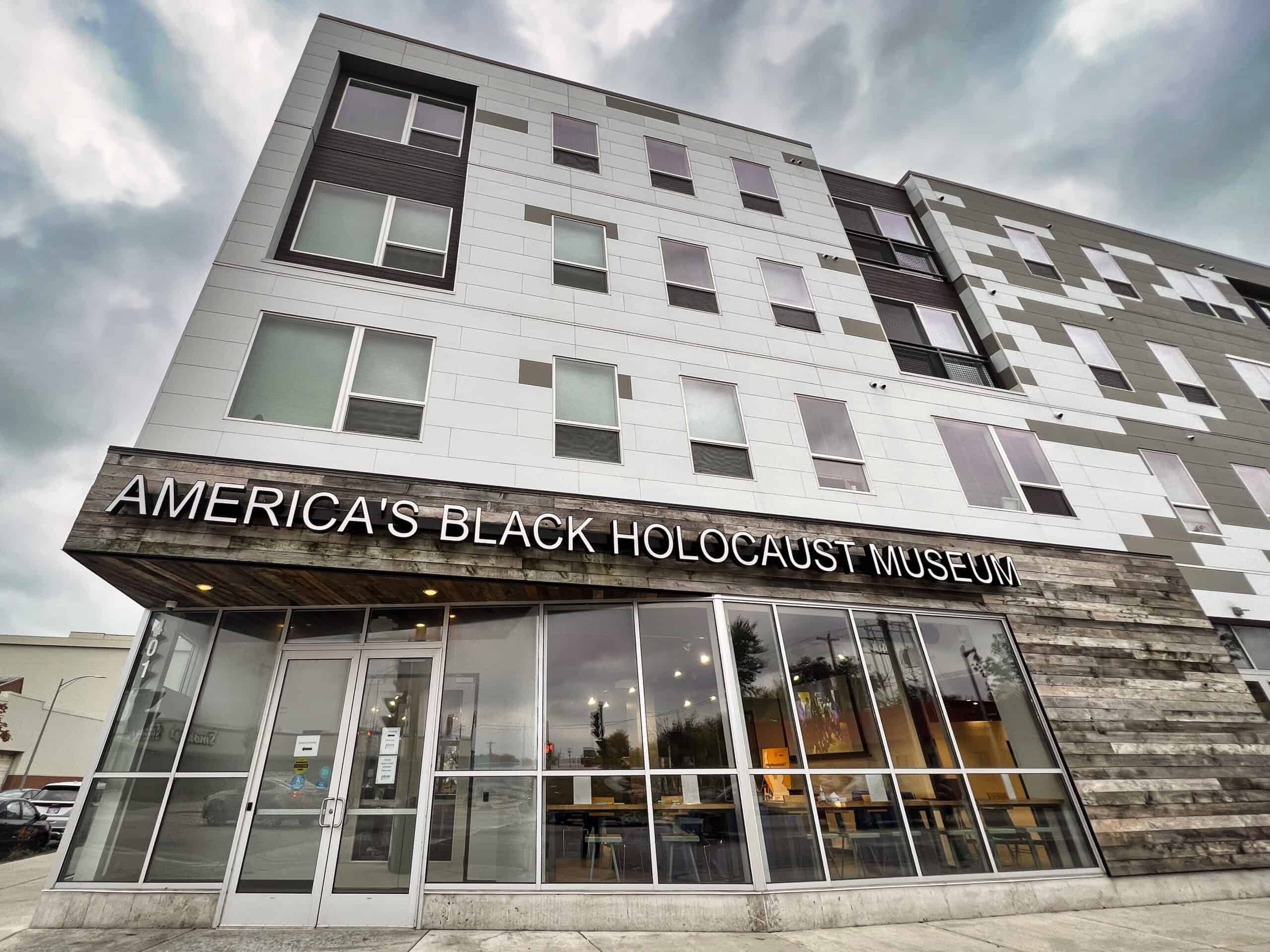
One of Milwaukee’s most powerful museums, America’s Black Holocaust Museum is home to moving exhibits you can learn about below.
Living in or visiting Milwaukee, museum lovers have plenty of options to choose from. From masterpieces at the Milwaukee Art Museum to natural history at the Milwaukee Public Museum and the zany fun of the National Bobblehead Hall of Fame and Museum, there’s always something to explore. But one of Milwaukee’s museums, America’s Black Holocaust Museum (ABHM), showcases some of the darkest and saddest points of American history—as well as stories of triumph over that darkness. While the museum, established in the 1980s, went digital-only in 2008, it reopened its doors as a physical, brick-and-mortar museum in 2022, though it still offers significant digital programming.
This Black History Month, anyone in Milwaukee should consider a visit to ABHM. The museum is home to extensive physical and online collections, but if you’re able to make it to the physical location, here are some things you’ll experience that you won’t soon forget:
1. The museum’s powerful origin story
Even before you visit ABHM, you ought to know how it came to be. The museum was founded by Dr James Cameron—the activist, not the filmmaker. Cameron survived an attempted lynching as a teenager and bore the scars, both physical and emotional, for the rest of his life. After studying engineering at Wayne State University and starting a career as a boiler engineer, Cameron turned to activism, fighting against segregation in the Midwest and founding multiple chapters of the NAACP.
During his career as an activist for racial justice, Cameron visited Yad Vashem Holocaust Memorial in Israel with his wife. While there, he was inspired by the Jewish idea of the memorial as a way to keep memory alive to prevent future atrocities, and saw parallels between antisemitism and anti-Black racism. These thoughts formed the idea for ABHM, which held its grand opening on Juneteenth, 1988.
2. A new look at African history
The story of Black Americans doesn’t begin in the United States. At ABHM, you’ll start your visit by learning about pre-colonial Africa, including the powerful empires of Mali, Ghana, and Songhai, each of which lasted for centuries. You’ll also explore the art, technology, and science that pre-colonial Africa brought to the world, and meet some powerful early African women warriors and rulers to learn their stories.
3. Eyewitness reports on the horrors of the slave trade
While you may already be familiar with the inhumane conditions on slave ships, particularly during the infamous “Middle Passage,” ABHM has preserved testimony from people who were on board. The Rev. Robert Walsh, who served aboard a slave ship in 1829, recorded what he witnessed, including the desperate, filthy conditions the newly enslaved passengers were expected to endure, and how, when he expressed shock and horror, he was told by other crew members that this ship was far from the worst they’d seen.
The other eyewitness testimony to the slave trade, by Dr. Alexander Falconsbridge, focuses on the process of capturing people in order to enslave them. This testimony, which was recorded in 1788, describes the process of kidnapping people and selling them off to be enslaved, and of the cruelties the kidnapping victims faced before even boarding a slave ship.
4. The groundbreaking work of an enslaved physician
While the majority of enslaved people were denied the opportunity for an education, one exhibit at ABHM showcases the career and scientific work of an enslaved doctor. This exhibit shows the work of Dr. Caesar, an enslaved man who lived in South Carolina with his wife and children in the eighteenth century. While Dr. Caesar did not attend formal medical school, he was a respected healer who discovered a cure for rattlesnake bites. Dr. Caesar used the efficacy of his snakebite cure to testify before a court and eventually secure both his freedom and an income, though not his family’s freedom.
5. The surprising story of a sweet treat
If you’ve ever enjoyed a sweet, chilly scoop of butter pecan ice cream, you probably didn’t realize that you were tasting a legacy of Black resilience and innovation. From the crucial roles enslaved persons played in the commercial cultivation of both pecans and vanilla—two of butter pecan ice cream’s key ingredients—to longstanding traditions of serving the dessert among Black American families, this exhibit shows the surprising cultural significance of one of the world’s favorite flavors of ice cream.
6. Black and Jewish history coming together in more ways than one
While the founding of ABHM was inspired by memorials to the victims of the Nazi Holocaust, the museum also highlights a long-standing historical connection between Black and Jewish communities in the United States. Given that both communities have been victims of prejudice, it’s not surprising that solidarity and a common fight against injustice have formed through history. The museum highlights this in a focus on the Rosenwald Schools, which were established by Julius Rosenwald and Booker T. Washington to educate underserved Black children in the South, and the work of America’s Historically Black Colleges and Universities (HBCUs) to help Jewish scholars escape the Nazis during the Second World War.
7. Remembering the victims of lynching
In addition to the educational exhibitions, one of the most powerful displays at ABHM is a memorial to the victims of lynching. While the whole museum serves as a memorial, this particular exhibit sheds light on the murders of over two thousand lynching victims, including men, women, and children. The museum also offers a searchable online database of lynching victims, organized by state. This can be used by descendants, historians, or anyone who wants to put a name and, where available, a human story, to the act of remembrance.