Dirty soda went mainstream last year—you can even order a Dirty Dr. Pepper at McDonald’s. But this huge trend started with a small-town, family-run business called Swig.
In 2010, Nicole and Gregg Tanner opened Swig, a small, walk-up soda stand near Utah Tech University in St. George. Catering to UTC’s Latter-Day Saint students observing the church edict against drinking coffee and tea, the Tanners created fun, mixy-matchy sodas spiked with flavorings and cream that gave Starbucks’ However-You-Want-It Frappuccino a run for its money.
By 2015, the Tanners had opened multiple locations around the state—and soon, Swig spawned an army of imitators, including Sodalicious, FiiZ, Thirst, Sizzurup Soda Lab, The Sodamix, Pop Drinks, Rocket Drinks, Twisted Sugar, Sips, Blue Blue, and Quench It.
Then, in late 2021, dirty soda popped up on the New York Times’ radar. Olivia Rodrigo posted a selfie on Instagram from the Utah set of “High School Musical,” holding a giant Swig cup, her red manicured fingernails perfectly matched to the logo. Swig cups also showed up in the exquisitely manicured hands of cast members from “The Secret Lives of Mormon Wives.” It was just a matter of time before this niche regional drink became a global obsession.
With 169 stores and counting (and nearly that many copycats), Swig remains the original dirty soda. In fact, you can still order a Dirty Diet Coke (Diet Coke, sugar-free coconut syrup, fresh lime, and coconut cream), Nicole Tanner’s original dirty soda recipe—though it’s now called “The Founder.”
1. The Tanners started Swig during the aftermath of the 2008 economic crash
When Nicole and Gregg Tanner first opened Swig in early 2010, they only charged a dollar for sodas. “My husband would be the only one there. He’d open at 7:30 (a.m.) and be there until 11 (p.m.),” Nicole Tanner told The Spectrum in 2014. The Tanners had to push hard to get the business off the ground—but it didn’t take long. “It was after the first three or four months that it started to go.” Lines wrapped around the block. The lines haven’t stopped since.
2. The swoopy red logo was there from the start—but early Swig locations looked very different
As you can see from the photo in this 2016 blog post and on this Flickr account, Swig’s first shops looked more like “a Texas sno-ball stand.” With a bright facade and a cartoonish mural of a guy sipping a giant soda, it’s very different from the sleek, Minimalist drive-thrus you see today. As Nicole Tanner told Utah Business, their first location was only 700 square feet, and the Tanners had to fix up the first two buildings themselves.
3. It’s the official soda shop of the Utah Jazz
When the Larry H. Miller Company purchased a majority stake in Swig in 2022, one of the goals was to put Swig soda stands in the Delta Center, home of the Utah Jazz—not a surprise, as Miller was the team’s former owner. The announcement was made in 2024, and an army of giant inflatable Swig cups danced in center court to celebrate. The initial three-year deal is almost up, but the two Swig stands in the Delta Center are likely there for the foreseeable future.
4. With Swig’s chilled cookies, necessity was the mother of invention
The average temperature in St. George during July is 102 degrees Fahrenheit. It doesn’t get much cooler than that, even in September, with highs hovering in the 90s. Serving chilled cookies solved some practical problems (like dripping icing and unpleasantly melty chocolate chips), but it’s also much more refreshing to bite into a cool, chewy cookie when it’s 100 degrees outside.
5. Nicole Tanner founded the company only a year after being treated for breast cancer
In 2009, the Tanners experienced multiple crises. With Gregg unemployed, the family was under financial stress and had no health insurance. Then, at only 37, Nicole was diagnosed with breast cancer. After her treatment, she called the hospital, only to learn that her bills had been covered by charitable donations. When Swig blew up, Nicole founded the nonprofit Save the Cups to help fund treatment for other breast cancer patients.
6. Swig is drive-thru only for a reason
Nicole Tanner told The Spectrum she attributed part of Swig’s early success in St. George to the fact that it was just a drive-thru. As a mother of five kids, she could clearly see that a huge percentage of their customers were “drive-thru moms who don’t have to get their kids out of the car.” Swig is still exclusively drive-thru, with each location averaging around 800 square feet—barely larger than the original location. With two drive-thru lanes and an army of soda hops armed with tablets and card-swipe modules, Swig’s “upstream ordering” enables a single location to serve up to 120 cars per hour.
7. “Dirty soda” first went viral 100 years ago—but not in a good way
According to Google NGram, “dirty soda” first entered the U.S. lexicon a century ago. But not for a fun reason. As the Salt Lake Telegram reported in August of 1916, only the state of Ohio held soda fountains to any reasonable set of hygienic standards; according to the U.S. Health Service, “the dirty soda fountain” had “a great deal to answer for in connection with the spread of tuberculosis,” among other nasty bugs. The article’s illustration features a disheveled soda fountain worker serving “flavors” like diphtheria, whooping cough, infantile paralysis, typhoid fever, and the aforementioned T.B., with a tiny skeleton bobbing around in every soda glass.
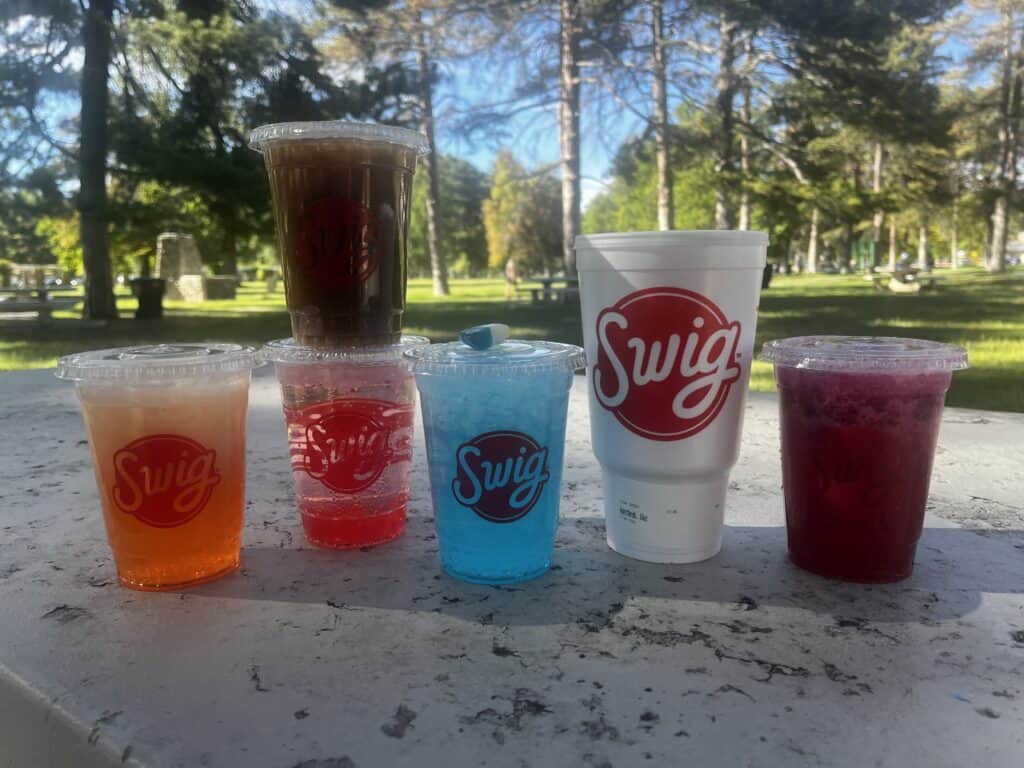
These days, with business and public health no longer at odds with each other, some dirty sodas only sound dangerous, like Swig’s Shark Attack—a bright blue mix of lemonade, Sprite, and blue raspberry, topped with a gummy shark.