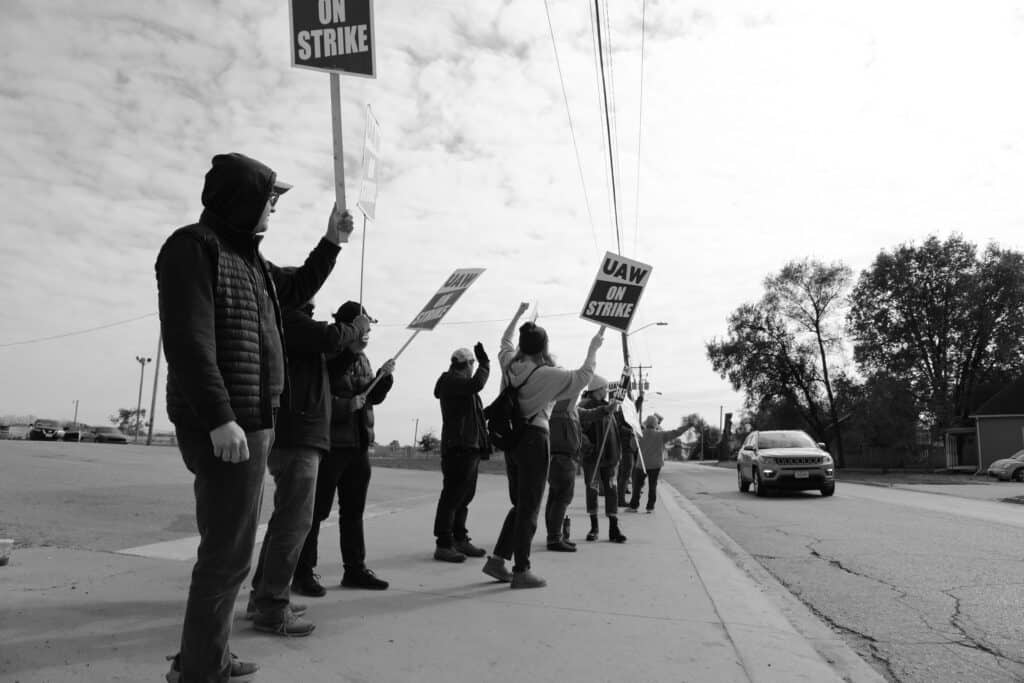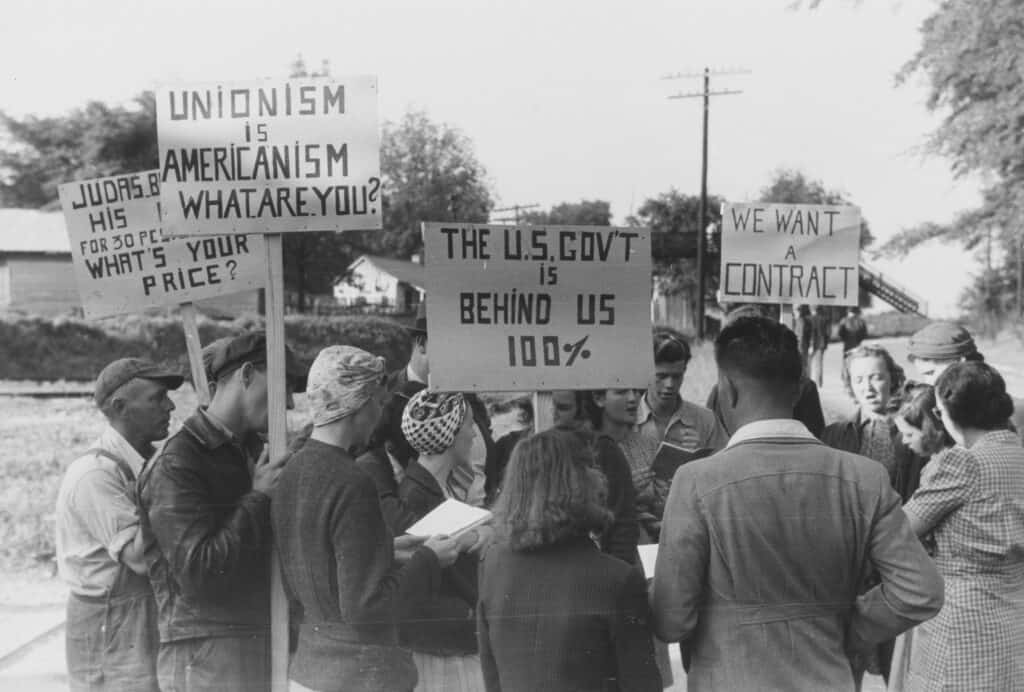
As a “right-to-work” state, Arizona has a storied history with labor unions. Here are eight notable moments to know about.
Jobs that are typically unionised include teachers, nurses, electricians, plumbers, construction workers, truck drivers, miners, auto mechanics, officers, firefighters, and hotel workers. Being unionized means employees have formed or joined an organization to collectively negotiate with employers for better wages, benefits, and working conditions. This collective bargaining results in more successful negotiations for better pay, contracts, and benefits packages. Joining unions often requires monthly dues, but is offset by statistically better pay. While the first unions began in the 18th century, their widespread necessity emerged in the mid-19th century due to the Industrial Revolution.
Arizona is a “right-to-work state,” allowing laborers in typically unionized jobs to work without joining a union. However, there are over 200 labor unions in the state, representing up to 185,000 workers. Given the rich history of unions and the way industry treats union workers in our slice of the Southwest, it is no surprise that Arizona has relatively few union workers. However, that has not stopped unions from making history—for all the right reasons in the modern day, and some very alarming reasons in the past.
Sordid labor history
Before celebrating some much-needed modern-day wins for labor unions, we must first look at how early treatment of union workers led to the Grand Canyon State’s lower union presence. Unsurprisingly, the sordid history has a great deal to do with a modern-day controversial industry: mining.
1. 1917 and the Bisbee Deportation
A handful of years after joining the country, Arizona was the scene of a major controversy after mine workers decided to strike. Members of the Industrial Workers of the World (IWW)—colloquially known as Wobblies—began organizing strikes at some mines in Jerome and then in Bisbee. Part of a pro-union movement, the mines would have none of it.
Following America’s entry into WWI, there was increased demand for bullets and military hardware, as well as for rural electricity, increasing the need for copper. This need did not help the already low-wage, long-hour reality of the miners, whose conditions were more strenuous and dangerous than in modern times.
When news outlets reported whispers of a strike, Jerome locals gathered the miners who favored the strike and loaded them onto cattle cars on the railway. Two days later, a similar outcome emerged in Bisbee. With about 10 times the number of workers to round up, the deportation of pro-union workers in Bisbee was on a grand, official scale, with deputies and temporary deputies rounding up the miners and union sympathizers alike. Around 1,200 people were loaded onto railcars and shipped to New Mexico.
The Army rescued the 1,200, many of whom pressed charges for kidnapping, charges that were never quite substantiated. This act, known as The Bisbee Deportation, set the tone for how mines would react to unionized workers in the coming century.
2. 1983 Phelps Dodge stood on principle
Nearly 70 years later, from 1983 to 1986, a copper miners’ strike against Phelps-Dodge ended favorably for the mines, not the people.
The company’s introduction of a new compensation practice initiated the strike. In this package, wages would not automatically adjust for inflation, new employees could be hired for less, wages could be reduced under a two-tier system, and benefit packages would require copays. United Steelworkers and 12 other union locals, representing about 2,500 workers, negotiated on opposite terms.
The three-year strike ended in defeat for the unions, officially disbanding them and resulting in one of the most significant union losses in U.S. labor history. The result had deep long-term effects—the unions’ collapse weakened organized labor statewide, devastated mining towns such as Clifton and Morenci, and effectively ended regular collective bargaining in Arizona’s copper industry.
What is important to note is that Phelps Dodge denied union pleas based on principle, not on profit. In an excerpt from “Mexican Workers and the Making of Arizona,” scholar Anna Ochoa O’Leary notes that “the company lost $100 million in operations and claimed another $100 million in write-offs in 1984. Stockholders lost $220 million, or $92,000 per striker, demonstrating that Phelps Dodge’s refusal to settle with the thirteen striking unions went beyond efforts to save on the cost of wages.”
The company sought something bigger, and that something bigger was exactly what was achieved: The silencing and dismantling of labor unions across the industry. While unions are present in mining today, this story is simply yet another example of the industry’s overall attitude towards unions from large companies.
Modern labor wins
Despite historical attempts to strong-arm labor unions, the 185,000 or so unionized workers in Arizona know that unionization means better pay, fairer practices, and greater negotiating power.
3. 2018 Red for Ed
Teachers are underpaid, a widespread modern issue that has especially been true in Arizona. In 2018, a campaign known as Red for Ed saw Arizona teachers go on strike for six days, earning a 20% raise (rolled out over several years) and renewed funding for the school system.
Prior to the strike, “schools were suffering from a budget deficit of $1.1 billion, per-pupil spending was 48th in the nation, and Arizona’s teachers were among the lowest paid in the country.” This unionized structure successfully brought funding back to education, notably an important tier for any civilized infrastructure.
4. A Mesa Starbucks paved the way in February 2022
In February 2022, a Starbucks location at Baseline and Power Roads in Mesa was the first Arizona location to unionize. It was also the first Starbucks store outside of Buffalo, New York, to join a labor union.
Driven by Workers United, the store launched inspiration for other locations in Mesa, Gilbert, Phoenix, Avondale, and Litchfield Park to organize under a similar guise. Unionization creates bargaining power for better staffing, pay, consistent hours, and safety, many of which were overlooked since COVID-era policies. Despite Starbucks officials stating that it is easier for the company to work directly with employees, employees strongly disagreed, instead turning to collective bargaining, which over 600 stores nationwide now see.
5. January 2024 and one lit union
Agriculture is a large industry that’s fairly unregulated for various reasons. Only once has the Arizona agriculture sector joined a union. That is, until January 2024, when Trulieve decided to go union. In a 37-to-4 landslide vote to unionize, this marked a first for the cannabis industry and only the second time for agriculture in Arizona.
Joining United Food and Commercial Workers Local 99, the 40+ workers successfully negotiated guaranteed wage increases and the right to take product home to sample—a privilege that many should enjoy after a long, hard day in the fields.
6. August 2024 was one for the books
Bookmans is a retail chain bookstore headquartered in Tucson that buys and sells used books, music, and games. It recently made history by becoming the first Arizona bookstore to unionize. Joining UFCW Local 99, the store was able to bargain for better pay and benefits and seek protection against sudden layoffs that left employees feeling vulnerable.
Joining the union is a huge step in a more secure future, making this one for the books—pun intended.
7. April 2024 took the heat off of Phoenix workers
Phoenix is Arizona’s capital and business hub, yet it is known mostly for one standout fact: the high summer heat. For many, this simply means lounging indoors or poolside, but what about the outdoor workers, such as construction workers, airport personnel, and contractors? Working in uniform during peak heat can literally be life-or-death. In fact, hundreds of people die from heat-related causes in Maricopa County each summer.
With the assistance of members of UNITE HERE Local 11, SEIU’s Airport Workers United, and other labor and community organizations, the Phoenix City Council unanimously passed an ordinance that offers heat protection to vulnerable workers. The ordinance requires employers to provide workers with access to training on recognizing signs of heat stress, seeking shade from the sun, using air conditioning, drinking water, and getting adequate rest.
Before this ordinance, there was nothing in place protecting these workers who build the very infrastructure that protects us from the same heat that threatens them.
8. August 2025 welcomed a union fair in the Navajo Nation
The only AFL-CIO federated body that represents Indigenous families in the Navajo Nation, the Nal-NiSHii Federation of Labor organized a labor union fair in Window Rock, Arizona.
The first of its kind for the Navajo Nation, unions from around Arizona and New Mexico gathered to set up booths intended to connect workers with information about different labor unions. With several keynote speakers, the idea of unionized labor was brought to a historically underserved community, thereby strengthening negotiating power within the largest reservation in the United States. What is to come of this event that happened about half a year ago is still to be determined.