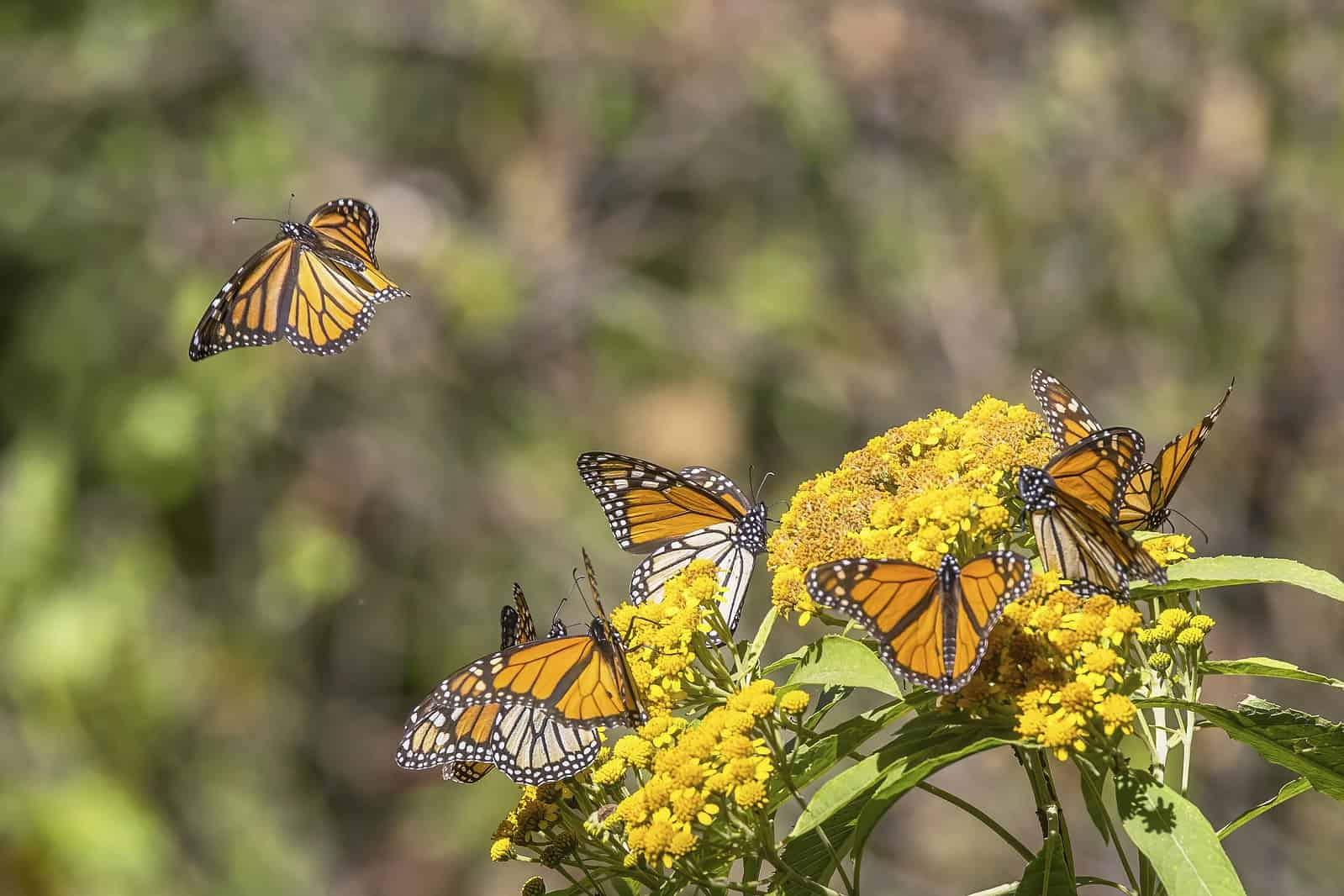
Texas A&M has been tracking the migration of monarch butterflies to better support this important pollinator. Here’s what you need to know.
For the Texas A&M College of Agriculture and Life Sciences, mapping the migration of monarch butterflies has been an ongoing act of patience and dedication. The process repeats itself each year—it happens in the fall, when millions of the insects take to the sky for their annual voyage to Mexico, and then again in the spring when they return to Texas to reproduce.
This migration, though seemingly simple, actually involves numerous connecting factors, including roadside habitats, wind, and geography, to name a few. Each of these connections is vital to the lifespan of the butterflies, perhaps now more than ever. According to the US Fish and Wildlife Service, monarch butterfly populations have decreased by upwards of 80% over the last 30 years. The work that Texas A&M is doing will, hopefully, prevent that number from worsening.
The College of Agriculture and Life Sciences has been working alongside the Texas Department of Transportation (TxDOT) and the Texas A&M Transportation Institute to reduce the risks the monarchs face as they migrate to and from Texas each year. In doing so, the teams hope to provide support for these important pollinators and to steadily increase their population again.
Speaking about their work, postdoctoral research associate James Tracy, Ph.D., told Texas A&M Stories, “When you see how many butterflies don’t make the migration, it gives you perspective.” He added, “It shows how closely our daily lives overlap with the natural world, and we are researching some small adjustments that could make a real difference.”
Want to know exactly how they’re making a real difference in the monarch butterflies’ migration? Let’s take a closer look.
The team is identifying migration risks and how to combat them
Since 2016, James Tracy and Robert Coulson, Ph.D., who is a professor at the college’s Department of Entomology, have been keeping track of the monarch butterflies on their annual migration. Through this tracking, they were able to identify one of the insect’s biggest risks: Vehicle collisions. Since the butterflies travel along major highways throughout the state during their migration, they’re often struck by vehicles. “It was eye-opening — We learned that monarch deaths were concentrated in very specific areas where landforms and wind patterns funneled them,” Coulson said.
The primary reason this happens is that specific food sources for the butterflies, like roosting trees and wildflowers, run alongside these busy roads. Additional factors, such as water features, causeways, and bridges, compound the issue, as each of these things draws the butterflies closer to oncoming traffic.
Once the team identified the issue, they began mapping out the best way to decrease vehicle collisions. This is where Carl Bierman and Darlene Goehl, two civil engineers at the Texas A&M Transportation Institute, come in. Goehl and Bierman worked together to create and test mesh panels, known as flight diverters, on some of Texas’s major roadways. These panels essentially help the butterflies realize they need to fly higher in the air through specific areas, which then lessens the likelihood of them being struck by a car.
These panels were put into action and yieled postive results
Two test sites were created, one at the Lavaca Bay Causeway and one in West Texas, to see if the mesh panels were effective in re-routing monarch butterflies away from the road. The West Texas site proved to be the most successful, with monarch deaths decreasing by around 50% during their fall migration. The panels installed at Lavaca Bay Causeway didn’t produce as consistent a decrease, as several factors, like the wind, often interfered with the barriers.
Despite the Causeway panels being less successful than the West Texas ones, the Texas A&M team was thrilled by their results. “Even modest changes in how roadsides are managed can make a measurable difference. That connection between science and application is what makes this work meaningful,” Tracy said. Coulson expanded on that line of thought, saying, “The lessons we learn here are not just for butterflies, but they help bees and other insects essential for agriculture and native ecosystems.”
Monarchs are a crucial part of the Texas ecosystem and beyond, as they pollinate wildflowers and native plants, which then provide forage for the state’s wildlife and livestock. This leads to higher crop yields, which produce more food for us humans. The Texas A&M team’s work has already led to additional pollinator conservation efforts to reduce traffic collisions along the state’s roadways.
“This is the epitome of what Texas A&M AgriLife does — We research and create solutions with practical, usable information and share it with people who can act on it,” Coulson said.