Learn about two pivotal moments in New Hampshire labor union history: the 1920 Palmer Raids tragedy and the 1963 Portsmouth Naval Shipyard triumph.
Labor unions have been an essential part of New Hampshire history for over 100 years. Thousands of workers have campaigned for fair working conditions, good wages, and beneficial schedules (among many, many other things). Amid contract negotiations, these unions will often make the news. That’s certainly the case for many workers across New England, including the women at Lowell Mill, who established the first union for working women in the early 1830s. This area has always had a rich history of working-class individuals advocating for themselves and what they rightfully deserve.
In the Granite State, there were two particular instances in which labor unions made headlines: during the Palmer Raids in 1920 and when the Portsmouth Naval Shipyard Workers gained collective bargaining rights in 1963. These snapshots in time perfectly capture the highs and lows of labor union history. Though it is often an uphill battle, workers have always remained committed to the cause. In telling their stories, we remain committed as well.
The Palmer Raids, 1920
To understand why New Hampshire unions and communities were targeted during the Palmer Raids of 1920, it’s important to first understand the effects of the 1917 Russian Revolution. The history of that event is complicated—it was decades in the making and involved numerous interconnected factors. You can read more about the revolution itself, including its causes, timelines, and outcomes, here. To condense the facts that are relevant to this story: Vladimir Lenin seized control and brought about radical social and economic change. He established a communist government centered on the rights of workers, soldiers, and peasants in an effort to create widespread equality.
Once this happened, other world leaders feared that workers would rise up and carry out similar revolutions in their countries. Stu Wallace, a New Hampshire historian, spoke with NHPR in 2012 about this issue. He said, “We heard the verbiage from people like Lenin talking about exporting the revolution to other countries. That this was really an international movement, the workers of the world were going to rise up. And as result of the economic problems here we had strikes, there were anarchist bombings, who knows who was responsible for half of those. And so there’s a fear beginning to develop in the country by the middle of late 1919, that the Red Revolution is coming to the United States.”
In response to this potential threat, an anti-Bolshevist bill was drafted by A.V. Levensaler, who was then leading Concord’s Bureau of Investigation. (Bolshevist was one of the terms used to describe individuals who supported the Russian Social Democratic Party led by Lenin.) That bill was signed into law in March 1919 by Governor John Bartlett. In essence, it became a serious crime in the Granite State “to advocate or encourage by any act or in any manner” for changing or overthrowing the state or country’s government. Certain acts, like private and public advocacy for workers rights and unions, or the possession, publication, or distribution of written or printed materials calling for similar sentiments, were also criminalized.
Then, Attorney General A. Mitchell Palmer began organizing raids across the country to round up “radicals,” or individuals who the government deemed likely to hold socialist beliefs. This included anyone from Eastern Europe who was labeled as Russian even if they weren’t, union members, immigrants, and Black workers, among others. Assisting Palmer in his raids—which received the name “Palmer Raids” because of the man who organized them—was an attorney at the Department of Justice by the name of J. Edgar Hoover. Hoover went on to become the director of the FBI for nearly 50 years and was largely seen as a controversial figure.
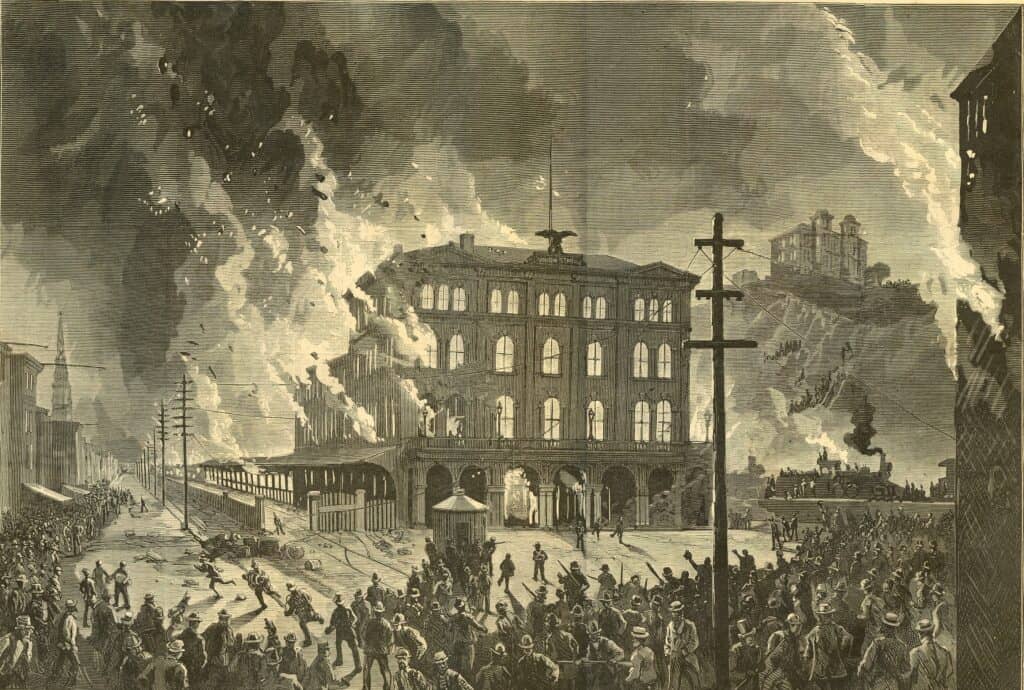
At the time, the Labor Department regulated immigration and had rules stating that any “anarchist immigrants” could be deported. Because of this, Palmer and Hoover targeted individuals whom they could classify as “anarchist immigrants,” even if they weren’t anarchists or immigrants. The Bureau of Investigation illegally planted listening devices and carried out break-ins for which they did not have warrants inside social clubs and labor unions to assist in their cause. Finally, on January 2, 1920, raids were initiated in 33 cities across the US, including several in New Hampshire. 141 people were taken in Nashua, and dozens of others were grabbed in Derry, Lincoln, Portsmouth, Manchester, Claremont, and Newmarket, among others. Hundreds of men and women were then taken by train to Boston, where they faced deportation.
One union member of the Open Forum, Koly Honchekoff, said he was taken out of his bed by federal agents. When they asked Honchekoff if he was a member of a union, he told them he was and had been for around three years. Instead of indicating that Honchekoff was part of the labor union, “The interrogator put down three years in the Communist Party, and the questionnaire became part of the official record.” In the eyes of Palmer and Hoover, being involved in a labor union meant you were all but signed up for the next socialist revolution.
Most of the detainees were released, though some were eventually deported. However, Wallace noted that the impact of the raids was long-lasting. “In 1920, New Hampshire had the 12th largest population of Russians in the country; but within a decade many had left,” he said.
Portsmouth Naval Shipyard Workers Win Collective Bargaining Rights, 1963
In January 1962, President John F. Kennedy granted federal employees collective bargaining rights through Executive Order 10988. Essentially, the term “collective bargaining rights” refers to the conversations between employers and unions regarding hours, wages, and employment terms and conditions. Prior to President Kennedy’s decision, many federal workers were excluded from receiving the same rights as private workers in the same fields were granted through the 1935 National Labor Relations Act. President Kennedy wrote in his memorandum for Executive Order 10988 that, “The participation of employees in the formation and implementation of employee policy and procedures affecting them contributes to the effective conduct of public business.” He believed that federal unions and employees should be extended the same courtesy, and that in doing so, the services they provided would greatly improve.
According to the Maine AFL-CIO, this order allowed federal unions to bargain over a variety of conditions, including:
- Grievance procedures
- Job classifications
- Personnel relations
- Demotion and promotion practices
- Vacation and work schedules
- Working conditions

Despite President Kennedy’s executive order, though, many of Portsmouth’s Naval Shipyard (PSNY) workers didn’t gain the ability to bargain for wages or organize strikes, even though they had organized unions in the beginning of the 1900s. A task force determined that it was “inappropriate” for these federal workers to receive collective bargaining rights, and that it would remain an optional practice in terms of whether the workers could pay dues to receive those rights. Additionally, the federal unions that were already in place were not legally allowed to act as bargaining agents for civilian workers in the PSNY.
In June 1963, after over a year and a half of work orchestrated by the Portsmouth Metal Trades Council, an official petition was created to recognize 3,000 PSNY employees in an effort to include them in arbitration hearings with the Pattern Makers Association and the American Federation of Technical Engineers. A few months later, the Navy Department and the Defense Department formally recognized the Metal Trades Council and the 14 local trade unions it represented. Then, on November 24, 1963—two days after President Kennedy was assassinated in Dallas—the Metal Trades Council, the Pattern Makers Association, and the American Federation of Technical Engineers all received official permission to legally act as bargaining agents for nearly 5,000 PSNY workers. It would take another two years to complete the first contract using the newly awarded collective bargaining rights to ensure fair safety, training, and grievance procedures, as well as fair working hours and leave.
Merl O’Donal, who had recently been elected as the president of the Metal Trades Council, addressed the historic moment, saying, “I cannot emphasize too strongly the necessity for both management and labor to live up to not only the letter of the agreement—but also the spirit of each. I know it is impossible for labor and management to always agree; however, in the spirit of the executive order, each, through mutual respect, should make an earnest attempt to understand the other’s position and reasons for it.”