For about 60 years, the San Antonio Chili Queens hosted one of the most popular spots to eat in the entire city. Discover their history and legacy.
You can find chili across the United States, though every region does it a little differently. Kansas City is heavily BBQ-inspired. Cincinnati is a smorgasbord of sweet and savory, often served over spaghetti and topped with cheese. Texas chili ditches the beans and embraces beef and chili peppers, creating a thick and scrumptious dish. Whatever your chili preference, the Chili Queens of San Antonio played a huge role in its development.
Today, San Antonio is home to over 1.5 million people. But back in the 1870s, the city looked a bit different. The Chili Queens weren’t only a clever name. They were food royalty among locals and visitors.
Learn more about these Chili Queens and how their legacy lives on, even nearly a century after they served their last dish.
How the Chili Queens of San Antonio began
In the post-Civil War period, San Antonio continued its growth as a multicultural frontier city, welcoming people with all kinds of different backgrounds. The city had become the largest in Texas in the 1860s and 1870s. Because San Antonio was a frontier city, most people got around either by walking or taking horse-drawn wagons. Exerting all that energy and focus worked up an appetite, and cowboys, drivers, and other passersby craved food they could eat quickly.
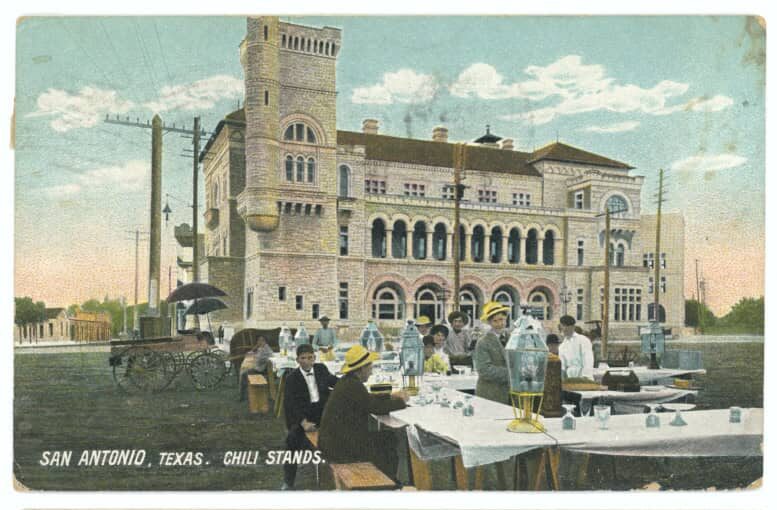
The Chili Queens first began setting up tables in Market Square and Military Plaza. Author Frank W. Jennings said the Chili Queens title was only reserved for a few of the women early on, such as Sadie and Martha, who are prominent in photographs from the era. However, as popularity grew, additional sellers soon earned the moniker of Chili Queen. They would bring ingredients from their homes and cook over mesquite fires. Locals and visitors alike were smitten by the scent of all those flavors, and they would eagerly chow down. Delicious food that keeps you full for hours? That would hook anyone with taste buds.
Word quickly spread around the city, and by the 1880s, the stands became must-see attractions. The Chili Queens were still slinging their traditional chili con carne, but they had also expanded to enchiladas, tamales, and other classic Mexican dishes. They were joined by musicians who sang and played next to their stands, creating a festive environment that everyone could enjoy.
In his writings, Jennings shared a quote from Stephen Crane, who authored “The Red Badge of Courage.” Crane visited San Antonio in 1895, and the picture he paints sounds magical: “Upon one of the plazas, Mexican vendors with open-air stands sell food that tastes exactly like pounded fire-brick from Hades—chili con carne, tamales, enchiladas, chili verde, frijoles.” Crane also commented that the “hum of conversation ascends from the strolling visitors who are at their social shrine.”
Increased popularity also led to some changes among the city and the tables. The Military Plaza welcomed the City Hall building in 1889, and the Municipal Market House was built in Market Square in 1900. So, the Chili Queens moved west and set up shop in Haymarket Plaza and Milam Park, other areas with hungry foot traffic.
A labor of love
Some historians equate what the Chili Queens did to modern-day food trucks. The Chili Queens turned their passion into a lucrative business. Despite waking up before sunrise and working late into the night, they were able to give themselves and their families a better life. And they did it all while delighting thousands of San Antonians and visitors.
UTSA Professor of Mexican American studies Lilliana Saldaña noted that the Chili Queens’s operation was quite elaborate. They had to move equipment and large amounts of chili to and from the market. Fans of the U.S. version of “The Office” may recall this is not an easy task.
“To transport all these big casuelas or pots of maybe pre-made food,” she said. “Also the plates, the utensils, the wood to heat up the food in the plazas, the tables, the chairs, the tent…this is an enormous labor. They were there every single day.”
All that hard work paid off. Although the chili sold for a modest price, some Chili Queens were quite lucrative. Graciela Sánchez, the Director of the Esperanza Peace and Justice Center, is the great-granddaughter of a Chili Queen. She said her great-grandmother lived in the area for over three decades, from 1890 until 1921, and had a home in the historic West Side on Chihuahua Street.
The Chili Queens legacy
By the 1930s, the Chili Queens were facing a decline. There were two primary reasons for this change. First, the public was more aware of how germs spread. While the food trucks and restaurants of today have to adhere to general health codes, the sanitation practices of the early 20th century weren’t nearly as stringent. In fact, the San Antonio City Council closed down the chili queens’ stands multiple times throughout their existence. Each time, however, the public protested, and the stands were reopened.
The other issue was that more San Antonio restaurants were beginning to pop up around the downtown area. Although the Chili Queens were legends in the city, they drew the ire of their fellow business owners. These owners argued they should have to pay rent, have health inspections, earn certificates, and follow other business practices like they did. Mayor Maury Maverick agreed with the business owners, and he enforced a rule that the Chili Queens needed to work from a central commissary kitchen with proof of passed health inspections, including adequate dishwashing methods.
Despite their best resistance, the pressure forced the Chili Queens to close down. However, their legacy continues to live on, with their flavorful dishes inspiring Tex-Mex creations for the generations that have followed them. Food stands and all the fun festivals across San Antonio and Texas also have the Chili Queens to thank, who laid the foundation for this type of open-air food enjoyment.
Their history is captured in books from historians and descendants, and their unique place in culture should be a great mindset for current times. People from all walks of life would line up for a serving of chili. Class and societal differences didn’t matter; everyone could bond over their shared enjoyment.
The Texas legislature named chili con carne the official state dish in 1977. There’s no shortage of Chili Queens recipes, either, like this classic chili con carne from the Witte Museum. Now, let’s dig in!