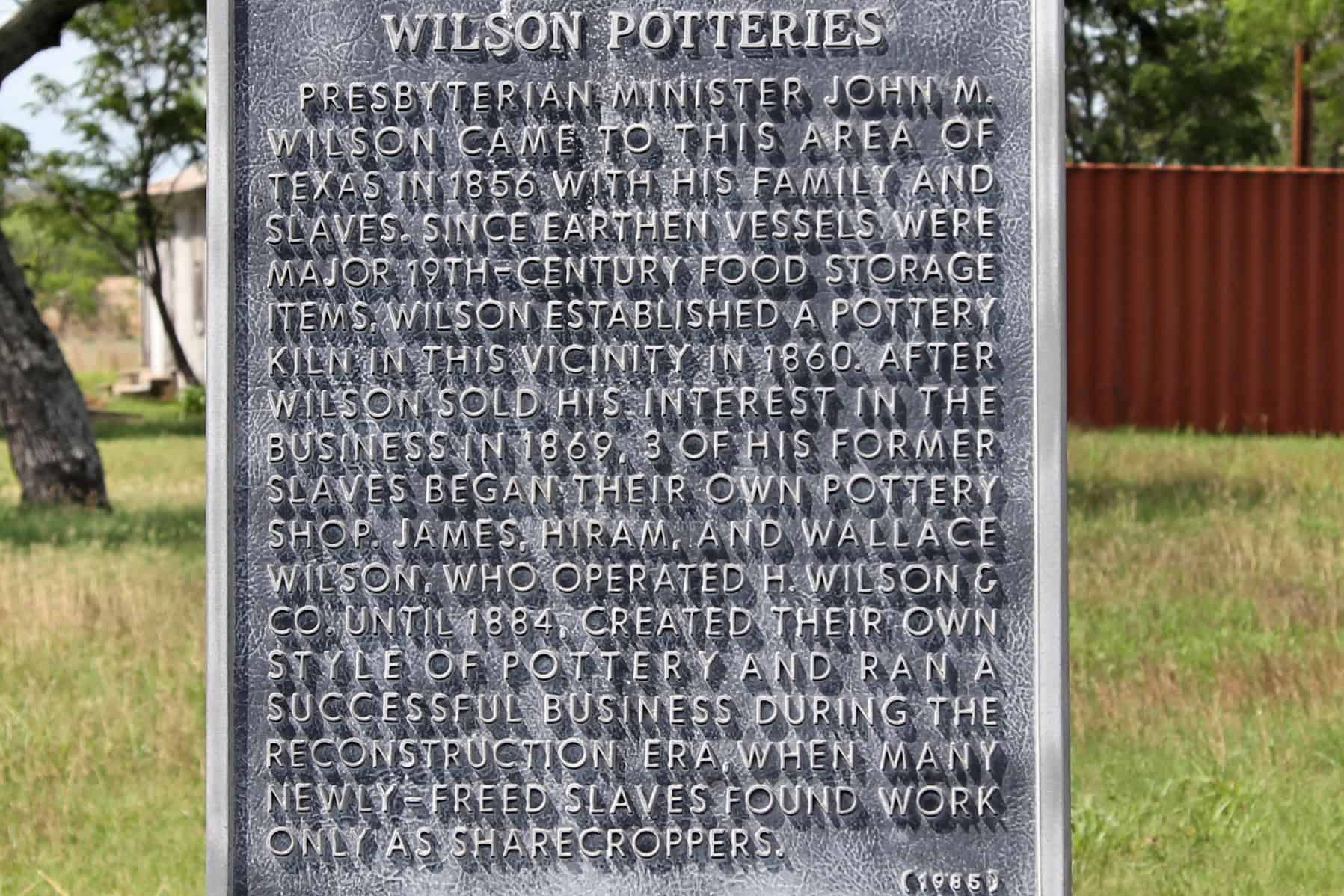
In 1869, Hiram, James, and Wallace Wilson made history when they founded H. Wilson & Company. This is their story.
In 1856, Hiram, James, and Wallace Wilson were enslaved servants of Reverend John McKamie Wilson Jr. In addition to Rev. John’s pursuit of the Presbyterian ministry, he was an entrepreneur focused on designing and making churns, jugs, crocks, and other items from clay. These objects were, at the time, akin to Tupperware, as people across the country would store food in the lidded pots. Rev. John’s Guadalupe Pottery business soared because of this necessity, and because of the detailed craftsmanship of the young men who worked tirelessly to produce products on a consistent basis. Paula King Harper, a fifth generation descendent of Hiram, and the President of the Wilson Pottery Foundation, said that Rev. John “taught them [Hiram, James, and Wallace] as children the art of pottery making — Hiram was about 19, we understand, when they arrived, and James was maybe 9 or 10.”
The men were the primary individuals responsible for production at Guadalupe Pottery. They mixed the clay and transformed it into practical objects using a kick wheel. From there, the trio would glaze the items and watch them carefully in the kiln to make sure each one was perfectly made. They carried on like this until 1865, when news of the Emancipation Proclamation finally made its way to Texas. Though enslaved individuals had been granted their freedom through the proclamation in 1863, it wasn’t until Major General Gordon Granger issued General Order No. 3 in Galveston on June 19, 1865, that slavery was finally abolished in the Lone Star State. The day was immortalized as Juneteenth.
Four years later, Hiram, James, and Wallace set out to create a pottery business of their own. The men were likely unrelated, but all bore the Wilson surname—many enslaved individuals retained the last name of their enslaver, as it made certain things easier, such as receiving government pensions—and decided to name their new venture H. Wilson & Company. In doing so, they established what is widely believed to be the first Black-owned business in Texas. It would become the first step of many on the path of history for these groundbreaking pioneers.
Hiram, James, and Wallace changed how pottery was made
When Hiram, James, and Wallace decided to start H. Wilson & Company, they knew it would be a costly and dangerous decision. Smithsonian American Art Museum fellow Ashley Williams said the trio operated in an “intensely dangerous environment,” with close to 200 Black residents filing “complaints with the Freedmen’s Bureau for unpaid wages and violent crimes” in Guadalupe County. Amid this violent turmoil, the Wilsons worked to secure a safe site to build their kiln, test clay, hire workers, and start turning out a steady stream of products. They received help from Reverend Leonard Ilsley, who secured $500 for the men so Hiram could purchase the right plot of land. Their new estate stretched over 600 acres and became the backdrop for their revolutionary creative ideas.
You see, before the Wilsons started their own pottery business, most of the objects crafted during this time were adorned with cup-shaped handles and flimsily secured with tops you had to tie down. Because the lids didn’t fit snugly, products stored within the pots would often spill or spoil. To prevent this from happening, the Wilsons opted to build horseshoe-shaped handles that lay almost flush against the side of the pottery. By shifting the design here, they made it less likely for the handles to break off. They also incorporated a rim along the top of every jar, jug, and crock that helped secure the lid more tightly. This helped food stay fresher for longer, so you can just imagine how popular H. Wilson & Company became after this invention.
Hiram, James, and Wallace made history in another way, too. Prior to the Emancipation Proclamation, Williams said that enslaved potters would not have been allowed to write their initials or names on their work. Since the Wilsons were now free men, they added their own maker’s mark to every single item their company produced. Paula King Harper said, “What we know is that Hiram … was the first to create an enterprise and stamp his work.” Williams said this was monumental for tracking the history of their pottery and where hundreds of their pieces have ended up today. “Because we can tie the makers to these objects, which is so rare, it allows us to see the story about the resilience of the Wilson potters during slavery, and their extreme success and survival,” she said.
Their pottery is displayed in museums across the U.S.
The Wilsons’ resilience, success, and survival were paramount to establishing their legacy. Before Hiram died in 1884, he bought 6,000 acres to divide among families who had also recently been emancipated. He went to college, founded numerous nearby schools, and eventually became a minister in the Baptist faith. Reverend Leonard Ilsley, who had previously assisted Hiram, James, and Wallace when they were starting H. Wilson & Company, was the administrator of Hiram’s estate. Rev. Leonard helped Hiram’s widow, Senia, and the couple’s 11 children when Hiram died at just 48 years old. Once this happened, James and Wallace joined John Chandler and Marion Durham’s pottery business, where they worked until that company shuttered in 1903. The objects the Wilsons created there remained in circulation alongside those they created under H. Wilson & Company, but it’s unclear as to what their lives were like following Hiram’s death.
What we do know is that their pottery steadily grew in popularity, and once people began to learn about the Wilsons and their story, their pieces grew in renown and value. Several of their jars, pots, and bowls are on display at the Museum of Fine Arts in Houston and at the National Museum of American History in Washington, DC. To further preserve their legacy, the Wilson Pottery Foundation was founded by LaVerne Lewis Britt, who is one of Hiram’s great-great-granddaughters. She also authored a book titled “In Praise of Hiram Wilson: The Story of a 19th Century Guadalupe County Potter,” and spoke highly and often of what her great-grandfather was able to achieve—not just for himself, but for the entire Black community. “We feel it isn’t just our legacy, but everyone’s in Texas. And we want to share it with everyone,” Britt said.