With a history that dates back over 130 years, the Virginia Cavaliers and Virginia Tech Hokies have one of the most enduring rivalries in college football.
When you have a rivalry that’s older than sliced bread, you know you’ve got something special with tons of history. And the Virginia-Virginia Tech football rivalry—perhaps better known as the Commonwealth Clash—is one of the fiercest rivalries in all of college sports.
The rivalry began way back on October 5, 1895. Virginia beat Virginia Tech 38–0, and … well, thankfully, a lot of the ensuing games have been a lot more competitive.
Discover how the rivalry began, memorable games from the series, and players who have gone on to have successful NFL careers.
How did the UVA vs. Virginia Tech rivalry get started?
Like many good rivalries, proximity played a critical role. Blacksburg (home to Virginia Tech’s campus) and Charlottesville, the location of the University of Virginia, are only 150 miles apart.
Yet initially, Virginia’s biggest rival wasn’t Virginia Tech, then known as Virginia Agricultural and Mechanical College and Polytechnic Institute, or VPI for short. Instead, the Cavaliers were part of the South’s Oldest Rivalry with the University of North Carolina Tar Heels.
Still, Virginia and Virginia Tech met often over the rivalry’s initial decade. Virginia won the first eight games by a combined score of 175–5. VPI scored its first victory in 1905, and then the teams didn’t face off for another 18 years.
Though the two schools continued playing each other nearly every year, the rivalry started becoming even more intense during the 1980s. They’ve continued playing annually since 1970, aside from the 2022 season, when an ex-Virginia football player shot and killed three other football players, and the game was canceled.
What’s the record of UVA vs. Virginia Tech football?
As of the start of the 2026 college football season, the Virginia Tech Hokies hold a 62-39-5 record against the Virginia Cavaliers. The Hokies have especially dominated the 21st century, winning 22 of 25 contests since 2000. That includes a 15-game win streak from 2004–2018.
If there’s any consolation for Hoos fans, Virginia is the latest winner after defeating Virginia Tech 27–7 in 2025.
What does the winner get?
I’m sorry, are bragging rights over your biggest rival not enough?
For over 100 years, that was, in fact, the prize. But in 1996, the rivalry introduced the Commonwealth Cup. With its 2025 victory, Virginia is currently in possession of the cup.
This isn’t your standard participation trophy, either. The Commonwealth Cup stands four feet tall, constructed of stunning marble and cherry. There’s also a map of the Virginia commonwealth, including the cities of Blacksburg and Charlottesville, with the historical results of the matchup displayed on the base. The top of the trophy features a detachable silver-plated cup, perfect for a victory swig after a hard-fought battle.
When does the UVA vs. Virginia Tech football rivalry take place?
Since the rivalry has heated up, Virginia and Virginia Tech typically play during the last weekend in November, which coincides with Thanksgiving weekend.
The two teams have faced off in late November every year since 2000 and in all but two years since 1990. The rivalry just feels more intense when it’s one of the last games of the season.
Where is the Commonwealth Clash played?
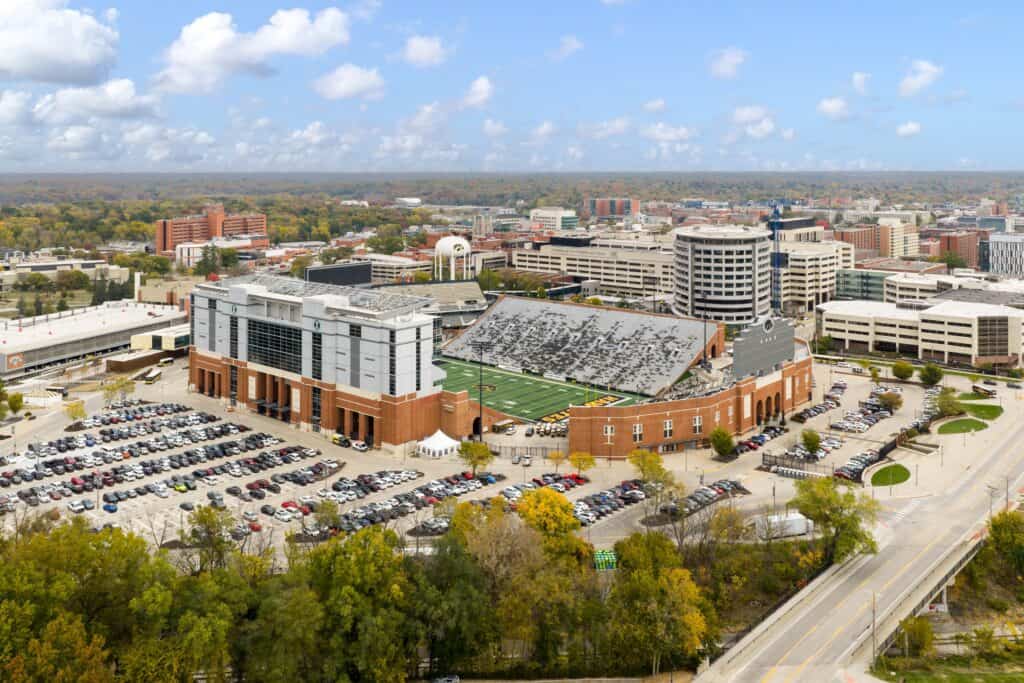
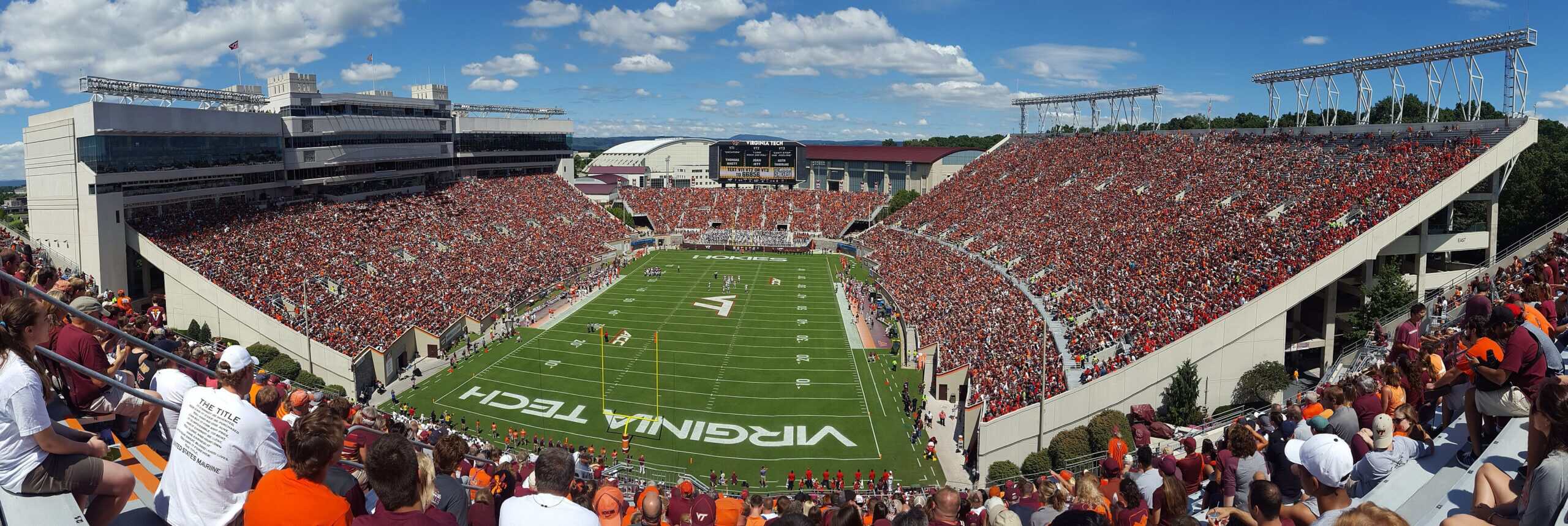
The early days of the rivalry bounced around the commonwealth. Some games were played in Richmond, others in Norfolk, and still others in Roanoke. Since 1964, however, Virginia Tech’s Lane Stadium and Virginia’s Scott Stadium have alternated hosting the Commonwealth Clash.
What are some notable games from the Virginia/Virginia Tech rivalry?
With over 100 matchups to pull from, there are plenty of memories across the Commonwealth Clash. Here are a few of our favorite games from the Virginia/Virginia Tech rivalry.
1995: Virginia Tech’s fourth-quarter magic
Virginia was cruising along for the first three quarters of this game, entering the final frame with a 29–14 lead. Virginia Tech came all the way back after Jim Druckenmiller found Jermaine Holmes with a touchdown pass to give the Hokies a lead with only 47 seconds remaining. Cornerback Antonio Banks then intercepted a pass and returned it for a touchdown, sealing the Virginia Tech victory.
This game was especially notable because both teams were very strong throughout the season. Virginia Tech wound up with a 10–2 record, defeated Texas in the Sugar Bowl, and finished 10th and 9th in the AP and Coaches Polls, respectively. Virginia wrapped up its season with an 8-4 mark and Peach Bowl victory over Georgia, placing 17th and 16th in those same polls.
1998: The Cavalier comeback
With both teams entering the game ranked in the top 25, Virginia Tech leapt out to a 17–0 lead. By halftime, the score was 29–7. The Blacksburg crowd was celebrating, but Virginia wasn’t out of it yet. They mounted a furious rally in the second half to pull close and make it a contest.
When Aaron Brooks completed a 47-yard touchdown pass to Ahmad Hawkins with 2:01 remaining, it capped off the largest comeback in Cavaliers history. Wali Rainer made an interception to ensure the comeback stuck. And the image of Hawkins celebrating his score remains one of the most magical moments in the school’s history.
2003: Wali’s World
Wali Rainer was a linebacker on the ‘98 Cavaliers team. Wali Lundy was a Hoos running back in the early-to-mid 2000s. Both put up impressive performances to help Virginia secure victories. In the 2003 matchup against Virginia Tech, Lundy simply could not be stopped.
He racked up 96 yards from scrimmage and scored four touchdowns, single-handedly outscoring the entire Hokies team. This game also featured a fake field goal that led to a pass between two future NFL players in quarterback Matt Schaub and tight end Heath Miller. Though the Cavaliers were pumped up, the tides were about to turn. This would be Virginia’s last victory in the series for 15 straight games.
2007: Two teams united by tragedy
Football creates strong relationships on the field, but the bonds off of it are even bigger. That was on display during the 2007 game of the rivalry, which took place the same year as the 2007 Virginia Tech shooting that claimed the lives of 32 victims.
Both teams were in contention for a trip to the ACC championship and were ranked nationally. The tragedy was still on everyone’s minds, and emotions were running high on the field and in the stands. The Hokies ultimately prevailed 33–21, showcasing, for a brief moment, the healing power that sports can provide communities during terrible moments.
2018: The first overtime game (and fumbles everywhere!)
It’s wild to think that it took over 120 years for Virginia and Virginia Tech to play an overtime game, but the 2018 installment of the Commonwealth Clash gave us an all-time classic. Virginia Tech took a 14–0 lead into halftime and led 24–14 early in the fourth quarter, though the Hokies found themselves down by seven with 2:41 to go.
After two incomplete passes to start the drive, Ryan Willis hit Dalton Keene on a 45-yard heave down the field. Two plays later, Steven Peoples rumbled to the goal line. Safety Joey Blount forced a fumble at the goal line, only for Hokies receiver Hezekiah Grimsley to fall on the loose ball in the end zone. The game headed to overtime, where Brian Johnson kicked a 42-yard field goal for Virginia Tech. Virginia botched a fumble on its ensuing drive, and the Blacksburg faithful rejoiced as Emmanuel Belmar recovered the loose ball for a Hokies win.
2019: The battle for the ACC Coastal Championship
2019 marks the last time both the Cavaliers and Hokies finished the year with winning records. To put even more at stake, the two teams entered this matchup with identical 8–3 marks and were tied for first in the ACC’s Coastal Division. That meant the winner of this game would advance to the ACC’s title game for a chance to win the conference.
Both teams were coming into the game with momentum. Virginia had won three in a row and four out of its last five, putting up a combined 174 points in those victories. Meanwhile, Virginia Tech had won six out of its previous seven games and shut out its last two opponents, a fitting end to Bud Foster’s tenure, who was retiring after 33 years as Virginia Tech’s defensive coordinator. Virginia Tech had also won 15 games in a row in the series.
On the field, Virginia quarterback Bryce Perkins was a menace as both a passer and rusher. He threw for 311 yards and ran for 164 more, including two long first-quarter touchdown runs. After Virginia Tech fumbled in its own end zone with 1:01 remaining and Virginia fell on top of the fumble, the Cavaliers had broken the Hokies’ winning streak with a 39–30 win. Virginia headed to the ACC Championship Game and received its first-ever trip to the Orange Bowl. Virginia Tech wound up in the Belk Bowl, which is not nearly as prestigious.
What are other wild moments from the Virginia vs. Virginia Tech rivalry?
During that 1995 comeback, when Antonio Banks was returning an interception for a touchdown, he raced down the Virginia Tech sideline. A trainer named Joe Gieck stuck his foot out, pretending to trip Banks as he came by. Gieck said he was only joking around, though it became a memorable moment from the game and rivalry.
Perhaps the most unusual situation dates all the way back to the early 20th century, however. A running back named Hunter Carpenter enrolled at Virginia Tech in 1898, playing for the team from 1899 to 1903. In the 1899 matchup, Virginia Tech lost to Virginia 28–0. Carpenter then made it his mission to defeat the Hokies, though he found that to be quite tricky. Virginia Tech lost four more games against Virginia; Carpenter transferred to North Carolina, where he lost again to the Cavaliers.
He returned to the Hokies in 1905—his eighth year of college ball—amid accusations that he was a professional player who was paid to beat the Cavaliers. Carpenter signed an affidavit saying that he had never received such payment and was allowed to play. Despite getting ejected during the game for throwing the ball at a defender’s face, Carpenter finally defeated Virginia, as the Hokies won 11–0. After the season, Carpenter left the commonwealth, never to return.
Who are standout players and coaches from the UVA vs. VaTech rivalry?
If you were making a Hall of Fame team for each school, chances are, you’d find these guys on the roster:
Virginia Tech
- QB, Michael Vick: Michael Vick was one of the early “dual-threat” quarterbacks who could torch teams with his powerful arm and impressive speed. In 1999, he was named Big East Rookie of the Year, Big East Offensive Player of the Year, and first-team All-American. Vick had a solid NFL career that included four Pro Bowls, though he was also involved in an illegal dog-fighting ring and spent 21 months in federal prison.
- QB, Logan Thomas: Starting as the team’s quarterback from 2011 to 2013, Logan Thomas was another mobile dual threat, causing defenses fits with his arm and legs. Thomas retired with 9,003 passing yards and 52 passing touchdowns. Both are Virginia Tech school records. In the NFL, Thomas began as a backup quarterback before switching to tight end.
- WR, Cam Phillips: A steady presence throughout his four-year NCAA career, Cam Phillips is Virginia Tech’s all-time leader in receptions (236) and receiving yards (3,027). After a professional career, Phillips returned to Virginia Tech in 2024 and now serves as assistant wide receivers coach and quality control coach.
- OT, Blake DeChristopher: Offenses can’t be successful without strong offensive line play, and Blake DeChristopher was a key part of solid rosters from 2007 to 2011. The Midlothian native started every game of his career at right tackle, making multiple All-ACC teams. In 2011, he won the Jacobs Blocking Trophy, awarded to the top offensive linemen.
- DE, Bruce Smith: Smith’s stellar college play made him the top pick of the 1985 NFL Draft. He won two NFL Defensive Player of the Years, made 11 Pro Bowl teams, and has more sacks (200) than any other player in NFL history. He’s a member of the College Football, Pro Football, and Virginia Tech Sports Hall of Fame.
- DE/LB, Corey Moore: 1999 was a special year for Corey Moore. The defensive standout set a league record with 17 sacks and was the first player to win consecutive Big East Defensive Player of the Year awards. He also took home the Lombardi Award, the Bronko Nagurski Trophy (for top defender) and the Dudley Award, given to the best athlete in Virginia. His No. 56 is retired, and he’s a member of the Virginia Tech Sports Hall of Fame.
- CB, DeAngelo Hall: DeAngelo Hall was born and raised in Chesapeake before enrolling at Virginia Tech in 2001. He spent time as a cornerback and punt and kick returner, receiving first-team All-American and Big East Special Teams Player of the Year honors in 2003. He holds NFL records for most passes intercepted in a half (4) and most career fumble return yards, with 328.
- Coach, Frank Beamer: Frank Beamer took over as Virginia Tech head coach in 1987, leading the Hokies as they moved from a Division-1 independent school to the Big East and later the ACC. Beamer retired in 2015 with a 238–121–2 record, and the school had winning seasons every year from 1993 until his retirement. The Hokies won the Big East title three times and the ACC championship four times under his watch. He also won multiple Coach of the Year Awards during the 1999 season, when Virginia Tech reached the National Championship Game before losing to Florida State.
Virginia
- QB, Shawn Moore: Shawn Moore led the Cavaliers to a 7–0 start in the 1990 season, which included multiple weeks ranked as the top team in the nation. Moore finished that season fourth in Heisman Trophy voting and received first-team All-American and ACC Player of the Year nods. His No. 12 is retired by the university.
- RB, Bill Dudley: Originally brought on as a punter and kicker, Dudley eventually took over as Virginia’s starting running back, though he still made time to knock in a few kicks here and there. In 1941, he won the Maxwell Award, was consensus All-American, and earned the Best Player of the Year award from the Washington D.C. Touchdown Club. He was the first overall pick of the 1942 NFL Draft and earned the league’s MVP Award in 1946, when he led the league in rushing yards, interceptions, and punt return yards.
- RB, James Gillette: James “Jim” Gillette was playing football long before most of us were even born. He graduated in 1940 and became the first Cavalier ever drafted into the NFL. He scored the game-winning touchdown for the Green Bay Packers in the 1945 NFL Championship Game
- RB, Thomas Jones: Another player with his jersey (No. 6) retired, Thomas Jones attended Virginia from 1996 through 1999. He was named a consensus All-American in 1999 and was first-team All-ACC in 1998 and 1999. After a productive 12-year NFL career, Jones began an acting career, appearing in films and TV shows including “Straight Outta Compton,” “Luke Cage,” and “Johnson.”
- WR, Herman Moore: Herman Moore was the top receiver for Shawn Moore (no relation) during the 1990 season. Moore was a consensus All-American and first-team All-ACC that year; he also earned second-team All-ACC honors in 1989. Virginia retired his No. 87 jersey, and he’s been named to the Virginia Sports Hall of Fame. Moore played 12 seasons in the NFL, earning three first-team All-Pro nods and twice leading the league in receptions. Earlier this year, he was inducted into the College Football Hall of Fame.
- DE, Chris Long: Chris Long is the son of Hall of Famer Howie Long. With the Cavaliers, he was a consensus All-American and the 2007 ACC Defensive Player of the Year. In the NFL, he won two Super Bowl rings and was the Walter Payton Man of the Year winner in 2018.
- RB, Tiki Barber and DB, Ronde Barber: The only twins on this list have to get some recognition! Ronde Barber was named to three consecutive first-team All-ACC rosters, was twice named third-team All-American, and was the 1994 ACC Rookie of the Year. His twin brother, Tiki, was twice a first-team All-ACC honoree and the 1996 ACC Player of the Year. The Cavaliers retired Tiki’s No. 21 and Ronde’s No. 19 jersey, and both have been inducted into the Virginia Sports Hall of Fame.
- Coach, George Welsh: George Welsh was the Virginia head coach from 1982 to 2000, and he retired as the winningest coach in ACC history. His final Virginia record of 134–86–3 is the most wins for any Cavaliers coach. Under his guidance, the team was conference champions in 1989 and 1995, finishing ranked in five seasons.
Virginia and Virginia Tech are set to face off once again on November 28. Rock your team’s gear with pride. It should be another excellent edition of the rivalry!