From True Aggie Night to the Dead Papers Society, these unique traditions persist on college campuses across Utah.
Maybe it’s because college offers young adults one last chance to be playful before entering the working world, but pranks and rituals have long been part of campus life.
Utah, like many western states, brings its unique topography into play, with lots of rituals built around giant logo letters carved into hillsides—as well as other traditions that are as tiny and fleeting as a kiss.
1. Pilgrimage to the “Block U” at the University of Utah
The University of Utah’s “Block U” is one of the oldest hillside letters in the U.S. Only the University of California–Berkeley’s “Big C,” is older, but only by two years. And U. of U. students were climbing up Mount Van Cott (“the Hill”) before that to spell out their class year with rocks.
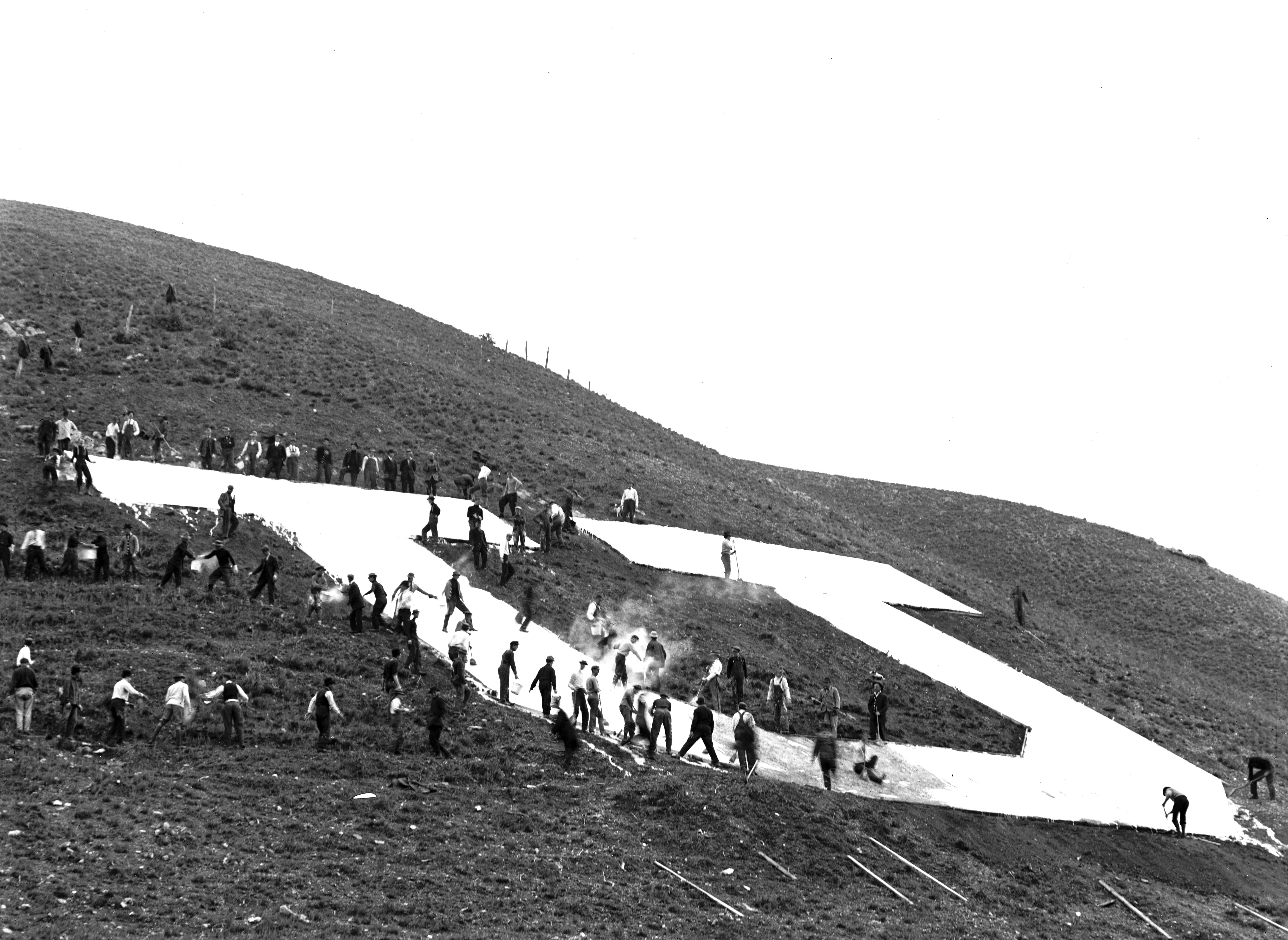
The “Block U” became an official campus landmark in 1907, when a group of students built a 100-foot-high U out of boulders, then whitewashed it with lime. Climbing the mountain to maintain the letter became a spring tradition. As the “Daily Utah Chronicle” wrote on March 18, 1915, on “U Day,” students would climb the hill for “the customary whitewashing of the big ‘U,’ on the hill” followed by “a large ‘feed,’ a cabaret entertainment, and a dance.” Over the years, boulders gave way to limestone and cement, and in the late 1960s, the university installed a lighting system around it.
As it approached its 100th birthday, students seemed indifferent to both the letter and its maintenance, and the Block U fell into such disrepair that trees began growing on it. It got a facelift in 2005, including a new pour of concrete and LED lights that change color to signal athletic wins, graduation, and commencement.
Though students no longer visit the U in the spring with scrub-brushes and buckets of lime, they do make a ritual of hiking to the Block U. It now has its own named trailhead, as well as an address (1635 New Bedford Dr., Salt Lake City, Utah 84103).
Runner-up for best rock-based tradition at the U is the “Rostrum Rock,” at President’s Circle, which is almost as old as the Block U. Placed in 1914 as a spot for students to air opinions, it instead became an object of pranks: freshmen clandestinely paint it green, upperclassmen paint it red, and (allegedly) BYU students sneak in and paint it blue.
2. Brigham Young University’s “Y Mountain”
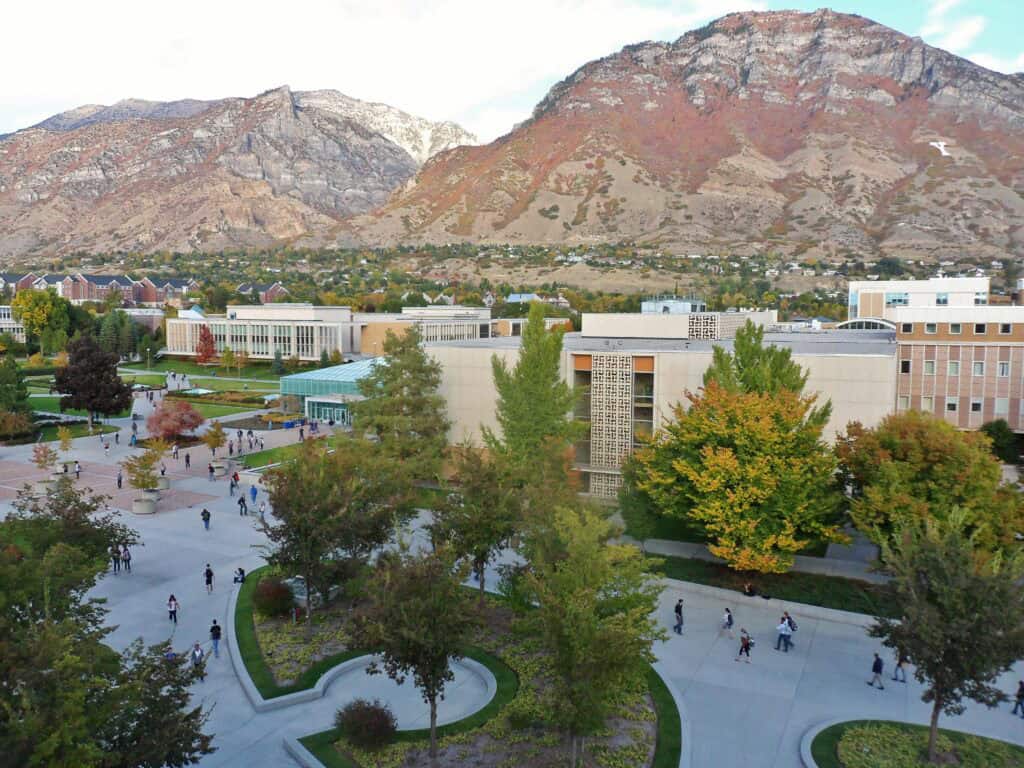
Speaking of the painting skills of BYU students, the university’s bright white hillside Y—which gave the school its nickname—is even bigger than the Block U, at 380 feet (20 feet longer than a football field). That’s a lot of giant letter to keep spiffed up.
Like the U, the Y has its own dedicated hiking path, but a slightly different origin story. When the graduating class of 1907—then juniors—had the moxie to climb Kyhv Peak and spell out their class year with white lime, the seniors took umbrage, hiked up the mountain, and replaced the 7 with a 6. After punches were thrown, it was decided the numbers would be replaced with “BYU,” to represent all students.
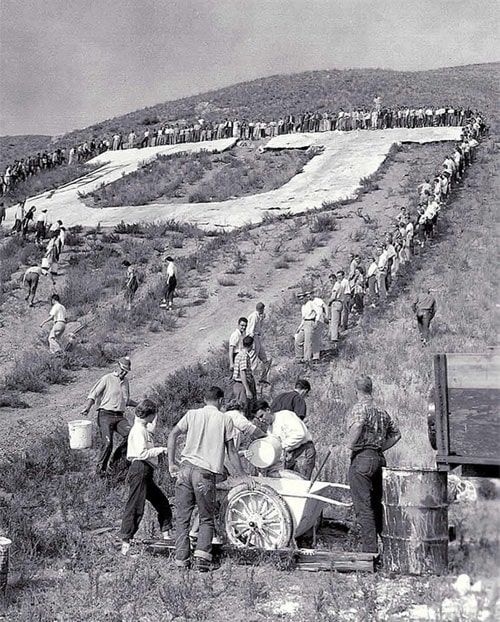
After spending the better part of a day building only part of a Y, the student work team realized they’d never make it through all three letters. And so “Y Mountain” was born. For decades, on “Y Day,” a chain of students handed whitewash, bucket by bucket, up the side of the mountain and poured it on the Y.
That lasted until the early ‘70s, when all that student muscle was replaced with a helicopter pilot flying loads of whitewash up the mountain. Starting in 1924, the university also began the tradition of lighting the Y, initially with buckets full of mattress batting and kerosene. That gave way in the mid-’80s to the much safer and longer-lasting practice of giant string lights. Though students no longer participate in its upkeep, they do maintain a tradition of midnight visits to the Y.
Like the Rostrum Rock, the Y received its share of prankish paint jobs over the years, plus one protest in light: in March of 2021, a group of students unofficially turned the Y into a rainbow of colors in support of BYU’s LGBTQ+ students.
Though the Y literally looms large over campus, BYU also has its share of smaller, quirkier rituals, including Tunnel Singing, No Pants Thursday, and swimming in rivers of “true blue” foam during Homecoming Week.
3. The “Dead Paper Society” at Westminster University
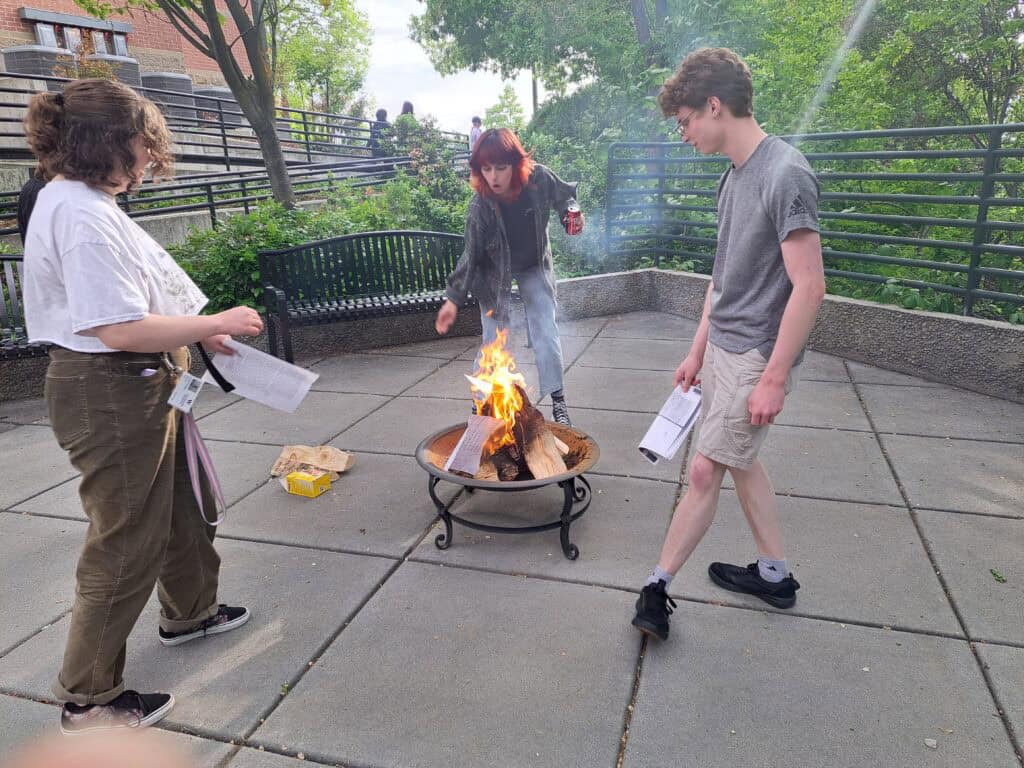
The last week of spring semester is always the craziest part of the academic year. And Westminster University discovered a wonderfully cheeky, cathartic way for students to get rid of that stress: the Dead Paper Society. Students burn hated term papers in a fire behind Nunemaker Place, then roast marshmallows over the flames. The ritual also includes the exchange of worst semester moments before a group screening of the 1989 film “Dead Poets Society.”
According to Dr. Alicia Cunningham-Bryant, dean of Westminster’s honors college, the event began in 2005. “With papers increasingly being submitted digitally, students now purposefully print out their papers just for the event to purge their feelings about them, which is pretty fun and makes a lot of them laugh as they release them to the bonfire,” she says.
4. Southern Utah University’s Bell Tower Curse
Located in tiny Cedar City, SUU’s Carter Carillion Bell Tower is a city landmark. But it looms extra large in the minds of SUU students, who are warned during orientation to avoid it—most of the time.
SUU notes it maintains more than 50 campus traditions, but the most Edgar Allen Poe-like of them all is the “Bell Tower Curse.” Incoming freshmen are led on a “first walk” at sunrise under the tower. They are warned to completely avoid it until their “final walk” on graduation day, when they’ll walk westward underneath it, toward the sunset.
Should they lazily take a shortcut under the tower, or pass under it during a tipsy midnight walk back to the dorms—woe! The Bell Tower Curse will cause all kinds of bad luck, including the academic kind.

5. The True Aggie Midnight Kiss at Utah State University
We’re not sure why Utah is all about the letters, but “True Aggie Night” is another letter-centric campus tradition.
In 1916, a small concrete sculpture was commissioned by a secret campus club called the “Be-Nos.” (Why that name? There are two theories). A small cube made up of four letter As, the “Block A,” originally sat near the Mechanical Arts Building. It then migrated to the library, and finally to the Quad. It briefly went into storage before being installed on Old Main Hill in the late ’60s.
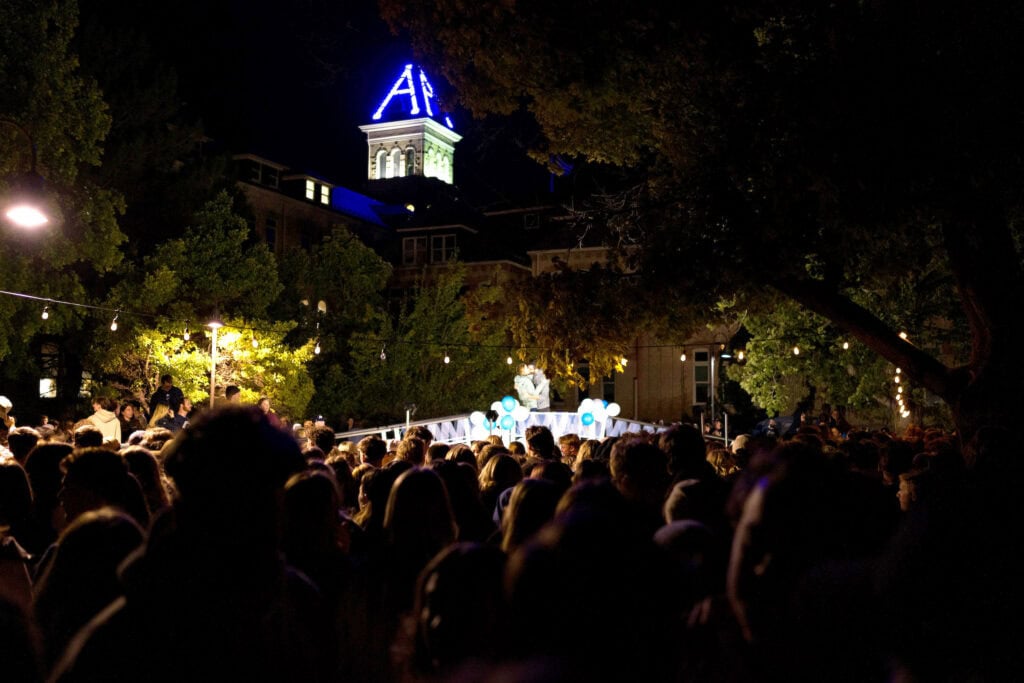
Now, 110 years later, USU students stand on the Block A to become “True Aggies” by “receiving a kiss on the ‘A’ under a full moon at midnight by somebody who already is a ‘True Aggie,’ or on Homecoming or A-Day by somebody who is not.”
Oddly enough, before the Block A existed, “True Aggie Night” took place in the school’s belltower—apparently a not-cursed one, unlike SUU’s Carter Carillion Bell Tower.
6. Utah Tech’s “True Trailblazer”
Another kissing tradition, the “True Trailblazer,” night confused the heck out of this student from Texas.
It’s actually one of the simpler Utah campus traditions, at least in terms of the rules—wear school colors (red), and gather at the O.C. Tanner Fountain on the UTU campus at midnight. Then jump into the water, stand under the fountain spray—and kiss as many people as you can get your lips on. Perhaps not surprisingly, this may be one of the most-documented Utah campus traditions on TikTok.
7. Weber State’s Flaming W
Weber’s W isn’t the oldest hilltop letter in Utah, and it’s not the biggest. But it’s definitely the most storied and dramatic.
In the fall of 1937, the “Ogden Standard-Examiner” wrote that Weber College sophomores had organized a new homecoming event: a midnight hike up Malan’s Peak featuring lectures “on moonlight and snakes,” by Weber professors, followed by “a song and yell fest around a flaming block ‘W,’” in the mountain basin.
That W’s flames were fueled by 100 cans of kerosene and a mess of burlap sacks—not the safest materials in the dry Utah foothills, though oddly (as the “Standard-Examiner” reported) it was “a fusee which either fell over or spluttered, scattering sparks in the tinder-dry grass,” that ignited a huge brush fire in 1957. And so the Flaming W was extinguished—for a while.
The W returned in the late 1970s, thanks to Lynn Kraaima, campus electrician, who engineered a dazzling electric W that wasn’t literally on fire, but it had to be redone each year.
Last September, Weber finally got a permanent W—and it’s a dazzler. Made with 285 solar panels, it’s a little taller than the Block U at 166 feet, and it’s programmed to glow in different colors, including “a special ‘flaming’ pattern of white and purple,” on graduation day.