There are feminist history landmarks across the Empire State; plan your ultimate road trip through New York’s feminist history.
America’s feminist history is as wide-reaching as the country itself, but New Yorkers can be proud that their state has played a unique, extraordinary role in the fight for gender equality. As a feminist historian, I’ve read about how New York has made history from the 19th century to today. But while you can learn that way too, there’s another great way to explore the feminist history of the Empire State—seeing it for yourself!
But how do you plan a New York feminist history road trip if you’re not much of a history buff with a pre-existing knowledge of what you’ll be looking for? Well, that’s where I come in. I’ve prepared this guide to the ultimate road trip through New York’s feminist history, which can be taken in its entirety or divided into day trips and excursions. So gas up your cars, and take a look at this road trip through the feminist history of the State of New York.
Stop one: New York City, for academic research and a wild political campaign
Start the adventure in the Big Apple as a jumping-off point and a place to do your homework on what’s to come. At The New York Historical, you can head over to the Center for Women’s History, which serves as a great starting point to learn about women’s history in New York and beyond, including an exhibition about how the women of New York played a role in the American Revolution. Nearby, you can research queer women’s history at the Lesbian Herstory Archives.
While you’re in the city, stop for a coffee or some lunch on Wall Street. While New York’s Financial District may seem like an unlikely spot for feminist history, in the 19th century, the street was once home to the offices of Victoria Woodhull and Tennessee Claflin, two sisters who were America’s first women stockbrokers.
They initially drew business because they were novel (and because Cornelius Vanderbilt endorsed them), but kept it because money invested with them tended to turn a profit. But for Victoria Woodhull, being a stockbroker was just one step on the career ladder. She went on to become the first woman to run for President of the United States—three times!
Stop two: Poughkeepsie, for historical women’s spaces
It’s college sports season—so why not take in a game at one of America’s most historic women’s colleges? Or better yet, try a history tour of Vassar College, which was founded in the 19th century as a women’s college, although it’s been coeducational since the late 1960s, over a hundred years after the school was established. Vassar is one of the so-called “Seven Sisters” colleges in New York, though the other, Barnard, is in New York City and is closely intertwined with its “brother school,” Columbia University.
Today, Vassar offers self-guided historical tours and maps to follow, with some focusing on the physical campus and its architecture, how the school has changed over the years, and even the Indigenous history of the land on which Vassar now stands. Vassar’s alumni over the years have included icons from Meryl Streep to Jackie Kennedy to Edna St. Vincent Millay, and even Anthony Bourdain—and you can enjoy a treat they all would have tasted when you get a “Vassar devil,” a fudge cake sundae beloved by students since 1913!
Stop three: Seneca Falls, where it all began
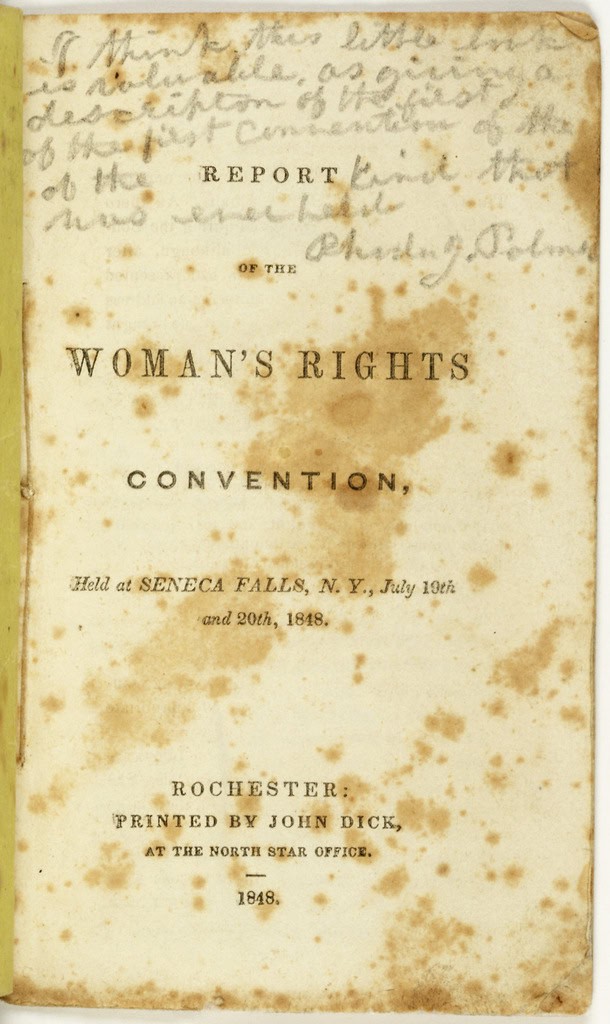
You can’t discuss feminist history in the United States without mentioning Seneca Falls. This little hamlet changed the world when it hosted the first-ever Women’s Rights Convention at the Wesleyan Chapel on Fall Street. The gathering, organized by Elizabeth Cady Stanton, Lucretia Coffin Mott, and several others, is considered the start of the women’s movement in the United States, including what would become the fight for women’s suffrage. It was followed by annual “Convention Days,” which continue to this day.
Today, visitors to Seneca Falls can tour the Wesleyan Chapel where that first convention was held, and the surrounding Women’s Rights National Historical Park. Within the park, you’ll even find Elizabeth Cady Stanton’s home, which is open for tours and where park rangers can answer your questions. For even more amazing historical women, you can also visit the National Women’s Hall of Fame, housed in a converted mill and celebrating over 300 inductees and counting.
Stop Four: Saratoga Springs, where New York’s women organized
Pack your “Saratoga Trunk” for the next stop, once a famous resort town beloved for its natural springs and famous racecourse. Beyond its reputation for good times and Victorian splendor, though, Saratoga Springs has a history of women’s activism, particularly during its 19th-century heyday. In 1869, the Congress Hall hotel in Saratoga Springs hosted a women’s suffrage meeting that laid the foundation for the New York State Women’s Suffrage Association.
Later feminist activism in the town included Kathryn Starbuck (no relation to the coffee shop), who, in 1916, after a motion for women’s suffrage was defeated in New York State, led the Women’s Suffrage Political Party. Meanwhile, a major financial contribution from publisher, socialite, and Saratoga Springs summer resident Miriam “Frank” Leslie would prove vital to passing the 19th Amendment.
Today, visitors to Saratoga Springs can learn more about these women at the Saratoga Springs History Museum. Or learn about the women behind the town’s racing history at the nearby National Museum of Racing and Racing Hall of Fame.
Stop Five: Lily Dale, where the ghosts of history live on
Is Lily Dale one of the most unique villages in all of New York? Quite possibly. This small community was founded in 1879 as the Cassadaga Lake Free Association and has since been a community for followers of the spiritualist movement. Today, only a few hundred people live in Lily Dale, many of them identifying as spirit mediums. Every year, the town welcomes visitors for its “summer season” of lectures, workshops, and demonstrations on spiritualist belief and practice.
In the 19th century, there was a strong overlap between spiritualism and women’s activism. Many women involved in the suffrage movement and early feminism found spiritualism less patriarchal than older religions. Victoria Woodhull was a spiritualist and described in speeches how that informed her personal and political life. In 1891, Susan B. Anthony was one of the speakers at a “Woman’s Day” event in Lily Dale that drew 5,000 people and is commemorated today, with both a marker and an exhibit at the Lily Dale Museum.
As you can see, feminist history is found all over New York, from the Big Apple to tiny hamlets. That means a feminist history road trip (or a handful of day trips) has plenty to see, whether you’re a feminist, a historian, or simply believe in rights for all and want to explore the Empire State!