From riding to roping and reining to heeling, local charrería teams carry on the folkloric tradition of charreada in Nevada.
The precursor to the North American cowboy lives on in Nevada thanks to an equestrian skills competition dating back to 16th-century Spanish conquistadors in Mexico.
Skilled horsemen of the Mexican countryside, or charros, were competing in Mexican roping-and-riding contests, charreadas, long before the American rodeo was a twinkle in a cowpoke’s eye.
A modern-day charrería or Mexican rodeo, with events for charros and charras, typically takes place in arenas known in Spanish as lienzos. Modern lienzos are similar to the originals but are strictly regulated to protect the animals.
Like the rodeo, charreada continues to face criticism from animal welfare groups, but—as the national sport of Mexico, inscribed on the UNESCO list of Intangible Cultural Heritage—it remains a source of pride and cultural identity for the Mexican-American community, with local groups like Charros de Las Vegas and Escaramuza Charra Colibríes de Nevada carrying on the tradition.
Charreada through the years
Rooted in the equestrian ranchero life and livestock traditions of Colonial Mexican haciendas, the tail-twisting, bull-riding, and leg-roping events (suertes) of charreada (historically known as Jaripeo) were all the rage in Mexico through the nineteenth century.
As the culture began to fade in the aftermath of the Mexican Revolution (1910-1920), charros took the reins to preserve their heritage, recording standard rules for future ropers and riders.
In 1933, charreada became a regulated sport under the Federación Méxicana de Charrería. The federation currently unites more than 1,600 charro associations with 1,800 teams, 20,000 charros, and 6,500 charras across a spectrum of ages.
The federation strictly regulates modern-day charreadas to prevent animal cruelty. Some of the events have been further banned or modified in Clark County and other places in the U.S.
Cultural elements of charreada
A festive combination of equestrian skills, handcrafted tack, intricate costumes, vibrant music, and authentic Mexican food, modern-day charrería includes nine events, known as suertas, for charros and one for charras. All events incorporate horses or cattle, or both.
You can also expect to see a Mexican Hat Dance or two since it is the national dance of Mexico.
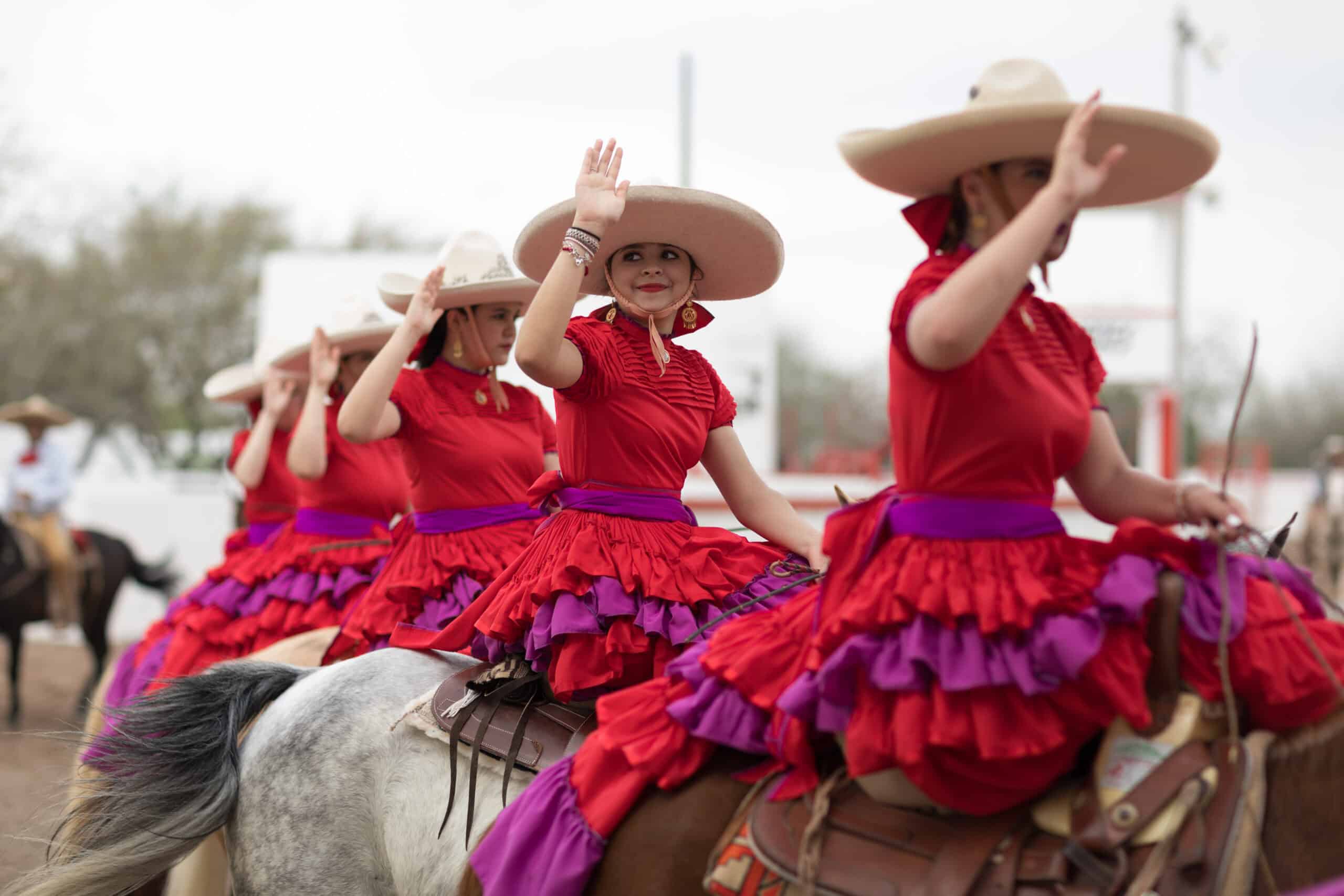
A charrería begins with a parade (Desfile de Charro) featuring the charro and charra teams and their horses riding to patriotic Mexican songs, such as “Marcha de Zacatecas.” During the parade, the competitors showcase colorful, ornately embroidered outfits, including suits with bolero jackets with silk bow ties for men, dresses inspired by women soldiers of the revolution (known as adelitas) for women, high-heeled boots, and wide-brimmed sombreros.
These outfits, some of which are more formal than others depending upon the event or occasion, are inspired by Spanish colonial culture and deeply rooted in Mexican heritage.
Men’s events include a variety of daring feats and tricks, including:
- Reining (Cala de Caballo)
- Heeling (Piales en Lienzo)
- Steer Tailing (Colas en el Lienzo or Coleadero)
- Bull Riding (Jineteo de Toro)
- Team Roping (Terna en el Ruedo)
- Bareback on a Wild Mare (Jineteo de Yegua)
- Forefooting (Manganas a Pie)
- Forefooting on Horseback (Manganas a Caballo)
- The Pass of Death (El Paso de la Muerte)
Women, or charras, started performing the tenth event, escaramuza, in the 1950s (although it didn’t become an officially sanctioned competitive event until 1989). This high-speed, synchronized horse ballet is a dressage-type of performance, done while riding sidesaddle in an Adelita dress, a wide-ruffled, mid-boot dress with a circular skirt.
According to the Nevada Independent, escaramuza is growing in popularity in the U.S.
From Mexican to American folklore
Charreadas originated with Spanish ranchers in Jalisco and Hidalgo, Mexico. When Mexican ranch hands (vaqueros) migrated to Mexico City and North America, they carried these traditions along.
Rodeos and cowboys are a purely American creation, but they evolved from these practices.
While American rodeos emphasize speed, charreadas are not timed, focusing on style, skill, and technique. Another difference is that the rodeo is an individual sport, while charrería is a team sport. And while cowboys compete for money and prizes, charros compete for honor.
Where to see charreadas in Nevada
Often made up of family members dating back several generations, charreada teams continue to spread their passion for the sport and promote cultural heritage by competing in arenas and at county fairs, locally and around the U.S. and Mexico. They also perform at local events, festivals, and parades, so keep your eyes peeled–especially during Mexican national holidays like Cinco de Mayo and Mexican Independence Day.
Late last year, local charra group Escaramuza Charra Colibríes de Nevada drew a crowd to a local park for a holiday event and was also honored by the City of Las Vegas for helping to preserve Mexican culture.
Sandy Valley Ranch, a 160,000-acre ranch in the heart (and heat) of the Mojave Desert, 45 minutes from Las Vegas, is home to a charro team, Sandy Valley Ranch Oro, and an escaramuza team, the Coronelas.
Follow the ranch on Facebook to stay up to date on authentic charreria events.