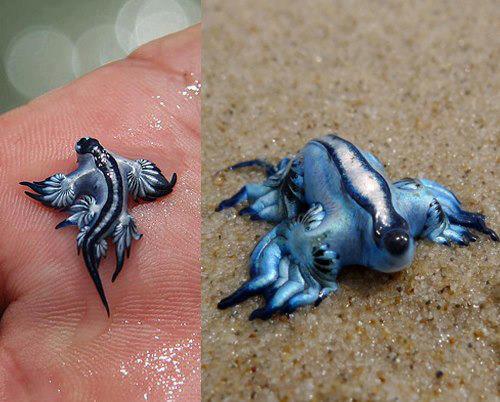
Rare blue dragon slugs are washing up on Texas’s shoreline, but beware: they sting. Here’s everything you need to know.
Small blue creatures have been washing up along the Texas coast recently, and while they look majestic, they actually pack a powerful punch if you get close enough for them to sting you. The scientific name for them is Glaucus atlanticus, but they’re more commonly referred to as “blue dragons” or “blue dragon slugs.” It’s uncommon for the sea slugs to be seen onshore, as they typically thrive in the open ocean, but the recent bout of blustery winds is sweeping them onto the coast. The blue dragons—which are usually only one to three centimeters in length—can become easily mixed in with other beach items like seaweed and shells, but you’ll want to do your best to avoid touching them if you can.
According to a Facebook post by the Harte Research Institute, these tiny blue dragons have a very powerful sting. They feed on Portuguese man-o-war, a type of jellyfish, and in doing so, the blue dragons essentially absorb the other creature’s stinging cells and harbor those cells inside their own bodies. Because the cells are more concentrated in the blue dragons’ small frame, it actually makes the stinging sensation more potent. In the post, the Harte Research Institute wrote, “The ocean is amazing — But sometimes the most beautiful creatures come with a sting.”
Visitors who come across the sea slugs have been instructed to take photos and then leave them alone to prevent themselves from being stung and to protect the creatures and their safety.
Blue dragons only wash up on rare occasions
The Harte Research Institute’s Director of Community Engagement, Jace Tunnell, spoke with Chron about the presence of blue dragons on Texas beaches. He said, “The last time we saw this many wash up at one time along the Texas coast was 2024. They tend to wash up between February and May during strong onshore wind events and always in connection with the man-o-war, blue buttons and by the wind sailors.” So far, they’ve been spotted at Surfside Beach and Corpus Christi.
Tunnell added that they might turn up in other areas. “Typically, what washes up on the central coast of Texas often is seen in other parts of the Texas coast within a few days. It’s one of those things where when they are washing up you better go to the beach that day to check them out because they’ll be gone the next day,” he said. Just remember to keep a healthy distance so you don’t end up injuring yourself or the sea slugs when you go to take a gander!