Shapeshifters, a haunted streetcar, and statues that cry blood: Plan a spooky road trip to 13 of Georgia’s most haunted cemeteries.
Among the well-trodden haunting tropes—the disembodied moaning, the Lady in White, the phantom footsteps—few get as much side-eye from ghost-hunting enthusiasts as the haunted graveyard. After all, why would a spirit hang around its grave instead of the places it actually lived? Well, maybe the Devil did go down to Georgia, because we have quite a few graveyards with a tale or two to tell.
Some are tied to real tragedies, including an 1887 axe murder in Macon and a yellow fever epidemic in Savannah, while others are pure folklore, like phantom hoofbeats under an old Athens bridge.
We rounded up 13 (naturally) of the state’s most haunted cemeteries, from a hillside graveyard in Dahlonega’s gold country to Savannah’s moss-draped landmarks. For each one, you’ll find the legends, the history, and everything you need to know to plan your visit, during spooky season and beyond.
One ground rule before you go: Every cemetery on this list is still the final resting place of real people, and several are still active, with families visiting loved ones. Stick to posted hours, stay on paths when you can, and leave grave decorations and offerings where you find them. Save the ghost hunting for an official tour.
Metro Atlanta
1. Oakland Cemetery, Atlanta
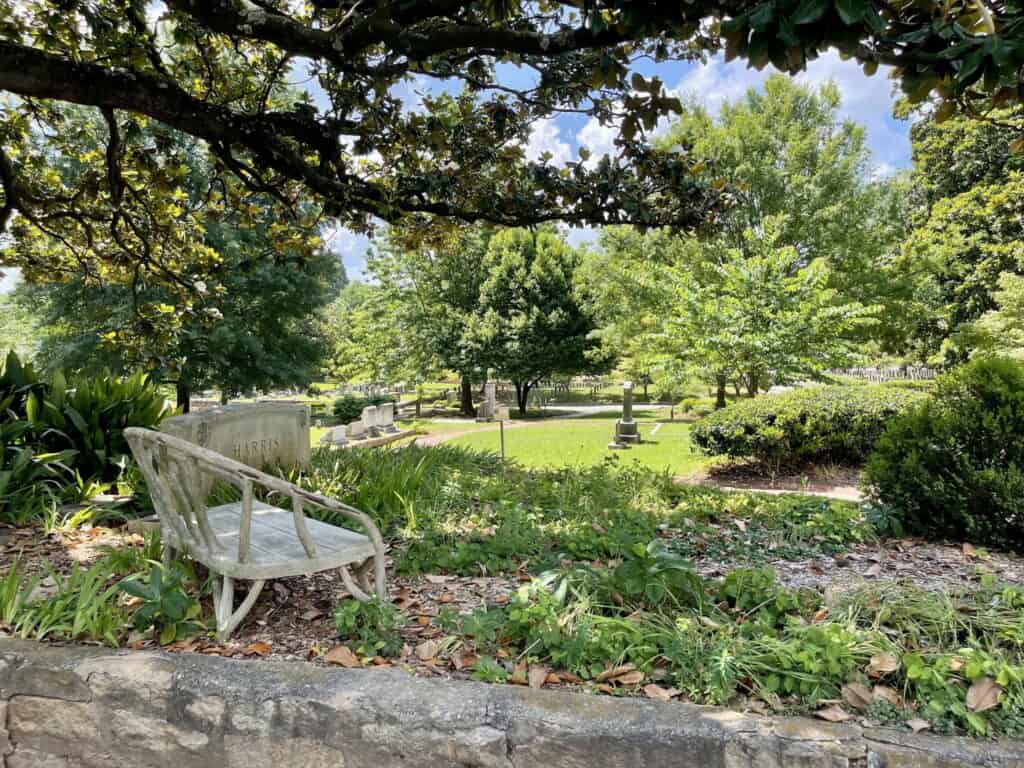
Imagine hearing a roll call echoing through a cemetery after dark, then catching your own name among those on the list. That’s just one of the stories tied to Oakland Cemetery’s Confederate section, where nearly 7,000 soldiers are buried, about 3,000 of them unknown. Visitors have also reported uniformed figures wandering among the rows.
These aren’t Oakland’s only rumored residents. Local ghost tour guides describe a Lady in White who glides between the tombstones at twilight, leaving the scent of jasmine behind. Some say they’ve heard the old bell tower ring around midnight, though the bell hasn’t worked in years.
Founded in 1850, Oakland is Atlanta’s oldest cemetery and an open-air museum of the city’s history. More than 70,000 people rest on its 48 acres of Victorian gardens and brick paths, including “Gone with the Wind” author Margaret Mitchell, golf legend Bobby Jones, and Maynard Jackson, Atlanta’s first Black mayor.
Plan your visit: Admission to the grounds is free, and the cemetery is open daily from dawn to dusk. This year marks the 20th anniversary of Historic Oakland Foundation’s Capturing the Spirit of Oakland. The after-dark Halloween tours, featuring costumed storytellers and promising to “enlighten, not frighten,” run Oct. 15-18 and 22-25. They usually sell out, so check availability before you go.
Address: 248 Oakland Ave. SE, Atlanta
2. St. James Episcopal Cemetery, Marietta
Near the old front gates of this tidy churchyard, a marble mother cradles two infants in her arms. According to local legend, she doesn’t always stay still.
The monument in St. James Episcopal Cemetery marks the grave of Mary Meinert. Over the years, visitors have claimed to hear a woman sobbing or a baby crying nearby, and some insist the statue weeps tears of blood. One version of the legend also dares visitors to circle the statue three times after dark and ask Mary how her children died.
Legend says Mary died in childbirth. In reality, she was a beloved Marietta mother who died of a lung ailment, likely tuberculosis, in 1898. Her family commissioned the statue in her memory, and her husband, Henry, rests beside her beneath a striking flower-draped cross.
St. James Episcopal Church established the cemetery in 1849, just off Marietta Square. Its first burial followed in 1850, and its residents include some of Marietta’s founding families and Civil War sketch artist Alfred Waud.
Plan your visit: The still-active cemetery is open daily from 9 a.m. to 5 p.m. and has overnight security, so the after-dark dare stays a story. Visitors can enter at the back from Polk Street.
Address: St. James Episcopal Church, 161 Church St. NE, Marietta
3. Founders Cemetery, Roswell
At Founders Cemetery, the haunting you’re most likely to notice is a smell. Guides on the Roswell Ghost Tour ask visitors to sniff the air on the walk up the hill for antique perfume, cigar smoke, or horse manure, even though there isn’t a horse in sight. According to the guides, these are lingering traces of 19th-century funeral processions that once wound up the hill from the church below.
Inside the cemetery, visitors report feeling tugs on their sleeves and hands as if a child is trying to get their attention. The apparition of a little blond girl has been seen here, too, but, according to guides, no child matching her description is known to have been buried here.
What’s beneath your feet is also unsettling. This hilltop was Roswell’s first burial ground, used from 1840 to 1860, and it was once far larger than the small plot you’ll see today. Many of the graves were poorly marked, and the cemetery’s original boundaries are unknown. Some graves now lie beneath nearby houses and streets, a fact a few unlucky homeowners have corroborated during renovations.
Those who rest here include Roswell’s founder, Roswell King, and Major James Stephens Bulloch, grandfather of President Theodore Roosevelt. Many children are buried here, too, victims of an 1841 scarlet fever outbreak, along with enslaved people whose graves were never marked.
Plan your visit: The cemetery is located in a residential area and is owned and maintained by the city of Roswell. For the full experience, join the Roswell Ghost Tour, a 2.5-hour walking tour that stops in Founders Cemetery. It runs Fridays and Saturdays year-round and every night from Oct. 14-31.
Address: 200 Sloan St., Roswell
4. Historic Lawrenceville Cemetery, Lawrenceville
One of Lawrenceville’s best-known ghost stories begins with a storm. As local tour guides tell it, a violent storm once ripped a massive oak out of the town cemetery, and its roots tore open the graves beneath it. That same night, a teenage boarding-school student took a shortcut through a nearby alley to avoid the weather. He came face to face with skeletons dancing in the street, then blacked out. According to the tale, the next morning, the local paper ran the headline “The Dead Walk the Streets of Lawrenceville.”
The story is pure local legend, but the cemetery’s reputation has more recent creepy credentials. Paranormal investigator Patrick Burns once spent a night here with an 11Alive news crew. The team reported floating balls of light, sudden 30-degree temperature drops, and camera batteries that died without warning. When they played back their footage, they heard a woman’s voice, even though no women had been with them.
Lawrenceville calls itself the oldest city in metro Atlanta, and its historic cemetery is the resting place of the town’s earliest settlers and founders. Its stones are weathered, and some are broken or worn illegible, adding to the eerie vibe.
Plan your visit: The best way to see it after dark is with Aurora Theatre’s Haunted Cemetery Tours, a 90-minute, roughly 1.5-mile walk led by a costumed storyteller. Tours run select nights at 8 p.m. through Nov. 1. Tickets start at $25, groups are capped at 25 people, and guests must be 13 or older. Wear sturdy shoes for uneven ground.
Address: Half a mile from the downtown square between East Pike Street and Highway 29
North and Northeast Georgia
5. Mount Hope Cemetery, Dahlonega
Dahlonega locals still talk about a photograph of Mount Hope Cemetery said to have been taken in 1953 by town librarian and historian Madeleine Anthony. Some believe it shows a strange mist and several ghostly figures among the headstones. Ask about it at the Dahlonega Gold Museum, and you might be lucky enough to see it for yourself.
Ghost tour guides also tell of Civil War soldiers seen playing cards among the graves, and of—what else?—a heartbroken Lady in White drifting between the stones, still mourning a lost love.
Whether or not you’re a believer, the setting suits the stories. Just a couple of blocks from Dahlonega’s square, this hillside cemetery dates to the town’s founding in 1833 and holds between 1,000 and 2,000 graves.
Among them are gold rush-era families, members of a local Confederate company known as the Blue Ridge Rifles, and Confederate officer and U.S. Congressman William Pierce Price. Look for the cemetery’s unusual “slot and tab” grave markers, a style found almost nowhere else.
Mount Hope also holds the graves of about 280 African Americans, free and enslaved, whose markers were lost to time. In recent years, University of North Georgia students worked with the city to give them permanent markers.
Plan your visit: Admission and parking are free. The cemetery is open 7 a.m. to 7 p.m. April through September, and closes at 5 p.m. October through March. Dahlonega Walking Tours’ Historic Ghost Tour stops at Mount Hope, and the cemetery’s paths are unpaved, so wear sturdy shoes and bring a flashlight.
Address: 438 W. Main St., Dahlonega
6. Oconee Hill Cemetery, Athens
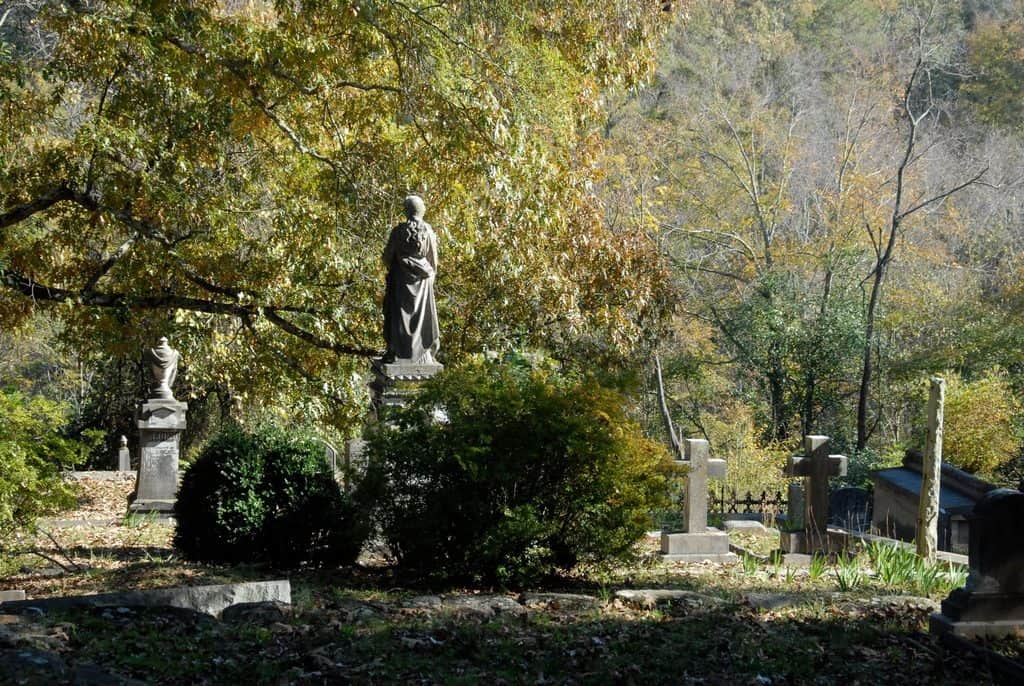
Stand beneath Oconee Hill’s old iron bridge on the night of a full moon, the story goes, and you may hear hoofbeats overhead. The legend dates back at least to a 1972 Red & Black newspaper article about a farmer who drunkenly drove his carriage off the bridge. According to the tale, he still rides near his grave when the moon is full.
He has company. Local lore also tells of “Wee Willie,” the ghost of a man supposedly killed by a train, who’s been seen carrying a lantern through the cemetery late at night.
The cemetery opened in 1856, after the city of Athens bought 17 acres along the North Oconee River when burials were barred at the old town cemetery on university land. Today, it sits just across the railroad tracks from Sanford Stadium, so on fall Saturdays, the roar of 90,000-plus Bulldogs fans rolls over the headstones.
Oconee Hill is listed on the National Register of Historic Places, with ornate cast-iron fencing and a rare through-truss bridge. Its notable residents include Georgia Governor Wilson Lumpkin, several UGA presidents, and longtime Bulldogs ambassador Dan Magill.
Plan your visit: Admission and parking are free, and visiting hours start at 8 a.m. year-round, ending at 5 p.m. in winter and 6 p.m. in summer. The cemetery is still active, and group tours and picnics require approval from cemetery staff. The Athens Historical Society leads a free guided tour on Oct. 25.
Address: 297 Cemetery St., Athens
Middle and South Georgia
7. Rose Hill Cemetery, Macon
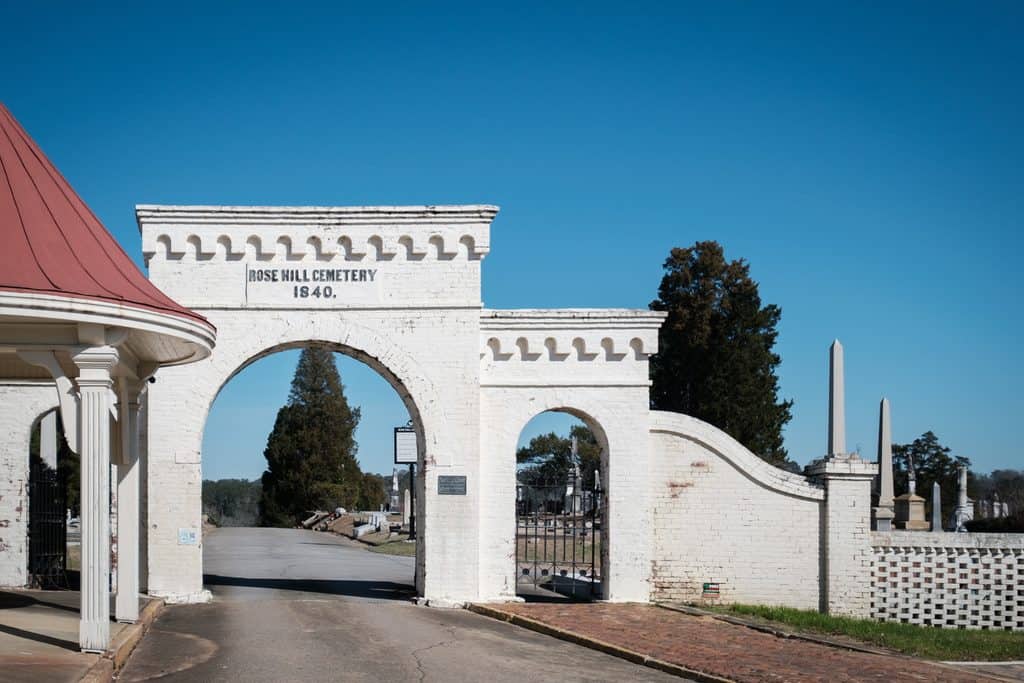
Few cemeteries can claim a shapeshifter, victims of a 19th-century axe murderer, and the Allman Brothers Band.
Start with the shapeshifter, since locals insist it’s out there. Macon residents describe a spirit that changes form as it roams the grounds after dark, and one group of YouTubers says it caught the thing on camera during a 3 a.m. visit.
In 1887, nine members of the Woolfolk family were killed with an ax in their farmhouse west of Macon. It’s still remembered as one of the most notorious crimes in Georgia history. All nine victims are buried together in the family plot, in two rows of brick-topped graves.
By day, Rose Hill is a different place. Founded in 1840 and designed as much like a park as a burial ground, its 50 acres terrace down toward the Ocmulgee River, with the Ocmulgee Heritage Trail running alongside.
Among the cemetery’s residents are U.S. senators, governors, some 600 Civil War soldiers, and Allman Brothers Band members Duane Allman, Gregg Allman, and Berry Oakley. The band even spent its early days writing music among these very headstones.
Plan your visit: Admission and parking are free. Hours are sunrise to sunset daily. Walk in from the trail via Amerson River Park, and you’ll share the paths with joggers, dog walkers, and the occasional photographer. For a guided walk, Historic Macon’s 40-plus-year-old Rose Hill Ramble returns Oct. 24. Tickets are $20.
Address: 1071 Riverside Drive, Macon
8. Memory Hill Cemetery, Milledgeville
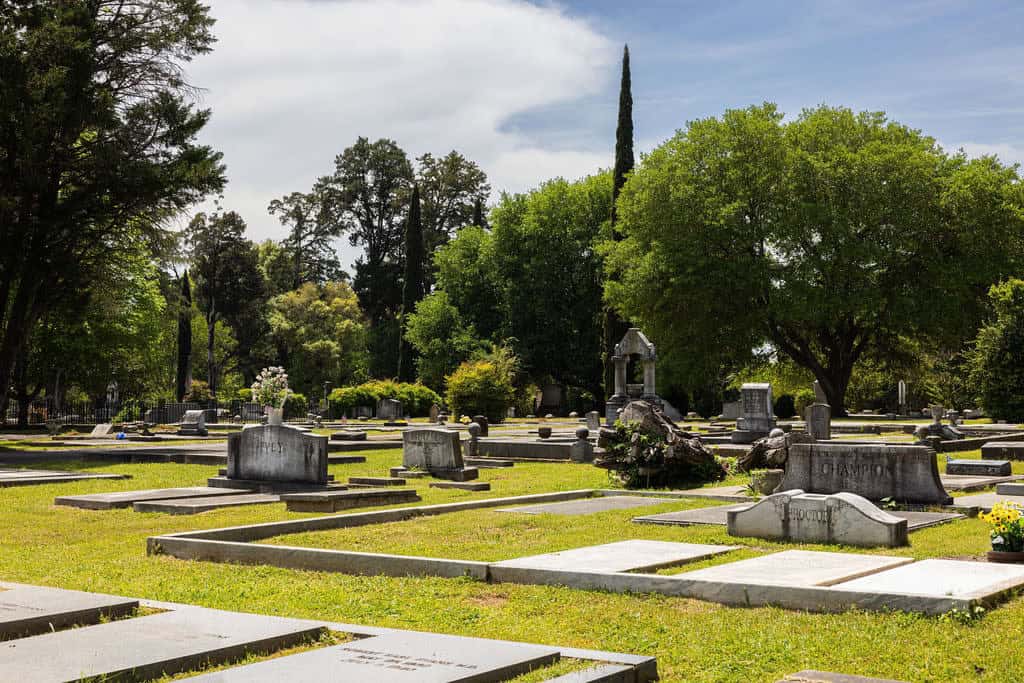
Every year around Christmas, a hole opens in the ground at Milledgeville’s Memory Hill Cemetery. It appears in the same spot each time, near the graves of Dixie Haygood and the neighboring Yates family. Workers fill it in, and some have even poured cement, but it keeps coming back.
Locals have a theory. Haygood was a 19th-century Milledgeville performer known as “The Georgia Wonder.” Though she weighed about 100 pounds, the strongest men couldn’t lift her off the ground, yet she could hoist several of them at once. Rumors spread that her powers came from witchcraft, and legend holds that she cursed John Yates. So is Haygood still working her magic, or is Yates trying to dig his way out from next to her?
For the record, local historians say Haygood was just very, very good at her job.
Memory Hill dates to Milledgeville’s early days as Georgia’s capital. The 1803 town plan set aside a 20-acre public square that became the city cemetery. Today, more than 7,700 people rest here, including Southern Gothic author Flannery O’Connor, longtime Congressman Carl Vinson, and train robber Bill Miner. Early governors, Civil War soldiers, and enslaved people are buried here as well.
Plan your visit: Admission and parking are free. Pick up a self-guided walking tour brochure at the gazebo by the entrance, or download it online. Numbered signs lead you to 47 points of interest—Haygood’s grave is No. 40. Guided tours are available for groups of 15 or more. For more local lore, follow Visit Milledgeville’s self-guided ghost tour of the historic district.
Address: 300 W. Franklin St., Milledgeville
9. Andersonville National Cemetery, Andersonville

It’s been said that a lone figure in a Confederate uniform sometimes walks the road leading into Andersonville. According to legend, it’s Captain Henry Wirz, commandant of the notorious Civil War prison here, who was hanged for war crimes in 1865.
Camp Sumter, better known as Andersonville Prison, held about 45,000 Union soldiers in just 14 months. Nearly 13,000 of them died from disease, malnutrition, and exposure. Today, they rest in long, close-set rows of white headstones in Andersonville National Cemetery.
Look for six graves set apart from the rest. They belong to the “Raiders,” a gang of prisoners who robbed and attacked fellow captives until other inmates tried them and hanged the ringleaders in July 1864. The six were buried apart from the others, a deliberate mark of dishonor. Some visitors say the spot still feels heavy, especially on the anniversary of the hangings.
The cemetery is still active, with more than 21,000 burials, and the site serves as the National Park Service’s memorial to all American prisoners of war.
Plan your visit: Admission is free. The national cemetery is open daily from 8 a.m. to 5 p.m. Start at the National Prisoner of War Museum, open daily from 9:30 a.m. to 4:30 p.m. (closed Thanksgiving, Christmas, and New Year’s Day). There, rangers can point you to walking and driving tours of the cemetery and the historic prison site.
Address: 496 Cemetery Road, Andersonville
Coastal Georgia
10. Midway Cemetery, Midway
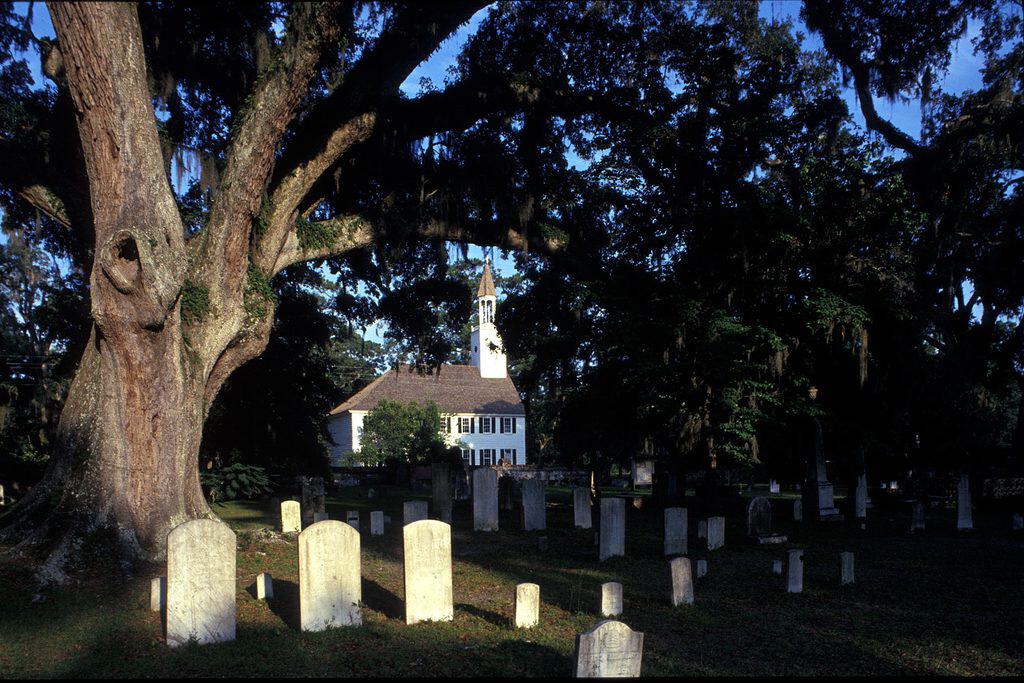
Walk the brick wall around Midway Cemetery, and you’ll find a crack along its north side that, legend says, never goes away.
According to local lore, two enslaved men were forced to stay late one night to finish building the wall. Only one made it until morning. He killed the other with a brick and buried the body beneath the wall.
Soon after, the wall began crumbling unnaturally fast. When it was torn down and rebuilt, the remains were found, but the crack reappeared. Locals say it still marks the spot where the murdered man was buried.
The cemetery’s other well-known legend is a tragic romance. Two young lovers who met in secret among these graves are said to linger together as shadowy figures beneath the oaks.
It’s no wonder there’s so much lore surrounding this graveyard. Midway Cemetery, the burial ground of the historic 1792 Midway Church, is one of the oldest in Georgia. It holds the graves of two Revolutionary War generals, honored by a monument at its center. During Sherman’s March to the Sea in 1864, Union cavalry used the walled grounds as a corral for their horses.
Plan your visit: The Midway Museum, across U.S. 17 from the cemetery, oversees the historic church and grounds. Its annual cemetery tour is Saturday, Oct. 24, with costumed volunteers bringing the stories of the people buried here to life. Tours run hourly at 6, 7, 8, and 9 p.m., last about 50 minutes, and start at Midway Congregational Church across the road. Tickets are $20 for adults and $15 for those under 18. Wear good walking shoes and bring bug spray.
Address: 480 N. Coastal Highway, Midway
11. Colonial Park Cemetery, Savannah
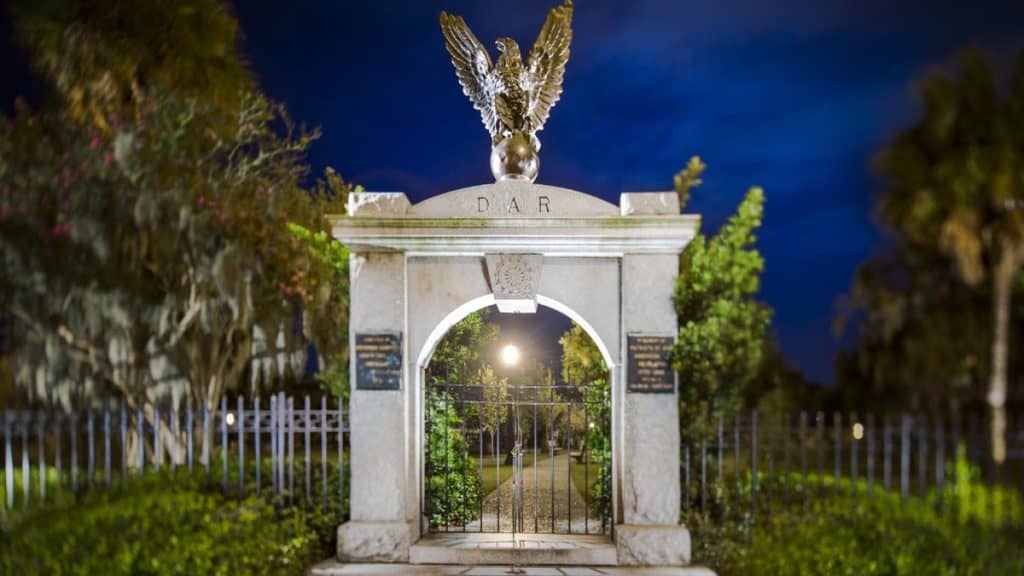
The story goes that Union soldiers camped here during the Civil War passed the time by recarving headstone dates with their bayonets. The results were impossible lifespans and at least one son born a millennium before his father. Many of the displaced markers now hang along the cemetery’s back wall. Historians point out that vandals have been at it for centuries, but locals prefer to blame Sherman’s troops.
Then there’s René Rondolier. Legend describes him as a towering, disfigured man accused of killing young girls in the early 1800s and lynched by an angry mob. When more bodies turned up afterward, townspeople blamed his ghost. Some still call the cemetery “René’s playground.”
Colonial Park also stars in one of the internet’s better-known ghost videos. In December 2008, a teenager visiting from Ohio filmed what looks like a small, grayish child darting through the cemetery. The figure appears to spring up a tree, drop back down, and vanish.
A special-effects team found no sign the footage had been faked, but couldn’t say for sure what the figure was. Skeptics point out that the cemetery was busy with visitors, and a real kid at play is a likelier explanation. Search “Colonial Park Cemetery ghost video,” and judge for yourself.
While not all stories associated with the cemetery are accepted as truth, the real history here is grim enough on its own. Nearly 700 victims of the 1820 yellow fever epidemic are buried here. So is Button Gwinnett, a signer of the Declaration of Independence, near Lachlan McIntosh, the man who killed him in a duel.
Founded in 1750, the six-acre cemetery holds more than 9,000 graves and is Savannah’s oldest intact municipal cemetery.
Plan your visit: Admission is free. The grounds are open daily from 8 a.m. to 8 p.m. March through November, and 8 a.m. to 5 p.m. November through March. Many of Savannah’s nighttime ghost tours stop outside the gates.
Address: 200 Abercorn St., Savannah
12. Laurel Grove Cemetery, Savannah
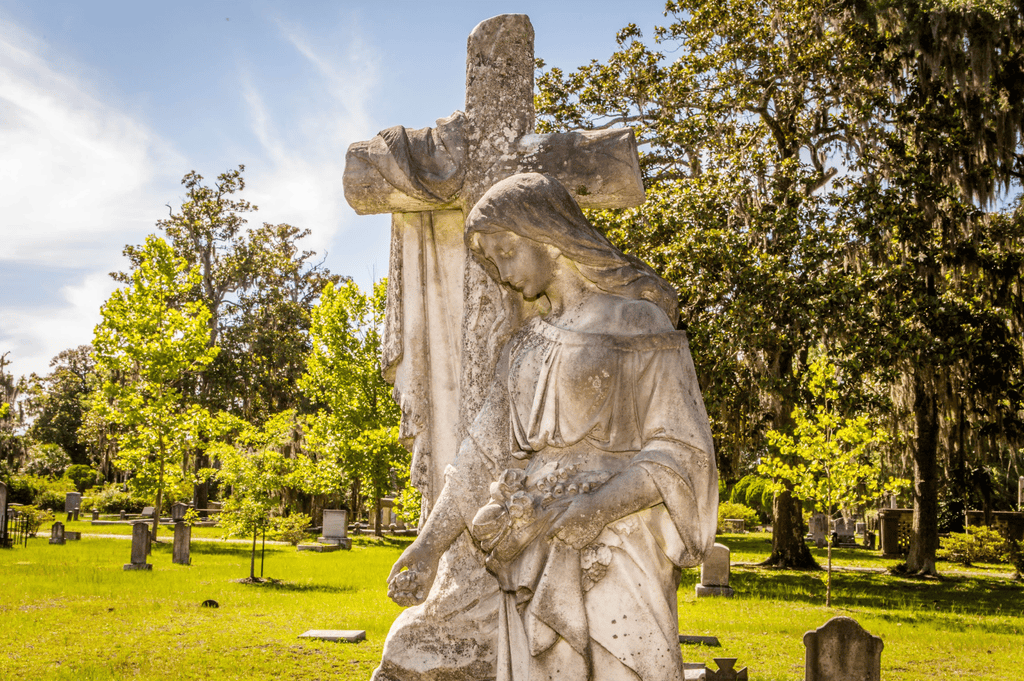
In the 1800s, a streetcar line ran right past Laurel Grove Cemetery, and riders began to notice something unsettling. Every time the car rolled by the graves, passengers heard a child sobbing. Yet no child was ever found on board. Stranger still, the story goes, the crying came only from car No. 28.
Visitors also describe footsteps that seem to follow them along the paths, and a young woman in a wedding gown is said to drift among the headstones, still searching for a lost love.
The cemetery opened for burials in 1853, after Colonial Park filled up, and it was segregated from the start. Laurel Grove North was reserved for white Savannahians and Laurel Grove South for Black residents, both free and enslaved. Interstate 16 now runs between them.
The North side is where you’ll find Girl Scouts founder Juliette Gordon Low, whose grave is often decorated with notes from young Scouts. “Jingle Bells” composer James Pierpont is buried here, too.
Laurel Grove South is one of the most significant African American burial grounds in the South. It’s the resting place of Andrew Bryan, founding pastor of what’s considered one of the oldest Black Baptist congregations in the country.
Plan your visit: Admission is free, and both sections are open daily from 8 a.m. to 5 p.m. The two halves have separate entrances, and visitors can drive through the grounds. Leashed pets are welcome.
Address: Laurel Grove North, 802 W. Anderson St.; Laurel Grove South, 2101 Kollock St., Savannah
13. Bonaventure Cemetery, Savannah
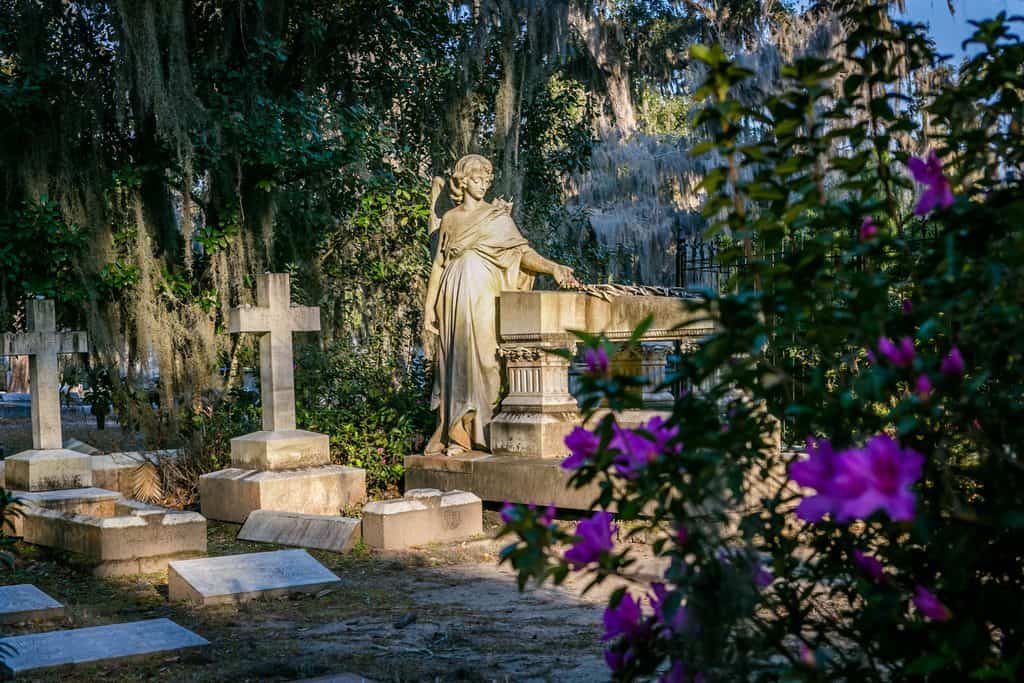
Whatever you do, don’t take anything from Little Gracie’s grave.
Gracie Watson died at 6 of pneumonia in 1889, the beloved child of a family that ran one of Savannah’s grandest hotels. Her heartbroken father commissioned a life-size marble statue of her, carved from a photograph, and it has drawn visitors here ever since.
Today, people leave toys, coins, and trinkets at her feet. Legend says if anyone takes one, the statue weeps tears of blood. Others claim they’ve spotted a little girl in a white dress playing in Johnson Square, where her family’s hotel once stood, before she vanishes.
Beyond Gracie’s plot, the cemetery feels like something out of a gothic novel: avenues of live oaks dripping with Spanish moss frame Victorian monuments on a bluff above the Wilmington River, where a colonial plantation once stood.
Bonaventure became a public cemetery in 1907, and John Berendt’s 1994 bestseller “Midnight in the Garden of Good and Evil” made it famous. The book also spotlighted one of the cemetery’s most unusual graves: a marble bench marking the grave of Pulitzer Prize-winning poet Conrad Aiken, beside his parents. Local legend says he wanted visitors to pull up a seat and have a martini with him. Nearby—also in Section H—rests Savannah native Johnny Mercer, the lyricist behind “Moon River.”
Plan your visit: Admission is free, and the gates are open daily from 8 a.m. to 5 p.m. The Bonaventure Historical Society offers free one-hour guided tours on the second weekend of each month at 1 p.m. Tickets are required, so reserve ahead. Its visitor center is open weekends from 10 a.m. to 4 p.m.
Address: 330 Bonaventure Road, Savannah