Harriet E. Wilson was the first Black author published in the US. Her novel would remain undiscovered for over 100 years.
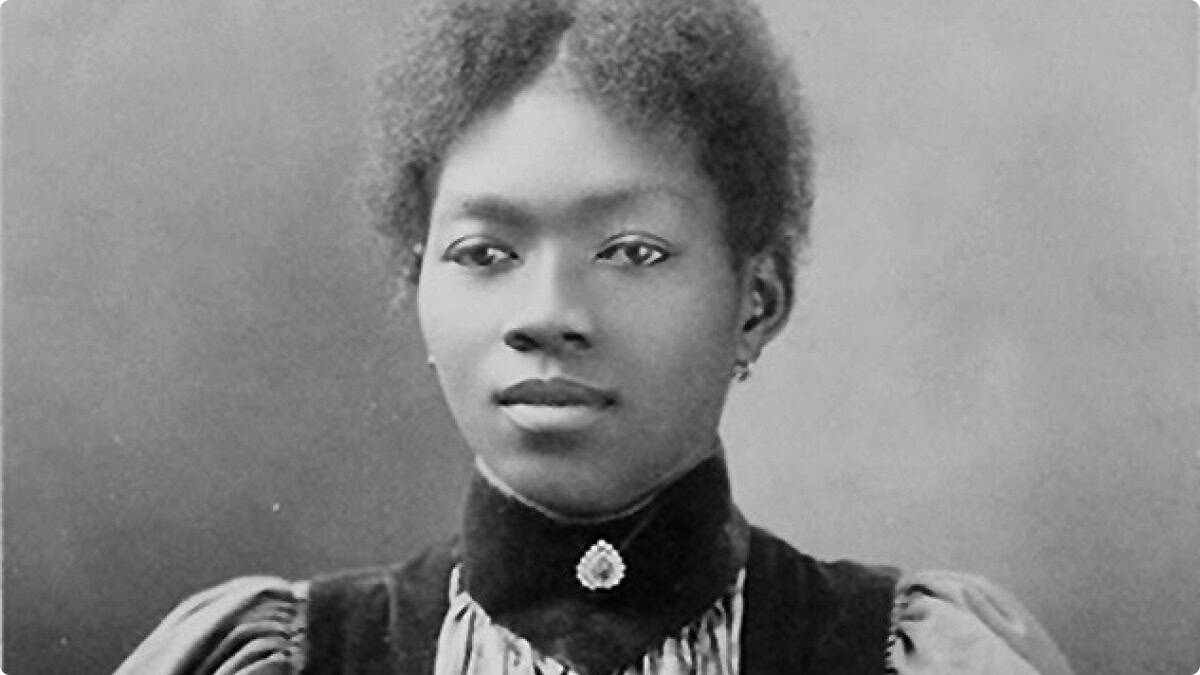
Harriet E. Wilson was born Harriet E. Adams in Milford, New Hampshire in 1825. Hattie, as she was known then, lived as an indentured servant to a wealthy local family, the Haywards, from six to 18 years old. Her time with the Haywards would go on to serve her in an unexpected way: They would become the basis for the Bellmonts, a mentally and physically abusive family who appeared in her novel, “Our Nig.” Published anonymously in 1859, Wilson’s story was significant not only for the way it detailed the horrific conditions she was forced to endure and her ability to overcome them, but because it was actually the first novel ever published by a Black author (and a Black woman) in the US. This historic fact didn’t come to light, though, until Henry Louis Gates Jr. discovered the book in 1982*.
Wilson’s novel describes the horrors of racism that plagued the North, which was an uncommon literary topic at that time. In the 1800s, most autobiographical accounts written by Black writers focused on slavery and racism in the South. Gates Jr. spoke to the New York Times after making his discovery, and he shed light on why Wilson’s depiction of racism in the North likely led to “Our Nig” fading into obscurity for 100 years. ”Publications like The Liberator, a weekly newspaper published in Boston, reviewed virtually everything Black people wrote, including books of much less importance than this one, as part of the ongoing attempt to prove the intellectual equality of Blacks,” Gates told the outlet.
He added, ”But all the abolitionists chose to ignore ‘Our Nig.’ There were two things you couldn’t do if you were a foe of slavery. One was to write about racism in the North — and this book is all about racism in the North. Second, the man Alfrado [the main character] marries is a Black man pretending to be an escaped slave. There was a big lecture circuit of fugitive slaves at the time, and Southern slaveholders were always claiming that these people were fakes. So here Harriet Wilson says that one such Black fugitive was indeed fake, that he married her, impregnated her and ran away. That was not designed to win Northern friends in the Black community or in the white community. The two aspects of her audience would have been Blacks in the North and white abolitionists, and she undercut her own strength with them by writing about these two subjects, which were both taboo.”
It’s unclear as to whether Wilson knew these topics were taboo. Through researching this piece, it seems to me that she was merely trying to write a true-to-life account of what she had experienced growing up in New Hampshire as a mixed-race indentured servant who suffered at the hands of those she worked for. She was also trying to raise money to help support herself and her young son, George Mason Wilson, who had fallen ill. George would die of bilious fever in 1860, one year after “Our Nig” was published. The loss, coupled with her novel being ignored, drove Harriet to seek new work opportunities and to become involved with the Spiritualist movement. She never wrote anything for publication again.
Below, we’re going to talk about Harriet’s life, her novel, and what happened to her following its publication, and how New Hampshire recently honored her with a historic marker on the Black Heritage Trail. It feels insignificant to only spend roughly 1,800 words trying to detail the life of someone who was trying to make the most of her circumstances and made history in the process of that, but sometimes the only way we can honor someone is by keeping their memory alive, and by making sure their stories are still being told.
*Some reports indicate that the book was discovered in 1981.
Harriet’s life was one of resilience and reinvention
After she turned 18, Harriet Wilson (then Hattie Adams) left her indentured servitude with the Haywards and began working as a seamstress and servant for several families in New Hampshire. She married Thomas Wilson in October 1851 and had a poem, “Fading Away,” published in the Farmer’s Cabinet in December of that same year. The couple’s son, George Mason Wilson, was born in 1852. Thomas, who worked aboard a ship, died in 1853, leaving Harriet and George destitute. The young mother was forced to leave her son in the care of foster parents as she traveled to find a steady stream of income. Between 1855 and 1857, she started her own business, “Mrs. H.E. Wilson’s Hair Dressing,” and began working on “Our Nig.” The book was published anonymously in 1859, and as previously mentioned, her son sadly died in 1860.
Following George’s tragic death, Harriet appears to have spent several years working as a servant while selling her hair care products. She then moved to Boston and met clairvoyant physicians Ellen Booth, Sarah H. Mixer, and Eleanor “Betsy” Came in 1866. By the following year, Harriet was working as a medium (someone who communicates with spirits) and had joined the Massachusetts Spiritualists Association. She was well-known and well-regarded in spiritualist circles and often spoke at conventions across New England in front of thousands of attendees. In 1870, she married physician John Gallatin Robinson and worked to establish a Spiritualist society in Foxboro and Mansfield, Massachusetts. In the late 1870s, she became a lecturer, a trance reader, and a spiritualist healer. She worked as a housekeeper for nearly 20 years, and also as a nurse, throughout this stretch. When she died in Quincy Hospital in 1900 at the age of 75, her occupation was listed as “nurse.”
Harriet’s ability to persevere after a decade of abuse while living in servitude, and after losing her first husband and her son, is commendable. She never stopped working, never stopped looking for ways to support herself and her reinvention, and she created a lifelong career for herself in spiritualism after her writing dreams were dashed. She used her gifts and kindness to help countless others, and to remind people “that the spirit-world is not afar off, in space, but here in our midst; and that spirits are not bodiless being but are with us in our homes.” To honor her life and legacy, the Black Heritage Trail of New Hampshire erected a historic marker at the Nehemiah Hayward Homestead in Milford in her memory. It was a poignant choice of placement, as it showed that even though she suffered at the hands of the Haywards, her strength and courage allowed her to reclaim the life they had once tried to diminish.
The historical significance of “Our Nig”
In the early 1980s, Henry Louis Gates Jr. came across a copy of “Our Nig” in a bookstore in Manhattan. He purchased it for $50 and brought it home, where it remained for several months before he eventually picked it up to begin reading. In the novel’s preface, the author says she’s a Black woman. Gates Jr. was immediately struck by this, as it was previously believed that a fiction book written by a Black female author had not been published until 1892. He knew that if the opening pages of “Our Nig” were accurate, he had just made a historically significant discovery. He looked up the Boston copyright for the novel and saw that the author—though unlisted on the book itself—was H.E. Wilson, a Black widow living in the city. He then cross-referenced the name in a Boston directory from 1859, the year of the book’s publication. That’s how he found Harriet E. Wilson, who was noted as a 52-year-old widow living in a predominantly Black neighborhood in Boston.
From there, Gates Jr. pulled up the 1860 United States Census Record to confirm the information he found in the Boston directory. Sure enough, Harriet was there, and all the details matched. He dug into her past while also reading through the pages of “Our Nig,” which is described as a “harrowing story” that follows main character Alfrado, who is a mixed-race woman, like Wilson was. The more he read the novel and uncovered information about Wilson, the more Gates Jr. realized that much of her story was autobiographical. She details Alfrado being abused and mistreated by the family she worked as an indentured servant for, and the character’s marriage to a man who abandons her and their infant son before dying of yellow fever. Alfrado also has to place her son in a foster home, and pleads with readers in the final pages to purchase the book so the author can take care of her own son. It’s a heartbreaking plea from a fictional woman on behalf of the real woman who was doing whatever she could to take care of her family.
Gates Jr. believes that Wilson’s novel was swept away by the sands of time because she not only detailed racism in the North, as previously discussed, but because she covered the topic of interracial marriage. ”That possibility was absolutely never talked about, because it was such an emotional issue for white racists,” Gates Jr. told The New York Times in 1982. Still, he couldn’t wrap his head around the fact that countless people had failed to come across this historically significant novel over the last 100 years. ”So many scholars have done so much research into the origins of Black writing in this country that it seemed unlikely no one would have found it before. There are excellent bibliographies of Black fiction, and this book had never been mentioned in any of them; in the bibliographies where it is listed, it is listed as having been written by a white man. It also seemed unlikely to me that a Black person would call a book ‘Our Nig,’ because ‘n*****’ was a denigrating title and Black people wrote primarily to improve the image of Blacks and to demonstrate mental equality. But as soon as I started to read it, I was convinced immediately that the author of the book was Black, and that the title was ironic: she called it ‘Our Nig’ because that’s what she was called by all the white racists in the book,” he said.
Gates Jr. also emphasized that while many elements do appear to be rooted in Wilson’s life and experiences, some details were fictionalized. ”The decade of the 1850’s was a golden age of women’s fiction in America. White women were writing sentimental novels, and Black men were writing autobiography in their slave narratives. Mrs. Wilson, a Black woman, combined the two forms,” he told the outlet. Wilson’s ability to accurately capture the pitfalls of what it was like to be a Black woman at that time can’t be overstated, though. She wrote authentically and earnestly about what she experienced, and she tried in vain to turn her story into something profitable to benefit herself and her son. Though “Our Nig” was ultimately unsuccessful and unpopular during her lifetime, Harriet E. Wilson is finally starting to gain recognition for her accomplishments, and for her powerful contribution to literary history.