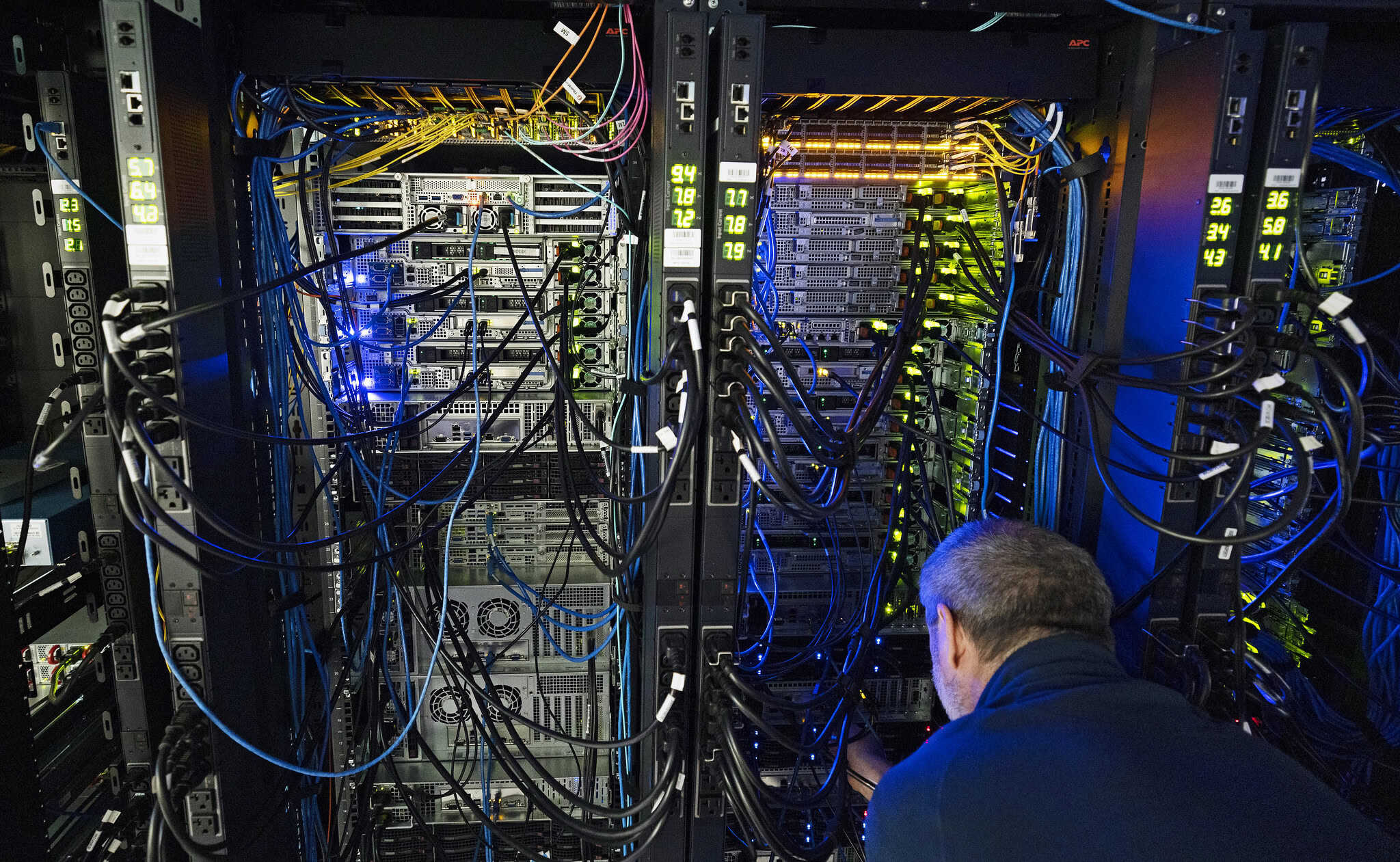
Thanks to a favorable location, strong fiber setups, and affordable land, Virginia has excelled as the Internet Capital of the World.
Being known as the Internet Capital of the World is impressive, considering how ubiquitous the technology has become.
Getting online was an adventure during the early days of the Internet. You’d go to a clunky desktop computer, use a dial-up modem, and marvel at this new ability to discover things without needing a collection of encyclopedias. That almost feels quaint today. The majority of the world owns a smartphone, we do many jobs entirely remotely, and “Let me Google that” has been replaced by “just ask ChatGPT.”
With how rapidly the online era is expanding, perhaps it’s a bit surprising that Virginia holds the title of Internet Capital of the World. It’s only the 35th-largest state in terms of square footage, and … well, the Internet is huge. You’d think a more grandiose state would fit the bill. Yet Virginia has the ideal setup to grow and continue to thrive alongside the Internet.
An ongoing need for more energy
In 2024, United States data centers consumed 183 terrawatt-hours (TWh) of electricity, or about 4% of the country’s total electricity consumption. That number is projected to grow to 426 TWh by 2030.
About 60% of the energy used by data centers goes toward powering servers that process and store digital information. With so many people on the Internet and the rise of energy-intensive tasks like AI prompting and cryptocurrency mining, more data is being transferred. Some AI-optimized hyperscale data centers contain advanced servers and computer chips that can run trillions of mathematical calculations every second. All of that is impressive, but it takes more energy than a traditional server or chip.
Data centers also require a large amount of energy for cooling systems to prevent servers from overheating. Imagine the heat you feel from the bottom of your laptop when it’s working hard, then picture that at a significantly larger scale, with thousands of servers all being pushed to the brink. Some data centers are more efficient at cooling, and there’s progress toward using renewable sources like geothermal energy to help with the cost and demand of cooling systems.
Earning the Internet Capital of the World title
Look at the Data Center Map, and you’ll notice an exceptional amount of activity in Virginia, especially the northern part of the state. Right now, there are 663 data centers in Virginia. Texas has the second-most data centers, with 405. That’s a huge gap.
Ashburn, Va., is the hub of “Data Center Alley,” as about half of the state’s collection resides there. The city handles over a third of all the Internet traffic in the world.
Virginia’s tie to the Internet has benefited from its location, particularly its proximity to the nation’s capital in Washington, D.C. Back in the 1960s, the government needed a way for the Department of Defense to connect with research institutions and universities. It tapped Virginia to tinker with fiber optic networking in the early days. This happened before the Internet as we know it, but this early networking required places to store data. Virginia still maintains the highest density of dark fiber across the entire world.
The 1990s saw an uptick in technology growth in the state. A group of Virginia network providers founded Metropolitan Area Exchange, East. In 1992, MAE-East developed one of the world’s first network access points, creating what they called an “Internet on-ramp.” And in 1996, two years before the release of “You’ve Got Mail” with Tom Hanks and Meg Ryan, America Online (AOL) moved to Loudoun County in Northern Virginia, and Equinix built its first data center in the vicinity.
Virginia’s geography is useful for data center developers, as well. It has large plots of affordable land, its energy costs are relatively mild, and it’s situated in an area that doesn’t experience natural disasters. Combine that with a strong fiber network, and Virginia makes perfect sense as the foundation of the Internet.
The state was also an early provider of tax incentives for data centers. Its first exemption for developers and operators came in 2009; today, 36 states offer some kind of exemption. Virginia took this route after Apple chose Maiden, N.C., as the site of a $1 billion data center in 2009. Despite Apple spurning the state, the exemptions have helped further advance Virginia as a data center power and the Internet Capital of the World.
Setting up for the future
That power will likely increase, too. In 2025, the International Energy Agency (IEA) reported that half of the country’s data centers currently being built will be located next to existing clusters. Virginia already has a strong advantage.
The state also has a Data Center Retail Sales & Use Tax (DCRSUT) Exemption, which encourages developers to continue using the land to build out data centers that will power the Internet and other AI advancements. The exemption includes relief on sales and use taxes on equipment and software if data center companies make at least a $150 million capital investment and create 50 new jobs. This exemption runs through 2035, so Virginia will expect steady growth for at least another decade.
During his State of the Commonwealth address in January 2025, Virginia Governor Glenn Youngkin called out the impact of data centers on the state’s economy. Youngkin said they generate $9.1 billion in Virginia GDP and billions in local revenue while supporting 74,000 jobs.
Virginia is also uniquely positioned to set the standard for data center development. A Joint Legislative Audit and Review Commission has made recommendations for operators, such as requirements around reporting energy and water use and emissions benchmarks for backup generators. These areas show a focus on responsible growth alongside rapid expansion.
The next iteration of the Internet holds a lot of promise. Virginia will lead the charge while maintaining its presence as the Internet Capital of the World.