Reno’s reputation as one of the speediest divorce mills during the first half of the 20th century helped shape the city as we see it today.
When it comes to nuptials in Nevada, Las Vegas is the city that comes to mind, but long before Sin City became the “Marriage Capital of the World,” the Biggest Little City had a marriage moniker of its own.
For the first six decades of the 1900s, Reno was one of the country’s top divorce mills, handling thousands of divorces every year. The city earned its nickname as “Divorce Capital of the World” due to its lax laws, including a residency requirement of only six weeks, speedy processing, and a divorce-driven tourism industry.
“The practice of seeking divorce in Reno dates back to the early 20th century, when the city shrewdly built lodging and entertainment steps from its courthouse, drawing a steady flow of ‘divorce tourists’ looking to escape the East Coast press,” writes Sofia Grant in Time Magazine. “By the 1950s … a thriving economy had evolved for the sole purpose of meeting divorcees’ needs while they waited — and, indeed, Reno relied on the divorce trade to keep her coffers full.”
Reno’s early history with migratory divorce had a drastic impact on the city’s culture and economy, as well as the local community, since many people seeking a divorce in Reno never left. It also played a role in establishing women’s rights, granting them a freedom not afforded in many other places until laws were loosened nationwide.
Untying the knot in Nevada
Nowadays in the U.S., no-fault divorce is the law of the land, but it wasn’t always that way. Up until the 1970s, aspiring divorcees were forced to flee to states such as Reno, home to what was once called the “six-week cure.”
Divorce laws greatly varied in the US during the 19th century, with state legislatures granting divorces until the responsibility was transferred to the courts around 1850.
Nevada emerged in the 1900s as one of the country’s primary divorce mills due to its six-month residence requirement, shortened to six weeks in 1931.
The city’s first high-profile divorce was that of US Steel President William Ellis Corey, one of the world’s richest men, and his wife, Laura, in 1906. The selection of Reno as a divorce destination started a trend among their peers, according to the Reno Divorce History, and an archive of over 1,000 individual items that showcase Reno’s divorce history, established by the Special Collections and University Archives at the University of Nevada, Reno Libraries.
Among the celebrities and dignitaries to divorce in Reno over the years were professional boxer Jack Dempsey, actress Rita Hayworth, newspaper mogul William Randolph Hearst, Jr., playwright Arthur Miller, illustrator Norman Rockwell, and mobster Benjamin (Bugsy) Siegel.
But it wasn’t just the wealthy elite who divorced in Reno. As Alice Barber explains in the KUNR article “A Look Back At Reno’s Quickie Divorce History,” “Just about anyone could take advantage of the state’s multiple grounds for divorce,” noting, “the options for short-term lodging during that period included something for every income level, from rooms in private residences and modest apartments to luxurious hotels and glorified dude ranches.”
Reno’s divorce landscape
The divorce industry raked in more than $3 million a year for Nevada’s economy during the 1930s, with divorce seekers spending money on housing, legal, medical, and dental services, food and drink, clothing and other necessities, entertainment, transportation, and anything else a resident might need.
As the Reno Divorce History archive points out, “Reno provided the divorce-seekers with everything they wanted and needed, as well as some things they might never have considered. All in all, American ingenuity and industry flourished in Reno during its divorce heyday.”
Reno divorces peaked at 10,313 in 1945, immediately after the end of World War II. The reason for this increase, according to Time, is women’s first chance for independence, as they held jobs when their husbands were away fighting: “Simply put, women were not inclined to give up their newfound independence easily, though whether they initiated divorce or their husbands did so in protest of their wives’ newly unruly natures is not clear.”
Divorce was reformed nationwide by the 1970s, causing Reno’s divorce trade to fade. However, as Barber points out: “The landscape of divorce is still visible throughout the city in the form of many homes that once served as boardinghouses or rented out rooms, as well as apartment buildings and hotels like the Riverside.”
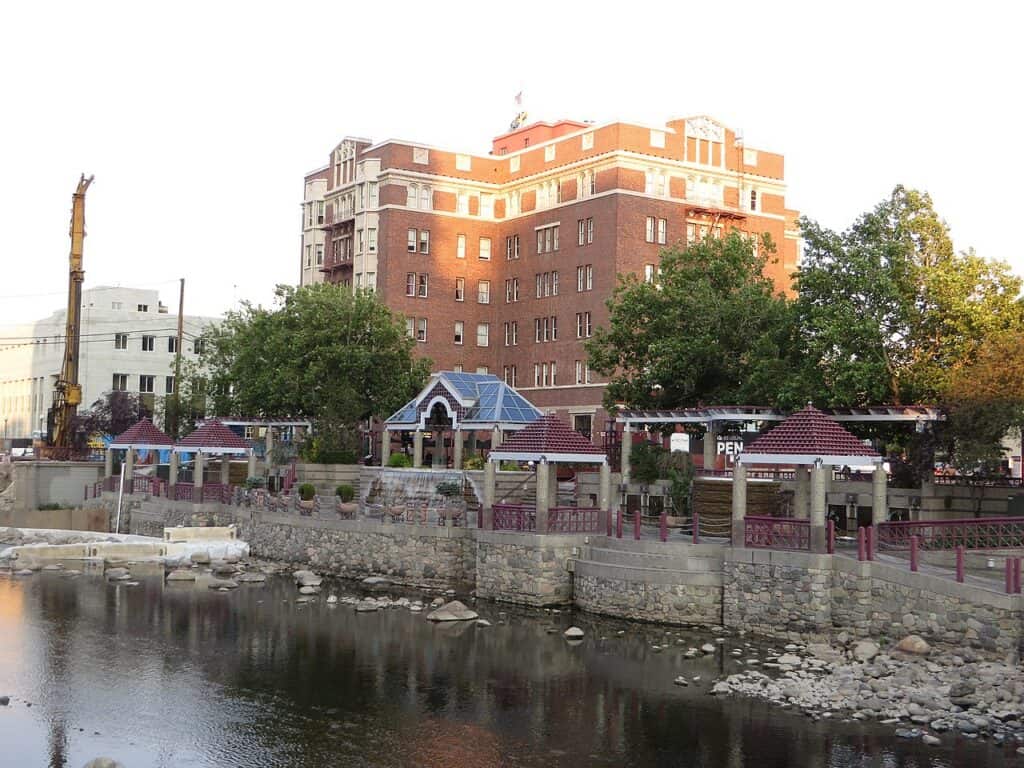
Listed on the National Register of Historic Places, the Riverside Hotel was a popular place to stay while awaiting a divorce. Built in 1927 on the exact location where Reno first started, it was converted into artist lofts in 2000.
In addition to historic buildings, Reno remains home to many of the children, grandchildren, and great-grandchildren of Reno divorcees who ended their marriages and never left.
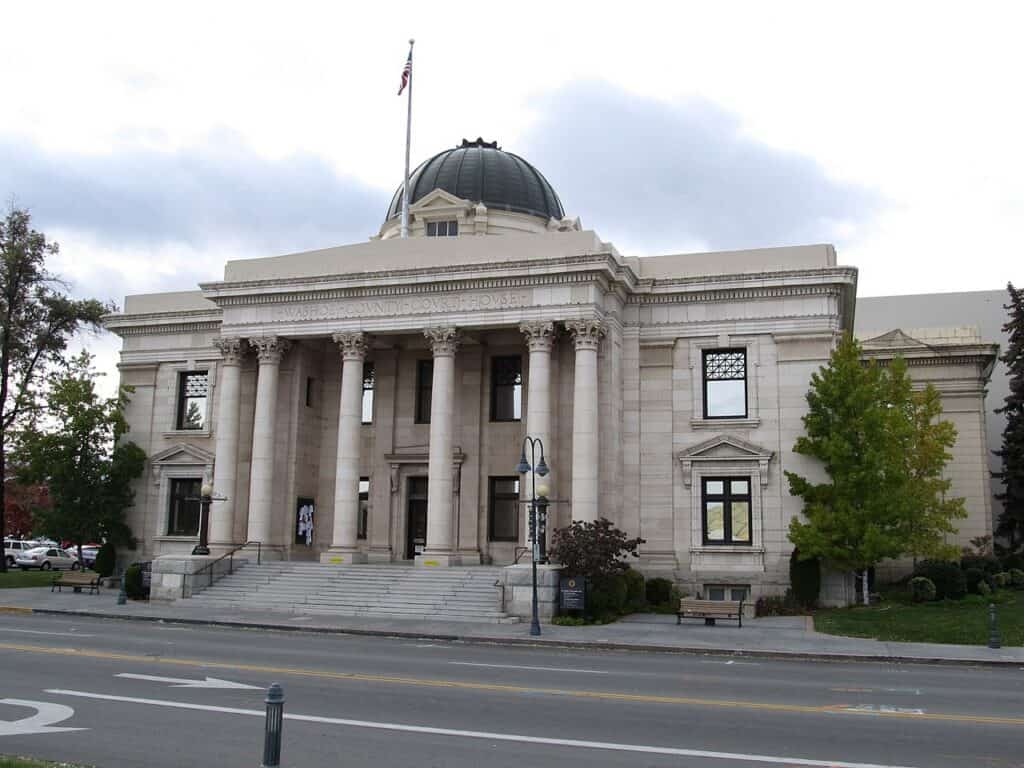
The city’s reputation as one of the country’s top divorce mills is memorialized in film, stories, and images, including those of newly divorced women kissing the columns of the Washoe County Courthouse, the building where proceedings took place. One long-held rumor that newly divorced women tossed their wedding rings off the Virginia Street Bridge, nicknamed “the wedding bridge” or “the bridge of sighs,” into the Truckee River, is merely a myth, according to a letter to the editor of the Reno-Gazette Journal by Reno resident Robert Welty. In his 2015 letter, he writes, “This phony story and rumor was around 70 years ago, and I, as a 10-year-old youth, searched the river bottom in low water times, as did my friend and neighbors. No rings ever found.”