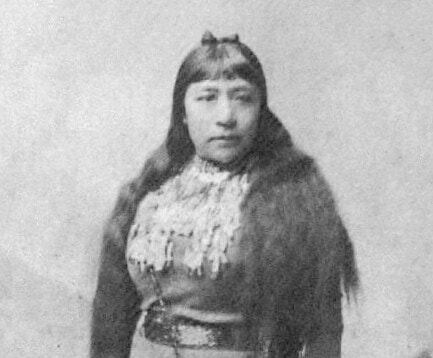
Sarah Winnemucca was a member of the Northern Paiute and served as a peacemaker for her people. Learn all about her life and legacy.
Sarah Winnemucca was born Thocmetony, a Northern Paiute name meaning “Shell Flower,” around 1844. As a member of the Northern Paiute—who were themselves part of the Numic people—her early life was predominantly nomadic. Her tribe inhabited areas of eastern Oregon and western Nevada, and it was through her travels with them that she learned about the importance of her people and their customs. The Paiute were wary of white settlers, but her grandfather, Tru-ki-zo, worked alongside them during the two-year stretch of the Mexican-American War. Tru-ki-zo taught Sarah and her siblings about the settlers in an effort to prepare his grandchildren for the ways in which their lives would be irrevocably changed by them.
In doing so, Tru-ki-zo gifted Sarah with the knowledge and insight needed to act as a go-between for the Northern Paiute and the people who were colonizing Indigenous land. She went with him to California, where she worked as a servant for a white family and learned how to read and write in both Spanish and English. It was around this period that she adopted the name Sarah. It’s unclear as to what prompted her to make the change, though she may have seen it as a way of further aligning herself with the settlers to gain their trust, as this would then allow her to be a better advocate for her tribe.
Unfortunately, there were many stretches of her life when belonging to both groups cast her as an outsider among each group. Despite this, Sarah dedicated her life to establishing and maintaining peace for her people in an increasingly hostile world.
The underlying message in Sarah’s story is that of perseverance, dedication, and empathy. She desperately wanted to protect the Northern Paiute and worked with the US government to safeguard them as best as possible, but she was often met with treacherous people who ignored her wishes for their own greater good. This is, sadly, a common tale among Indigenous tribes who have only ever wanted to enjoy their native land. Sarah may have been unsuccessful in achieving her goals, but the work she did was immeasurably meaningful just the same.
Northern Paiute were forced off their lands, and Sarah tried to intervene to help her people
In 1859, a discovery on Northern Paiute lands changed the trajectory of their lives forever. Silver was found under Mount Davidson in Virginia City, Nevada, in what would become known as the Comstock Lode. Hundreds of people flooded the area with the hopes of mining silver and making something better of themselves.
In response to conflicts bubbling up between these miners and the Northern Paiute, the US government decided to force the indigenous tribe out of the area to settle at Pyramid Lake Reservation instead. In doing so, the Paiute effectively had to forgo their nomadic way of life, and violent attacks at the hands of the settlers continued into 1860. After a Paiute rebellion where they overtook the miners, the US government once again intervened on behalf of the settlers by creating the Nevada Territory. In this new area, white Americans would have control over the governing body and the Northern Paiute people.
Sarah Winnemucca worked as an interpreter between her tribe and government officials for several years in an effort to protect the Paiute and preserve their customs as this was unfolding. She taught the new settlers about Indigenous culture by putting on shows with her family, but to no avail. Her mother and brother were killed during a campaign led by the US Army against her people, and her sister died soon after.
Eventually, in 1871, Sarah became a teacher and interpreter for the Bureau of Indian Affairs. She tried in vain to work with William V. Rinehart, the Indian Agent assigned by the government, but Rinehart was a cruel man set solely on further colonization. The Northern Paiute were then forced to move once again, this time to Washington’s Yakama Reservation.
During this relocation, Sarah wrote several petitions and letters on behalf of her people, advocating for them to be allowed to return to the Malheur Reservation, which occupied parts of northern Nevada and eastern Oregon. She received permission from the Secretary of the Interior to do so, but the Yakama Reservation’s Indian Agent refused the terms of this agreement.
It was yet another roadblock in Sarah’s efforts to protect her people and their lifestyle, but she never once became dejected by these devastating turns of events. She continued to work as an educator and advocate, right up until her death in 1891.
Later life, activism, and death
In the early 1880s, Sarah advocated on behalf of Native Prisoners of War during the Indian Wars, trying repeatedly to secure their freedom. In a letter written to then-President Rutherford B. Hayes, Sarah said of the 53 POWs, “If they could have a place, or a bit of land given them to use for themselves, yes, a place for their own benefit, and where they could work for themselves, I would teach them habits of industry, and it would help much in supporting them; and it is necessary that there should be, at least for the present, some appropriation made for them, in order to provide clothing for the women and children, and a proper place to live in.” Her pleas once again went unheard, as the prisoners were instead released in Idaho’s Fort Hall Reservation.
Her dedication and optimism didn’t waver, though, and she began giving hundreds of lectures to white audiences about Indigenous customs, culture, and history. She penned her autobiography in 1883, titled “Life Among the Piutes: Their Wrongs and Claims,” before heading back to start a school at the Yakama Reservation in 1885. That venture was also, tragically, short-lived, as the 1887 passing of the Dawes Act required children from Indigenous tribes to attend schools operated and owned by white settlers.
A few years later, in 1891, she died of consumption (then the common term for what we now call tuberculosis). It was a quiet end to a trailblazing life that was filled with an unyielding hope for better things, for deeper understanding, and for a level of peace the Northern Paiute deserved to be afforded but never were.