If you’re looking for roadside attractions in Utah, you’ll find them everywhere—but these are standouts.
Drive across the state, and you’ll find roadside attractions everywhere in Utah. Some are fun to visit if you’re already passing through. Others are so out of the ordinary they are worth the money, time, and effort to fill your gas tank and make a dedicated visit.
Many of these sites are available and free to visit 24/7, but some are managed by individuals and hours can vary. Not all are open to walk into or interact with, but all are worth a stop, a photo snap, and a hashtag on social media.
1. Dinah the Dine-o-Ville Pink Dinosaur
Address: 905 E Main St, Vernal, UT 84078
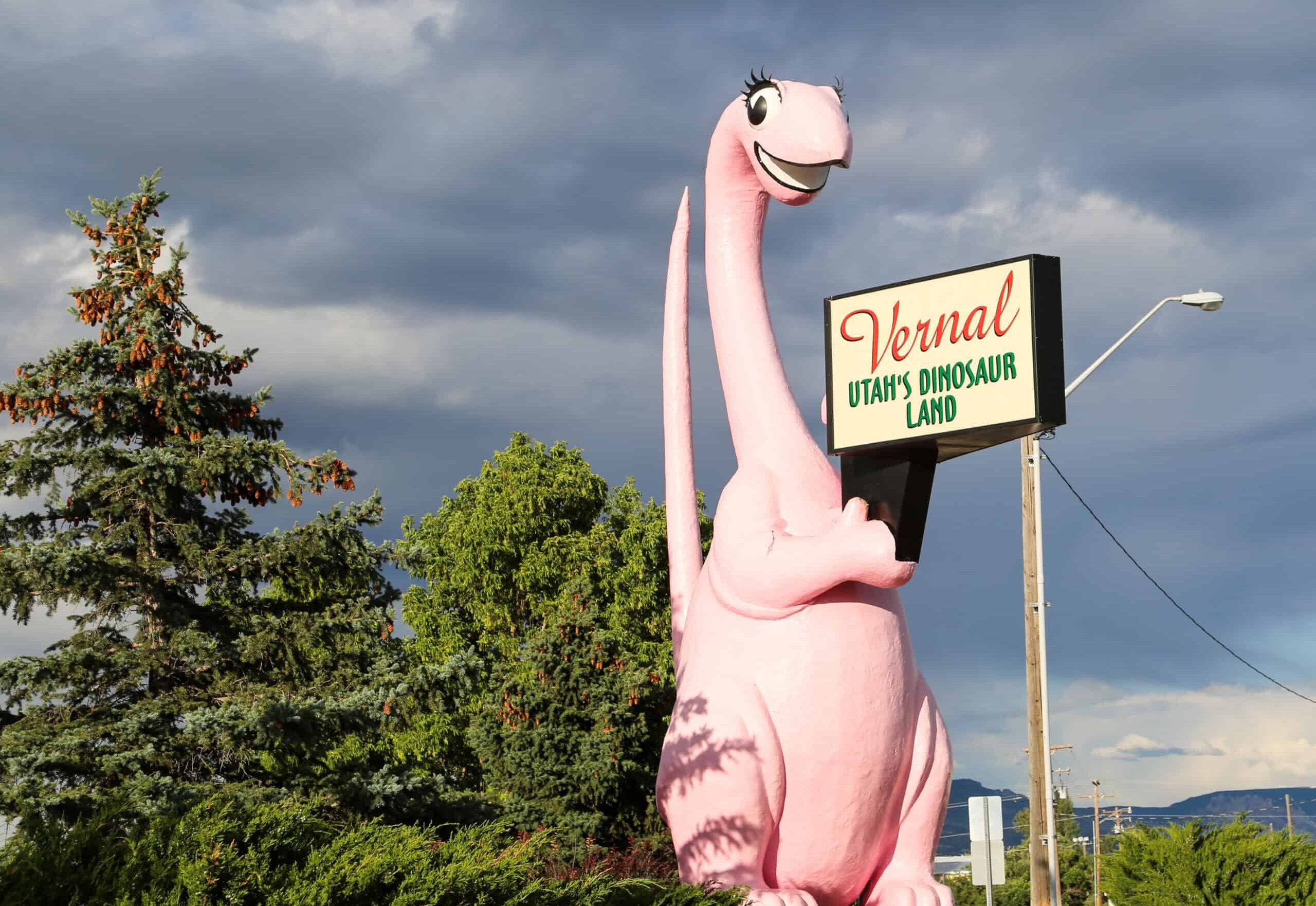
Dinah the Pink Dinosaur is 40 feet high, 4,200 pounds, and manufactured from pink fiberglass. Built by Salt Lake’s YESCO sign company in 1958, the 40-foot-high figure was commissioned by the owners of the Dine-o-Ville Hotel, George and Helen Millecam, who placed the motel sign in Dinah’s paws. In 1999, the site was bought by America First Credit Union, which demolished the motel and paid for Dinah’s relocation to her current spot on Main Street.
The “Vernal Express” noted at the time that the move took five hours, and Dinah’s head bonked into the moving crane before being lowered onto her pedestal, though no damage was done. (In 2024, a fatigued driver took out her tail, which has since been repaired. She also got a new paint job as a result.)
After the move, the mayor’s office solicited ideas for replacing the hotel sign. Ideas included “a dinosaur egg with a baby dinosaur coming out, a golf club, or some cattails,” but the city eventually chose a simple sign reading “Vernal: Utah’s Dinosaur Land.”
Dinah has been the official town greeter ever since. She was added to the National Register of Historic Places in November of 2023. While in Vernal, be sure to stop by to see some of the other dinos George Millicam gifted the town, like George the T-Rex, who gets dressed up for holidays.
2. Gilgal Sculpture Garden
Address: 749 E 500 S, Salt Lake City, UT 84102
Cost: Free
Hours: 8 a.m.–8 p.m. April–Sept., 9 a.m.–5 p.m. Oct.–March, closed New Year’s Day
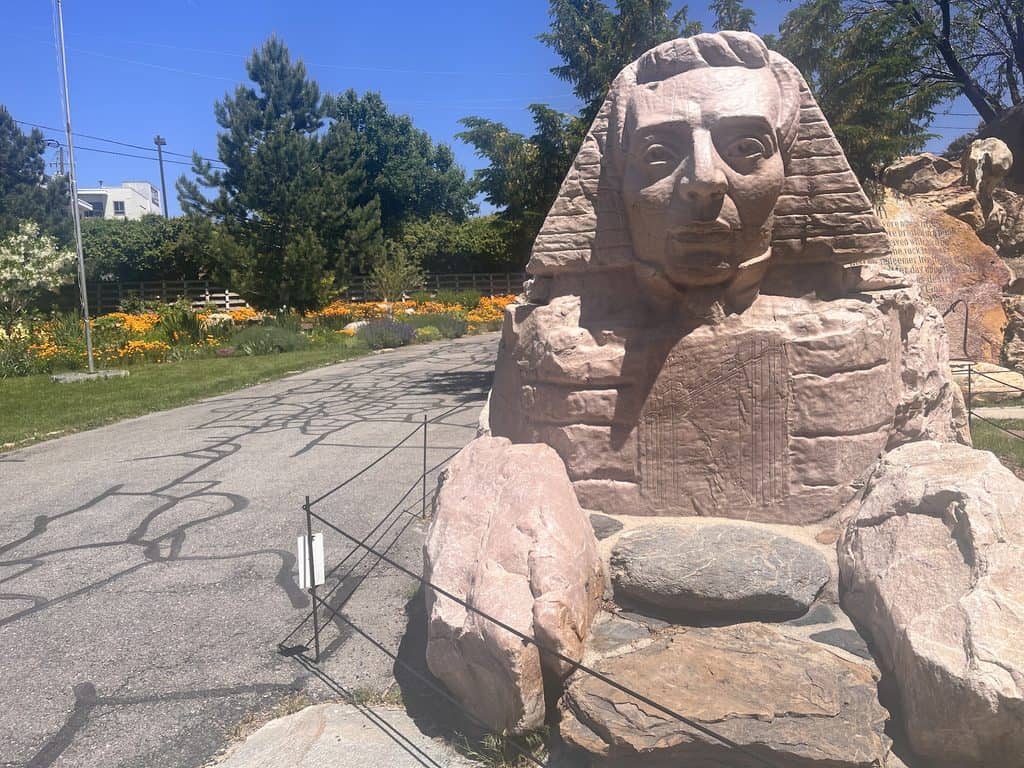
Gilgal Sculpture Garden wasn’t originally intended to be a public park, and it almost fell to developers’ bulldozers in the late 1990s. Created by building contractor and sculptor Thomas Battersby Child, Jr., Gilgal is hidden at the center of a city block, behind the still-in-use LDS Tenth Ward, where Child served as bishop.
The nonprofit Friends of Gilgal took over stewardship of the garden in 2000, planting native gardens and maintaining the 12 sculptures, including two of its best-known pieces, a sphinx bearing the face of Joseph Smith, and a self-portrait of the artist (often referred to as “Mr. Brick Pants), as well as 70 stones carved with poetry, literary quotes, and scriptures.
According to Gilgal’s website, it’s the only identified visionary art environment in Utah and a late-life project for Childs, who began it at age 57. He spent a decade traveling the state, “scouring mountainsides and streambeds for ‘a boulder in which I could put over the idea and tell the story and still have it a stone.’”
3. Hole N’ The Rock
Address: 11037 S. Hwy. 191, Moab, UT 84532
Cost: $6–$8 adults, $3.50–$5 kids, $4–$6 petting zoo admission
Hours: Mon.–Fri., 9 a.m.–5 p.m.
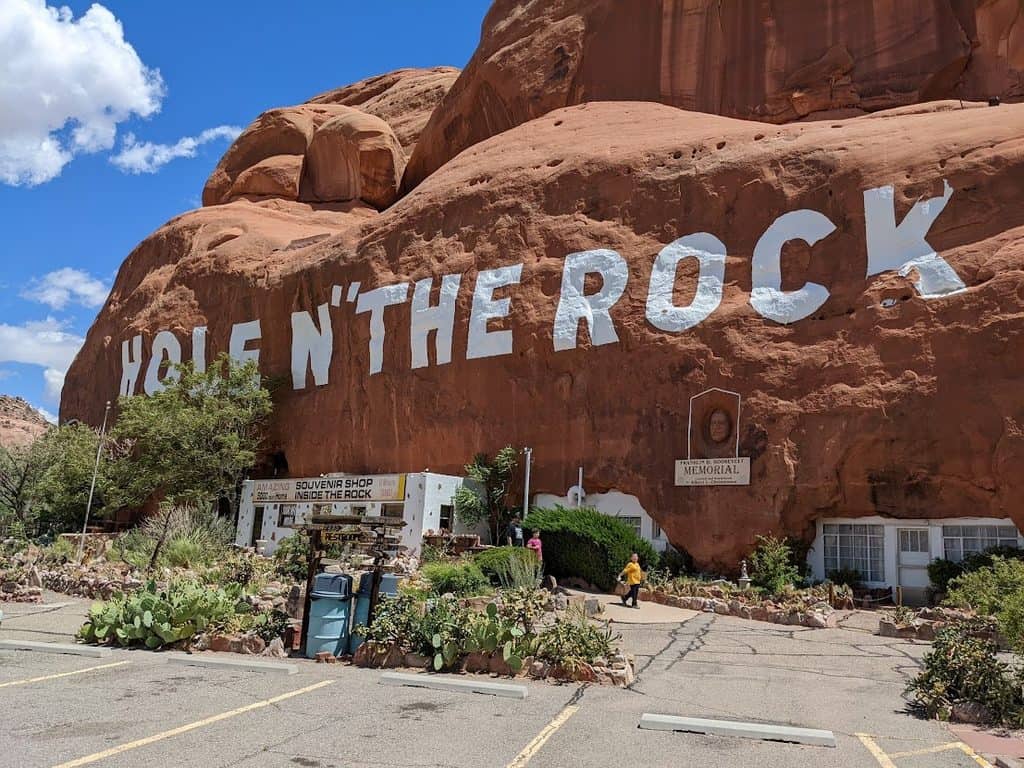
Long before “Fred Flintstone” was a household name, Moab brothers Albert and Leo Christensen began enlarging caves in the sandstone cliffs, turning them into caveman-like accommodations for traveling cowboys. This is what would eventually become Hole N’ the Rock.
In 1940, Albert threw himself into a much bigger project. And as a miner, he had the skills to do it: over the course of 12 years, he blasted out 50,000 cubic feet of rock from a sandstone cliff, creating a 14-room, 5,000-square-foot home for him and his wife, Gladys. He carved bookshelves into the rock walls, sculpted a deep tub out of concrete that’s set into the sandstone, and single-handedly built a 65-foot-chimney that vents out of a hole blasted through many feet of rock.
In 1952, the couple moved in; in 1955, the Christensen brothers opened Hole N’ The Rock cafe. Albert only lived another two years, but Gladys operated the site until her death in 1974. Subsequent owners have kept the home as is, preserving the midcentury furniture, Gladys’ doll collection, and Albert’s paintings.
The white painted sign, and Albert’s sculptural homage to FDR, carved into the side of the mountain, are both highly visible from U.S. Highway 191; the attraction also includes a gift shop and a petting zoo, but the home is the most unique aspect, hands down.
4. Marble Park Western Theme Park
Address: 11150 W. 11200 North, Tremonton, UT 84337
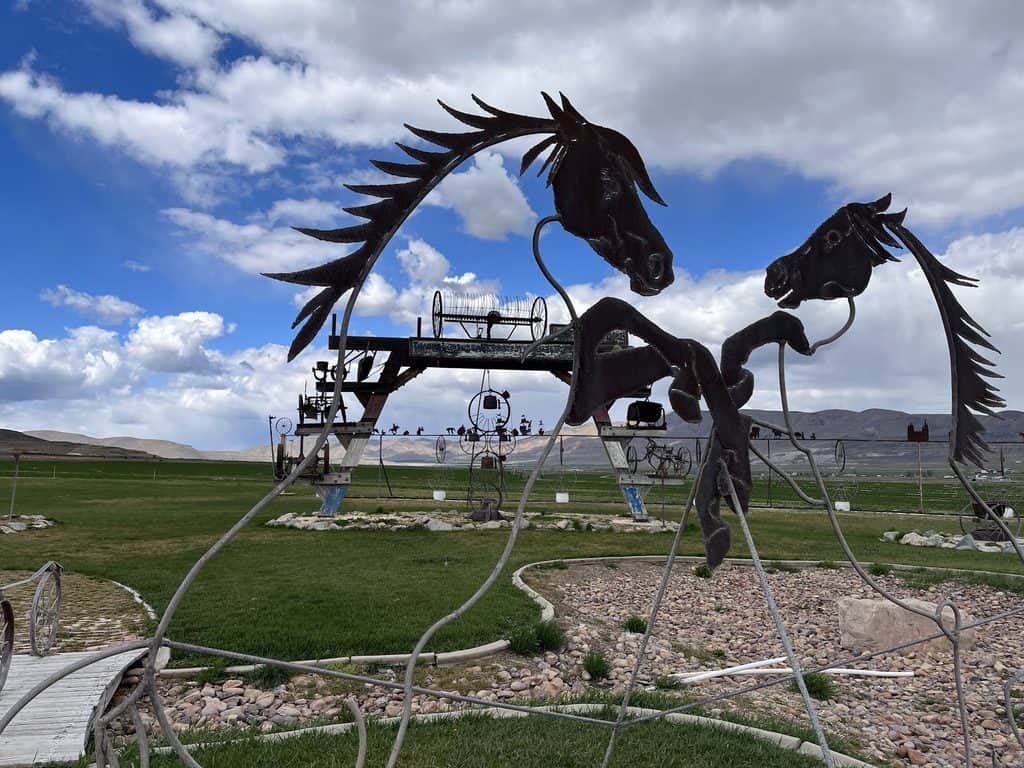
Blink, and you’ll miss it—stop, and you’ll be wandering for at least half an hour, exploring this built-from-scratch folk sculpture site. Created by late Tremonton resident Boyd Marble, the Western Theme Park, or Marble Park, tells the story of the American West with larger-than-life sculptures of cowboys, pioneers, and horses welded from discarded materials.
Marble began creating the park in 1990, starting with nothing but an old gravel pit, because he decided he needed a hobby. He began attending auctions to gather materials, including old farm equipment, barbed wire, and even larger pieces, including an old railroad trestle that became an archway.
Horses are the park’s most dominant theme. Marble told the “Herald-Journal” in 2002 that was because they “had a big part in pioneer work, they helped make it more comfortable living. That one over there is made out of barbed wire, which is significant of the pioneer era. Barbed wire came with homesteading.”
5. Mars Desert Research Station
Location: Hanksville, UT 84734
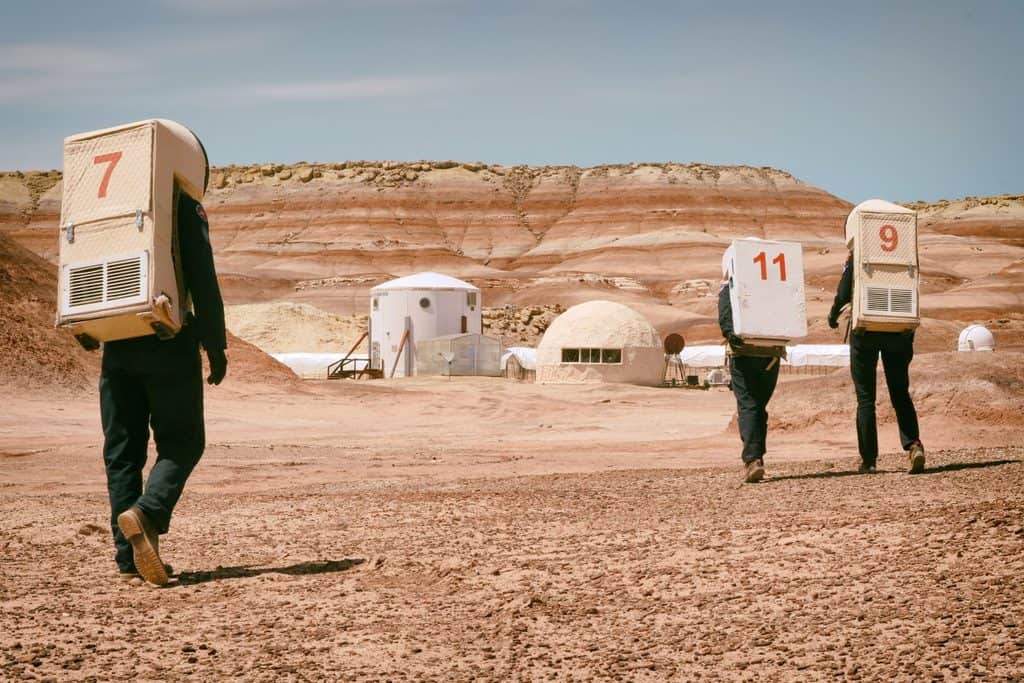
The Mars Desert Research Station, operated by The Mars Society, is a “space analog facility” for students and student scientists. Because Southern Utah is about as close to Mars as you get on Earth, they come out to the desert to simulate what a Mars landing might entail.
As Mars Society notes on its website, the Desert Research Station “is a private research facility, and is not open to visitors. People are allowed to pass the campus from Cow Dung Road, and are welcome to stop and park where allowed, and view the station from that spot.”
But it’s a heck of a photo op—the campus includes the “Robotic Observatory,” “habitat,” for housing crew members; the “GreenHab,” a hydroponics station; the “Science Dome,” a laboratory; and the “RAMM” or Repair and Maintenance Module, where rover repairs are done.
6. Rocket Garden
Address: 9160 UT-83, Corinne, UT, 84307
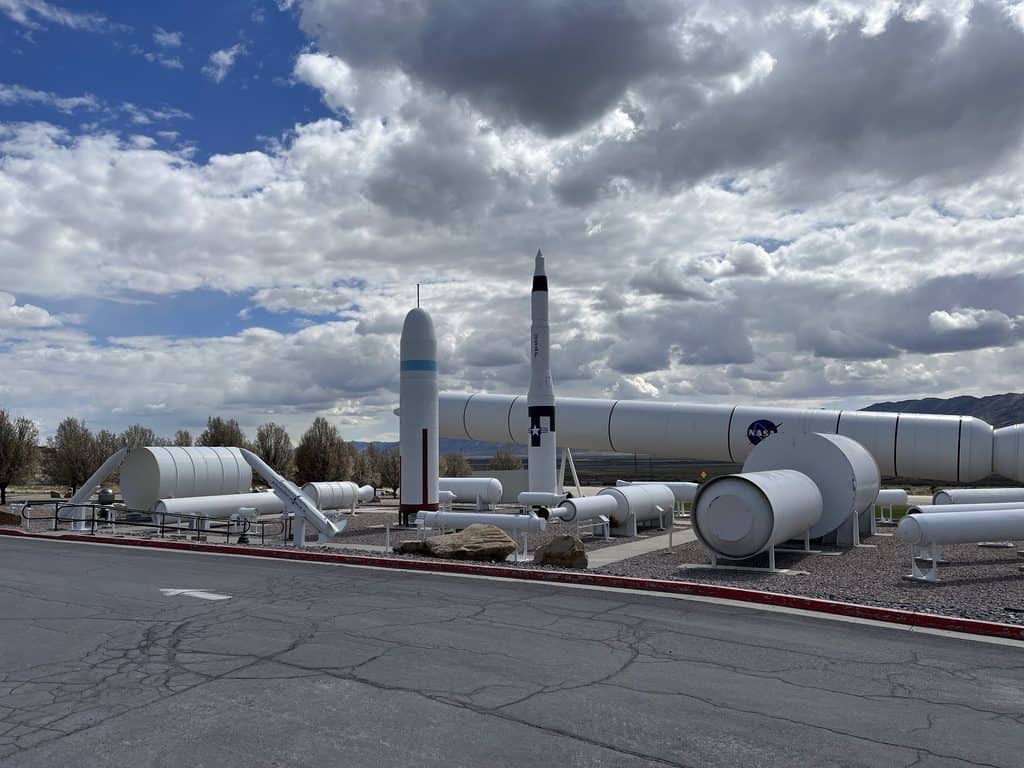
Located a few miles from the much-less-quirky Golden Spike National Historic Park, the Rocket Garden sits in front of the corporate headquarters of aerospace and defense contractor Northrop Grumman (formerly ATK Orbital Sciences, and before that, Morton-Thiokol, notoriously the company linked to the “Challenger” space shuttle disaster).
The garden is a sort of outdoor aeronautics and missile museum; structures on display include a variety of military missiles, including a Minuteman, a Trident C-4, an AIM-4 Falcon, an AIM-9 Sidewinder, Maverick missiles, high-velocity Loki rocket motors, a Matador guided missile booster, and components of a space shuttle rocket booster.
7. SUMMUM Pyramid
Address: 707 Genesee Ave, Salt Lake City, UT 84104
In 1975, an LDS bishop named Coky Newell claimed that, while meditating in his basement, he was contacted by highly evolved interdimensional beings called the Summa Individuals. They mentally downloaded information that became the basis of the new religion Newell founded, Summum, which was inspired by both ancient Egyptian practices and Gnosticism.
After changing his name to Corky Ra (or Summum Bonum Amen Ra), he built a pyramid-shaped church on Salt Lake’s west side, where members have meditated, made wine, and listened to lectures for more than 50 years.
Corky Ra died in 2008, but the Summum pyramid is still standing—at least for now. Like many historic buildings in rapidly growing Salt Lake, it is being threatened by the rapid construction of high-rise apartment buildings. Members of the public can attend lectures at the pyramid on the second and fourth Wednesdays of each month at 7 p.m., but since space is limited inside the sanctuary, reservations are required.
8. Tree of Utah
Address: PCMW+7X, Greenhaven, UT 84083
Completed by Swedish artist Carl Momen in 1986, “The Tree of Utah (Metaphor)” has definitely caused some rubbernecking on Interstate 80. Located in the middle of the sparkling but very desolate Bonneville Salt Flats, the 87-foot-tall structure suddenly appears in the landscape like something out of a Dr. Seuss pop-up book.
The sculpture was made with 225 tons of cement, and the spheres atop the trunk are studded with thousands of ceramic tiles as well as rocks and minerals native to Utah. If you pull over to take a closer look, you can also see the dedication plaque, which describes the tree as “a hymn to our universe, whose glory and dimension is beyond all myth and imagination”—a quote from Schiller’s “Ode to Joy,” an emotion this surprising sight has definitely evoked for travelers.
9. The UP House
Address: 13222 S Herriman Rose Blvd, Herriman, UT 84096
In 2011, custom builder Bangeter Homes received permission from Disney to re-create the house in the animated Pixar feature “UP,” and built “The Real-Life UP House.” Everything about the house is exact to the film, other than the fact that it’s still firmly attached to the ground. The 2,800-square-foot house was recreated down to the interior furnishings, including Carl and Ellie’s armchairs.
The house is currently occupied by a family, who have given passersby permission to take photographs of the exterior of the home, so long as they do so respectfully and keep the visits to five minutes or less. You can also reserve a tour of the home for a fee by reaching out to homeowner Lynn Hamblin; more details are available on Hamblin’s Instagram and Facebook.