The history of HALL Park (+ the top 7 sculptures you’ll find there)

Spanning 162 acres, there’s plenty to see at HALL Park, including hundreds of impressive sculptures and works of art from local and national creators.
HALL Park in Frisco has undergone a $7 billion, multi-phase redevelopment, though its beginnings are far more modest. Developer Craig Hall bought the 162-acre plot of land in 1989. Back then, Frisco was a Dallas suburb with only about 6,000 residents. But Hall believed the area was ripe for growth, and he set out to build a park to serve the soon-to-be-bustling community and offices occupying the space.
Ground broke on the first office building in 1997. By 2007, another 11 buildings had joined the space, spanning 1.8 million square feet. That first decade is also when the Texas Sculpture Garden launched; it’s the largest private collection of contemporary Texas sculpture that the public can view.
Hall saw that office parks were trending downward, so he turned to mixed-use development ideas. He planned to launch the redevelopment in April or May of 2020—that idea got shelved as the COVID-19 pandemic shut everything down. However, Hall stayed true to his vision, even if plans changed a bit during the wave of uncertainty. Finally, ground broke in October 2021.
The redevelopment over the past few years has included the opening of The Monarch, HALL Park’s 19-story, 214-unit luxury residential tower; a new 16-story trophy office tower; a 10,000 square-foot eatery within a boutique hotel and suites; and Kaleidoscope Park, a new addition with an enormous net aerial sculpture by Janet Echelman, fittingly called “Butterfly Rest Stop.”
Today, Frisco has a population approaching 250,000 people—and HALL Park is a highlight of the city.
The artwork of HALL Park
The most notable feature of HALL Park is its extensive collection of artwork. You’ll find more than 200 pieces across the park.
While HALL Park spans several blocks, the Texas Sculpture Garden sits on four acres at the park’s entrance. The garden showcases pieces by Texas artists and features an outdoor area with walking trails, lakes, and other distinctive landscaping. The 6801 Gaylord Parkway Building hosts additional works of art indoors.
If you’re heading to the park, it’s worth downloading the Otocast app as a guide. There are voice notes from the artists and curators offering insight into what you’re seeing. Just as importantly, the app provides a handy map to help you get around. Of course, stumbling across sculptures can be a good time, but a little nudge in the right direction doesn’t hurt.
In the meantime, let’s go on a tour of some of the top sculptures in HALL Park.
“Dancers MM” by Jerry Daniel
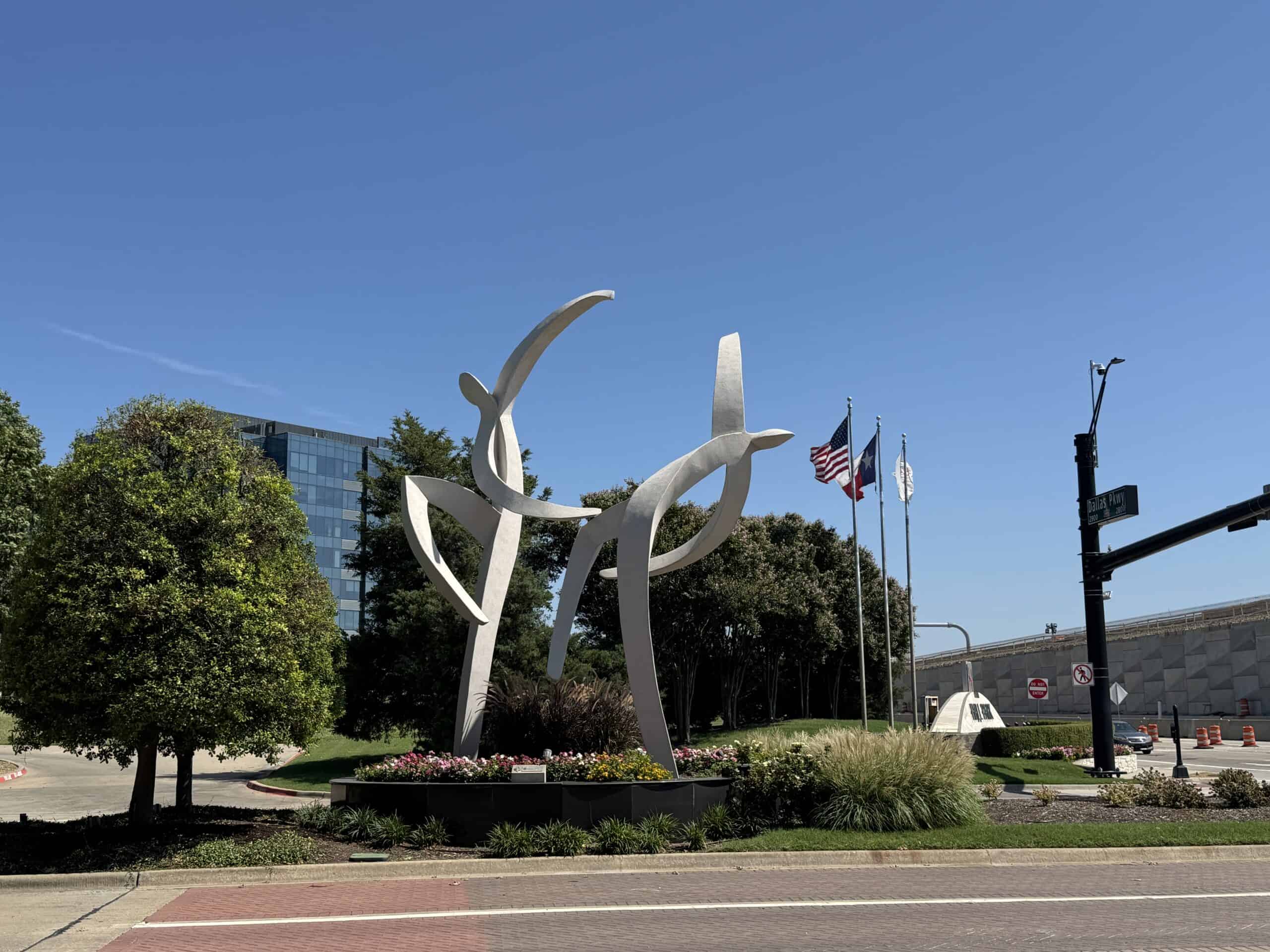
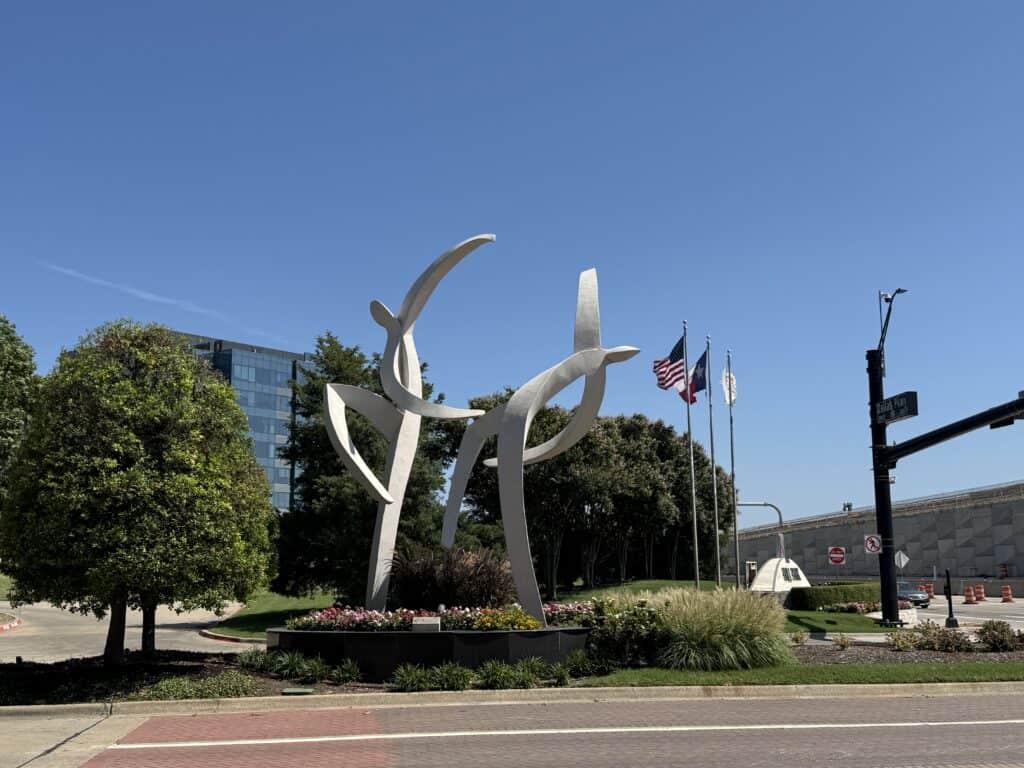
This pair of sculptures is hard to miss, as it serves as the entry to HALL Park. Artist Jerry Daniel was building a 12-foot-tall dancer sculpture when fellow artist Richard Hunt and Craig Hall, the namesake of HALL Park, visited his studio. They liked what they saw but suggested Daniel could make it even bigger. He took their advice, and the final sculpture bloomed into 30-foot-tall dancers. The latter part of the name “Dancers MM” indicates the year the sculpture was finished. Back in 2000, you could boogie down to NSYNC’s “Bye Bye Bye” or Mya’s “Case of the Ex.” Quite the tonal shift from the current era of Sabrina Carpenter and Teddy Swims!
“Time Management” by Zad Roumaya
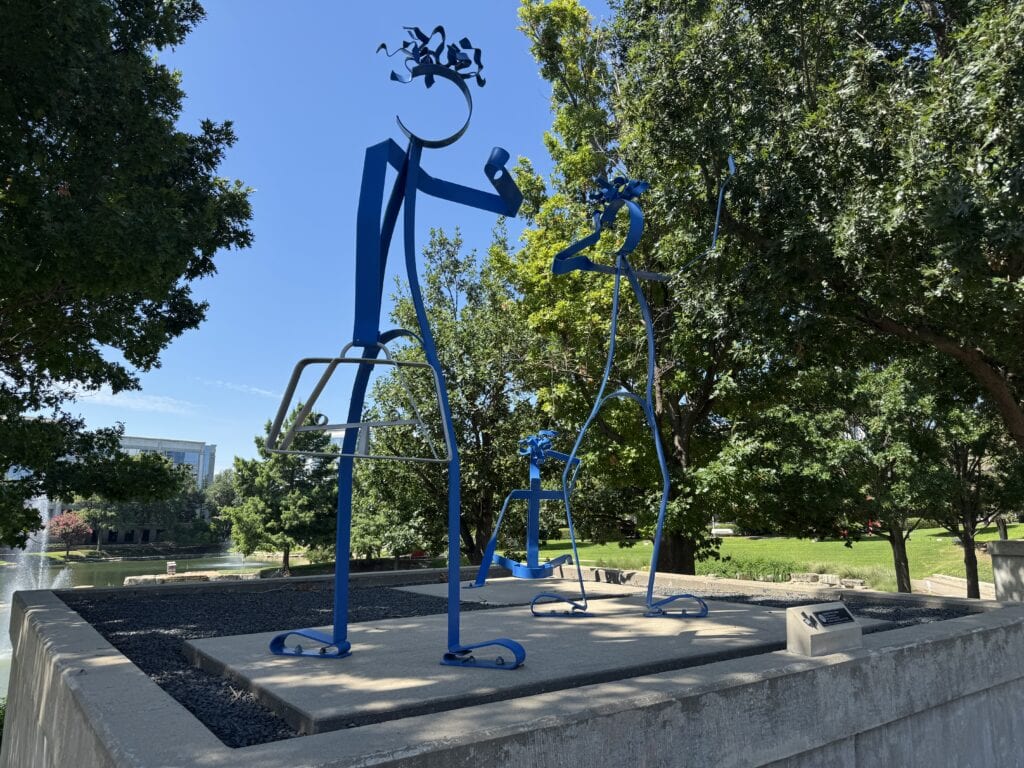
Dallas artist Zad Roumaya created “Time Management” as a critique of the hustle and bustle of the world. The sculpture features three whimsical figures going about their days. One is holding a briefcase and checking its watch; another appears to be chattering away on its cell phone. The third is simply relaxing, seated on a ledge and gazing out at the lake. As art curator for the Texas Sculpture Garden at HALL Park, Patricia Meadows says, “All of us have the challenge of managing our time and tasks. Which one of these figures best describes your method of dealing with your day? For me, I like the guy who’s looking at the water.”
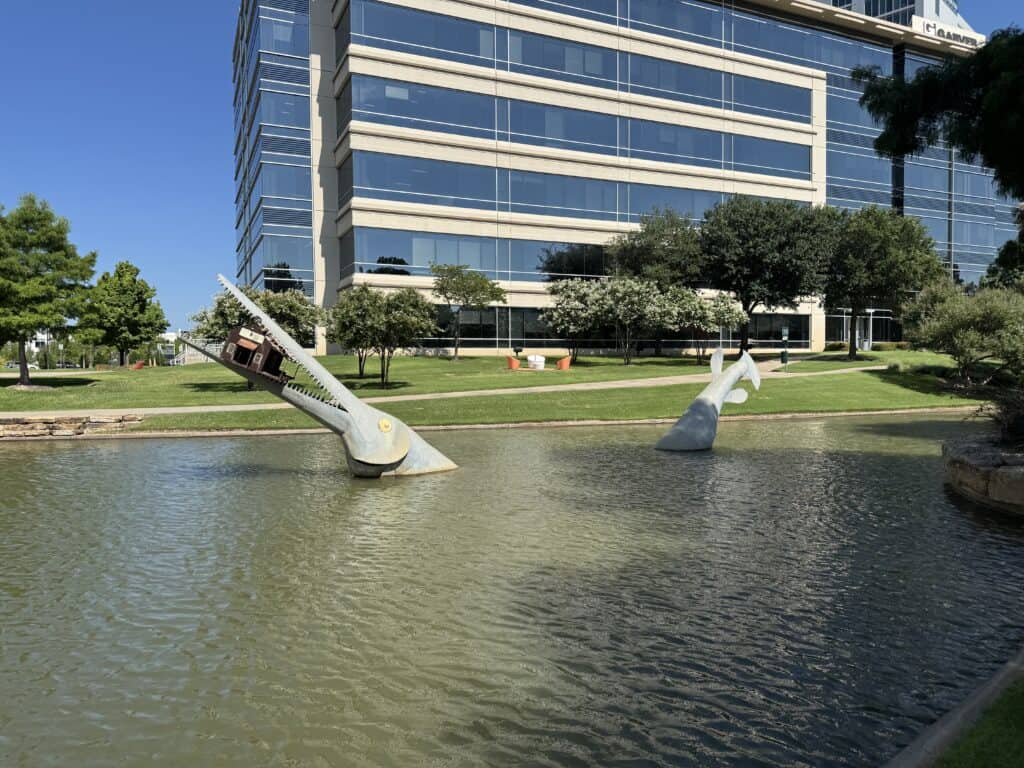
“The Headlines Screamed: Bait House Disappears Without a Trace” by Joe Barrington
Sculptor Joe Barrington grew up working in his father’s welding shop, learning the skill at a young age. He prefers working with welded steel and often incorporates humor and experiences of his West Texas childhood into his work. Perhaps there’s no better example of this than “The Headlines Screamed: Bait House Disappears Without a Trace.” This work shows a garfish with a seemingly endless number of pointy teeth emerging from the water to snatch the titular bait house out of the air. The sculpture utilizes the water to excellent effect; this one will definitely make you stop in your tracks. Keep an eye out for some of Barrington’s other animalia works, including “Roadrunner” and “Horned Toad.”
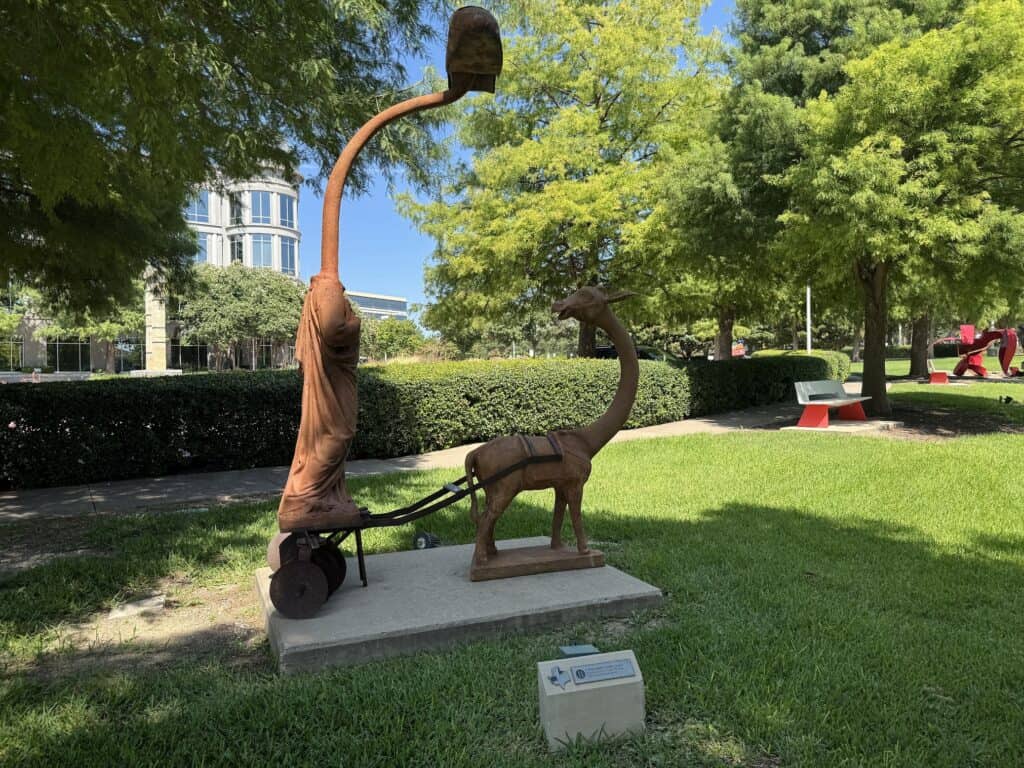
“Reincarnation of Farmer Bradly” by T. Paul Hernandez
Many of the sculptures at HALL Park allow you to walk fully around them, giving you a 360-degree view of their beauty. T. Paul Hernandez’s “Reincarnation of Farmer Bradly” is one of those works where you can capture a new perspective depending on where you’re standing. As Hernandez describes his work: “Gian Lorenzo Bernini rising from the grave to redesign ‘Pee-wee’s Playhouse’ under the direction of author Zora Neal Hurston.” This piece showcases a mule licking the wounds of Farmer Bradly, the two companions becoming equals. Hernandez lives and works in Austin and is also a tenured professor at Texas Lutheran University in Seguin. He’s also spent a considerable amount of time in Louisiana, and the state features prominently in his work.
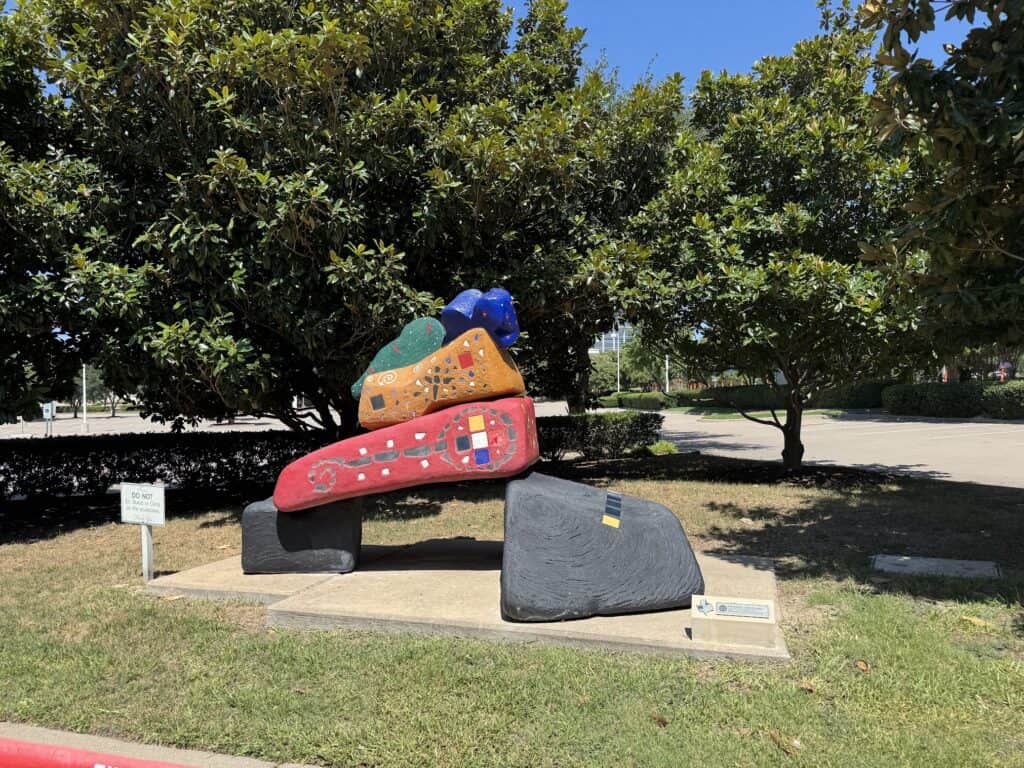
“Quanta: Celtic Spirit Catcher” by David McCullough
Should you prefer to get more hands-on with your sculptures, David McCullough’s “Quanta: Celtic Spirit Catcher” is designed to be touched. It’s got several tactile experiences alongside its vibrant array of colors. The dolmens—the megalithic tombs across Europe and the United Kingdom—inspired this work from McCullough, though his is far more colorful. He used cement and acrylic technology with watercolor paints. And because of the drying time of his work, McCullough typically works to music. He encourages viewers to approach “Quanta” like it’s a jazz poetry experience.
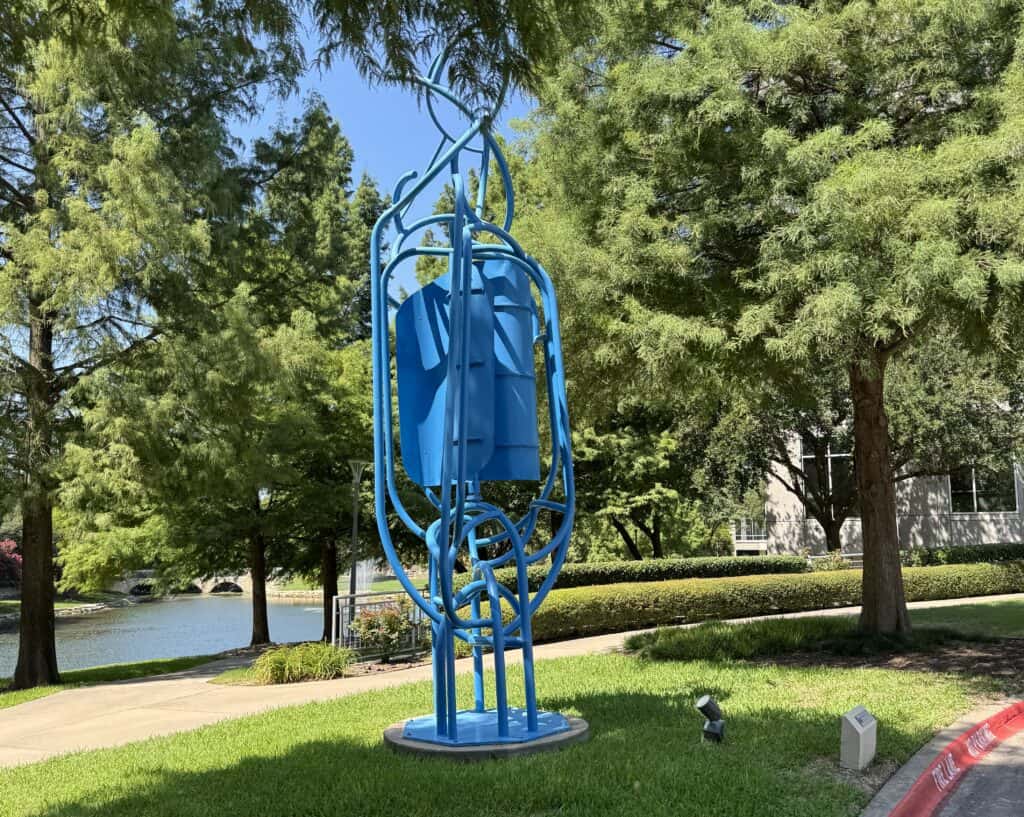
“The Wiz” by Art Shirer
Do you think that being named Art increases the chances of a child becoming an artist? Perhaps that’s not always the case, but Art Shirer has certainly made an impressive career for himself. He’s been making art since 1971 and has worked from a studio in Dallas since 1985. Inspired by his nuclear engineer dad tinkering in the basement to create new things, many of Shirer’s works have included kinetic energy and movement. “The Wiz” is no exception; it’s Shirer’s first attempt at a wind-powered sculpture on a larger scale. Impressive at any time, the sculpture is particularly frenetic on a windy day.
“Tar Roses” by Dennis Oppenheim
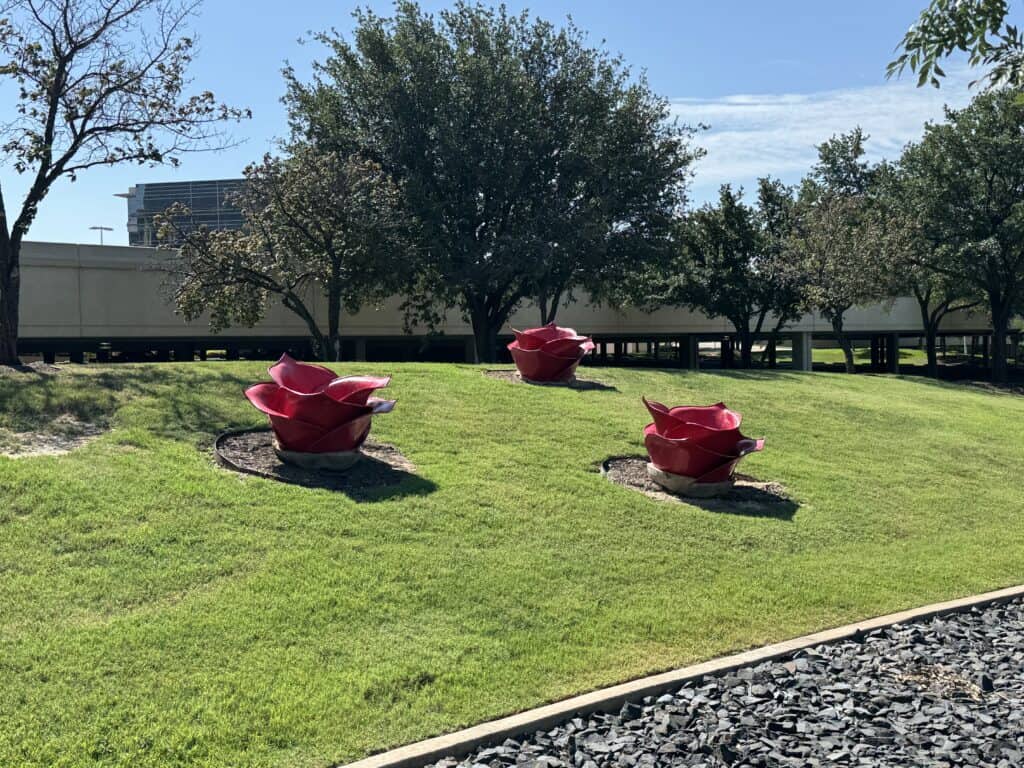
Dennis Oppenheim grew up on the West Coast, although he spent much of his career living and working in New York City. He was part of the rebellious East Coast contemporary art scene, constantly experimenting with materials, themes, and direction. With “Tar Roses,” he traded in his usual industrial art vibes for rose buds about to bloom. The roses are made from painted fiberglass on a concrete base. Over the years, the sun began to deteriorate the roses—much like it does with Texas plants—but Oppenheim never wanted to update his work. Luckily, a Texas sculptor named David Iles restores the work annually, so the roses continue to shine.