Historic Westside Las Vegas survived and thrived despite segregation and neglect. Now it’s undergoing a Renaissance as a Vegas landmark and cultural hub.
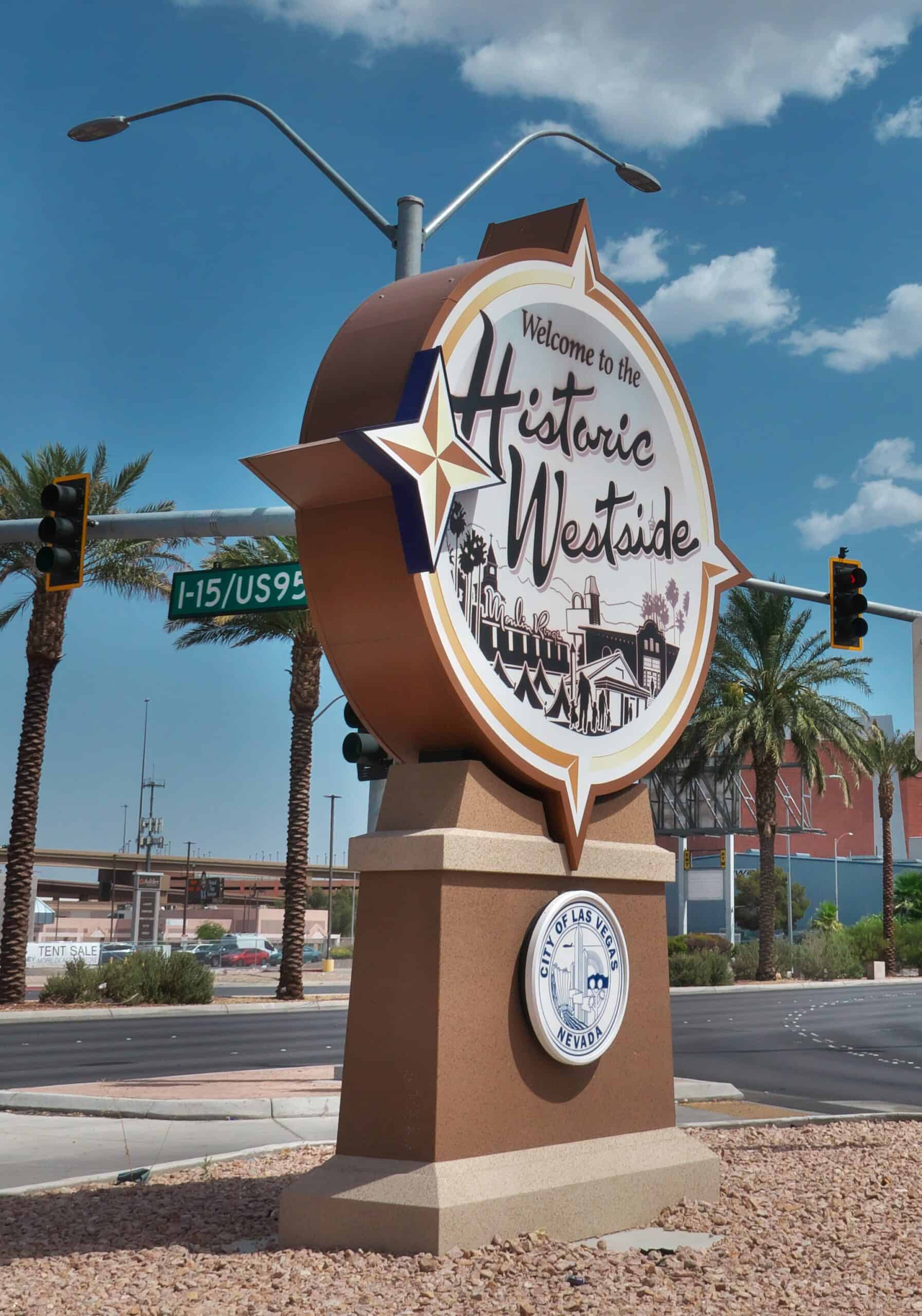
Historic Westside Las Vegas, or the Westside, originated in 1905 as a small townsite west of the railroad tracks in Downtown Las Vegas. But when gambling was legalized in 1931, the neighborhood came to symbolize segregation in Sin City, separating the Black community from the glitz and glamour of the Las Vegas Strip.
A thriving “city within a city,” the Westside (bordered by modern-day Carey Avenue, Bonanza Road, I-15, and Rancho Drive) has a rich heritage as a resilient and self-sufficient community and cultural hub, playing a vital role in the Civil Rights movement of the 1960s, with residents fighting for their rights for decades.
Today, the area is undergoing a renaissance, thanks to the community-led Hundred Plan (Historic Urban Neighborhood Design Redevelopment), with millions of dollars invested in renovations and additions by the City of Las Vegas, UNLV, federal agencies, developers, nonprofits, politicians, and local partners.
Here’s a brief look at the history of the Westside and its significance to the past, present, and future of Las Vegas.
Location. Location. Location.
Civil engineer John Thomas (J.T.) McWilliams caught the real estate bug while mapping a possible stop in Las Vegas, along the Union Pacific Railroad in the early 1900s.
In 1904, he purchased 80 acres of unclaimed land, now known as Historic Westside Las Vegas, which was located about a half mile west of the proposed railroad tracks.
The land to the east, now Downtown Las Vegas, belonged to Senator William A. Clark, majority owner of the San Pedro, Los Angeles, and Salt Lake Railroad (SLR). He acquired his ranchland from local postmaster and ranch owner Helen J. Stewart in 1902.
Las Vegas was already a water stop for wagon trains thanks to a nearby natural spring-fed creek (the site of the modern-day Springs Preserve). It’s the same creek that hydrated indigenous tribes, 19th-century explorers, and early Utah missionaries.
By 1905, McWilliams’ Townsite was the area’s first business and residential development, with more than 1,000 railroad workers and miners calling it home, and several small businesses, such as bars, restaurants, and banks.
In May of that year, however, Clark auctioned off his land, officially creating a townsite on the east side of the tracks. Since he also owned rights to the creek, he established the Las Vegas Land and Water Company, thereby controlling water distribution.
The McWilliams’ Townsite had thrived, but the population dwindled with the promise of amenities and infrastructure from the east, and a massive fire a few months later. The majority of the remaining Westside residents and businesses moved to the east side of the tracks.
Private developers, the City of Las Vegas, and individual property owners now share ownership of the land.

A forced reversal.
African Americans primarily began arriving in Las Vegas in the early 1900s, working to construct the railroad and later the Hoover Dam. But the city’s first Black resident, a ranch owner named John Howell, dates back to 1870, according to the City of Las Vegas.
The PBS series American Experience reports that the Las Vegas African American community remained small, peaking at about 178 before the opening of the Basic Magnesium plant in 1943.
Systematic racism and white supremacy simmered nationwide during this post-Civil War era, leading to dehumanizing laws for black communities in the South, economic oppression, segregation, race riots, and lynchings, particularly during the Great Depression.
African Americans were prohibited from living in Boulder City, despite working on the dam, and even getting hired at the dam took action from the National Association for the Advancement of Colored People (NAACP) and the U.S. President. But there weren’t any segregation laws recorded in Las Vegas before the legalization of gambling in 1931.
Then, under Las Vegas Mayor Ernie Craig, city officials stopped reissuing licenses to black businesses downtown, forcing them to operate west of the tracks. Black people, many of whom originally owned land downtown, were permitted to entertain and work in the casinos (mostly back of house), but were no longer allowed to live in or patronize the area.
According to the state tourism bureau Travel Nevada, Las Vegas became so segregated that it was known as the “Mississippi of the West.”
A small win.
When the black community was ushered to the Westside in 1931, the small white community still living there showed its true colors. They put together a zoning petition to prevent Black people from settling in their neighborhoods.
The Black community pushed back, writing a letter to city commissioners, signed by the Las Vegas Colored Progressive Club, and the zoning petition was ultimately declared Unconstitutional.
The Westside pulls itself up by the bootstraps.
While tourism was booming on the east, the Westside’s new residents didn’t have paved streets, running water, or working sewage lines. They had to petition for these commonplace amenities, only beginning to receive services in 1944.
Despite this, the Black community was pretty much self-sustaining. By that time, the area was home to more than 3,000 African Americans from all over the U.S. Some held jobs outside their community, with Herman Moody making history when he was hired as the first Black police officer in Las Vegas in 1946. Others developed a Westside business district with dry cleaners, restaurants, barbershops, beauty shops, cab companies, bakeries, and entertainment venues, primarily along Jackson Avenue.
The fabulous Westside Strip.
Black entertainers like Sammy Davis Jr., Nat King Cole, Lena Horne, and Pearl Bailey were among the headliners drawing audiences on the Las Vegas Strip, yet were barred from staying in the resorts—forced “to leave through the kitchen with the garbage,” as Davis Jr. once put it, to find lodging on the Westside.
The historically-designated Harrison House (originally Harrison’s Guest House) on F Street is the first and only known surviving example of a Westside boarding house. Genevieve Harrison opened it in 1942 to accommodate the performers.
Along with staying in the Westside, many of the performers hung out and played in the neighborhood venues. Some of these venues included Smokey Joe’s Club Alabama, The Brown Derby, Cotton Club, and Harlem Club. Jackson Avenue became known as The Westside (or Black) Strip.
A couple of major developments.

With a growing population and a lack of enough housing, 1954 brought the Westside’s first housing development, Berkley Square. Named for its African American financier, Thomas Berkley, the homes were designed by African American architect, Paul Revere Williams.
By the time the $3.5 million Moulin Rouge resort opened at 900 West Bonanza in May 1955, Las Vegas was home to more than 15,000 Black people–about 10 percent of the entire population.
The Moulin Rouge became the first integrated casino in Las Vegas with A-list performers and well-paying, visible jobs for Black people. It opened to fanfare, appearing on the cover of Life magazine in June 1955. After their shows on the Las Vegas Strip, white performers such as Frank Sinatra, Judy Garland, George Burns, and Jack Benny swarmed to the integrated hotel to continue their acts.
Though it went bankrupt only six months after opening, the excitement sparked a resurgence of energy on the Westside and helped smooth the coming transition to integration.
A movement for equality begins.
As African American entertainers began to stand up for themselves and demand the same privileges as white performers, the NAACP provided Las Vegas leaders with a 30-day ultimatum. The NAACP would stage a citywide protest unless the city desegregated.
A desegregation agreement was made in 1960, one day before the ultimatum’s deadline at the now-defunct Moulin Rouge. It allowed African Americans equal access to dining, gaming, hotel rooms, and entertainment, though housing segregation continues.
Westside reaches its boiling point.
Westside residents played an active role in the Civil Rights movement, organizing for protests and demonstrations to end segregation and improve Black people’s lives. Dr. Martin Luther King Jr. visited Las Vegas to speak about the Civil Rights Act of 1964 at a banquet for the Las Vegas chapter of the NAACP (established in the 1920s).
In 1968, the NAACP, the League of Women Voters, and other civil rights leaders sued the Clark County School District for intentionally maintaining racially segregated elementary schools.
Racial tensions came to a head with race riots in 1969 when police arrested two brothers for seemingly unjust reasons. A riot broke out, culminating in the arrest of 200 people, two deaths, and hundreds of injuries. A curfew was imposed in the Westside and enforced by the National Guard for four days, after which everything returned to “normal.”
In an article in the UNLV News Center, professor Tyler D. Parry explains that the riot was “the conclusion to a decade that exposed the false promises of many political leaders. It showed how people living in the post-Civil Rights era remained dissatisfied with the lack of progress and demanded the government’s attention by openly resisting police brutality and systemic racism.”
In 1971, the NAACP sued unions and hotels in Las Vegas and won, putting an end to housing segregation in Las Vegas and Reno.
A few steps forward.
There was some progress over the next 30 years, such as the launch of radio station KCEP Power 88 in 1972 and attempts to revitalize Jackson Avenue.
Sarann Knight Preddy, the first Black woman in Nevada to obtain a liquor license (1955), secured the Moulin Rouge’s spot on the National Register of Historic Places in 1992. Several fires led to the eventual demolition of the remaining structure. The signage is now prominently displayed at the Neon Museum in Downtown Las Vegas.
The Clark County School District attempted to develop a court-mandated desegregation plan in 1972 by busing white children to the Westside for sixth grade, while Black students were bused to white schools for the other 11 grades.
This Sixth Grade Center Plan ended during the 1992-1993 school year as Westside families boycotted in pursuit of neighborhood schools. CCSD then developed a plan that stopped the busing of white 6th graders, minimized bussing for Black elementary school students, and gave schools in the Westside extra assistance to help boost achievement, “an uphill fight,” according to an article in The Review Journal.
In a win for the Westside and Black Nevadans, former Democratic Assemblyman Wendell P. Williams co-sponsored a bill that made MLK Day a state holiday in Nevada in 1987. The annual MLK parade he started in Downtown Las Vegas a year earlier is now one of the biggest MLK parades west of the Mississippi.
A more diversified population.
The West Las Vegas population began diversifying in the 1990s and continued to change over the next 10 years, with Black people comprising just over half of the residents by 2000 and Hispanic people, 30 percent. By 2023, the Hispanic population had grown to 35 percent, according to KTNV Las Vegas.
Modern-day improvements.

At the top of the new century, there were plans to revitalize the area, but none materialized. In 2008, a divisive 1-15 freeway widening project reopened the wounds of segregation by blocking F Street and the Westside from downtown Las Vegas with a concrete wall.
It took six years of protests and a $13.6 million project to reopen the F Street underpass in 2014. It now reflects the name Historic Westside Las Vegas and is covered in historic murals.
The HUNDRED Plan was accepted by the City of Las Vegas in 2016, and plans to revitalize the area were finally realized. Based on input from more than 250 residents of the Westside, the plan outlines several desired programs and projects to address food insecurity and high unemployment levels while also improving the area and showcasing community pride and cultural heritage.
One of the first improvements was a $12.5 million restoration of the Historic Westside School. Opened in 1923 as Las Vegas Grammar School #1, it’s the oldest school in Las Vegas. It is now home to KCEP, the Economic Opportunity Board, the Nevada Preservation Foundation, and other nonprofits. A new $16.4 million, 15,000-square-foot Historic Westside Education and Training Center opened on the Historic Westside School campus in August 2025.
The Historic Westside Legacy Park opened in 2021. The park honors past and future leaders in the Historic Westside community. In April, the park will add Reverend Mary I. Carroll, Greg McCurdy, Alma Faye Hudson-McDonnell, Bishop Bill Herbert McDonnell, Jr., Sam Robertson, and Juanita Smith to its honorees.
In 2023, the Historic Westside opened a community-based urban agricultural farming facility at James Gay Park, named for James Arthur Gay III, a local Black leader who was fundamental in desegregating the Las Vegas Strip. Food grown there is distributed for free at farmers’ markets and through area senior and community centers.
In December 2025, theHistoric Westside opened the doors of the new West Las Vegas Library. The $40 million project more than doubled the size of the original library. It houses over 60,000 volumes of content as well as historical timelines and exhibits to honor the rich cultural legacy and heroes of the Historic Westside.
Several other projects are in the works, including:
- The Good Word Market Hall, a modern food hall and small business incubator that’s designed to support emerging entrepreneurs.
- shareDOWNTOWN Westside, a mixed-use development with housing and business space.
- The Lakemead Microbusiness Park, with retail, office, classroom, and business space.
- An African American Museum and Cultural Arts Center.
- Improvements for Ethel Pearson Park, named for an influential Westside leader known as “Mama.”
A trail of pioneering spirit.
Today, you can explore the Historic Westside on the Westside Historical Society’s Pioneer Trail, which takes you on a historical progression through sites pertinent to the Westside’s early days. The recreational trail begins at the Las Vegas Springs Preserve.