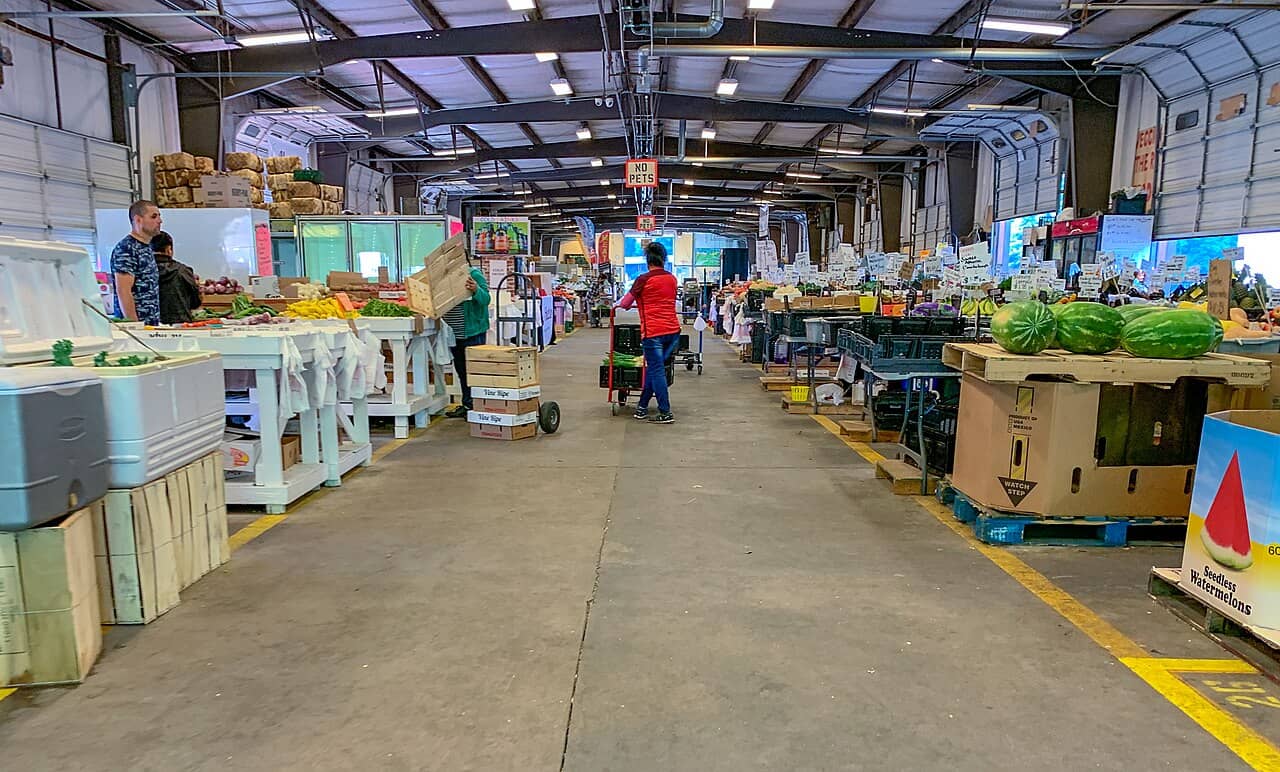
Read about the most underserved areas among North Carolina’s 353 food deserts and the steps community leaders are taking.
An estimated one-in-seven North Carolinians currently face food insecurity, a statistic that may worsen as the cost of groceries continues to rise. One food pantry in Cary, N.C. cited a “100% increase in applications and visitors” compared to last year.
Food deserts, or areas that lack access to affordable supermarkets with healthy food, can be a major driver behind food insecurity. The North Carolina Medical Journal reports that, as of 2019, there were 353 food deserts in the state alone.
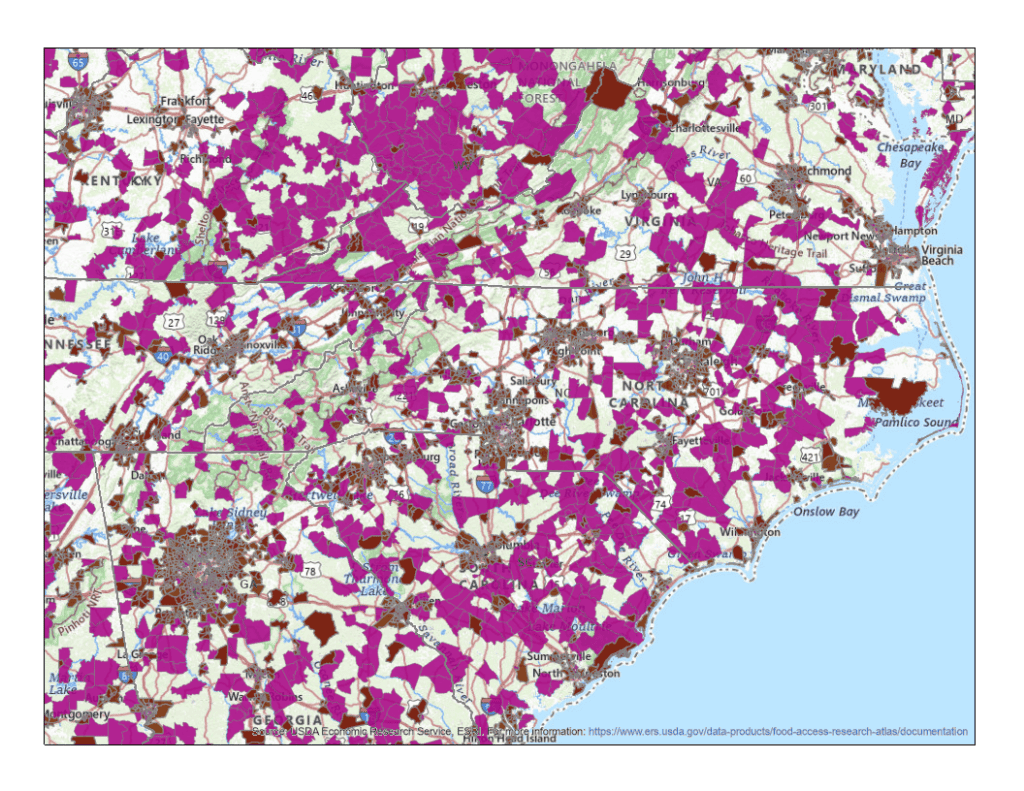
How food deserts are determined
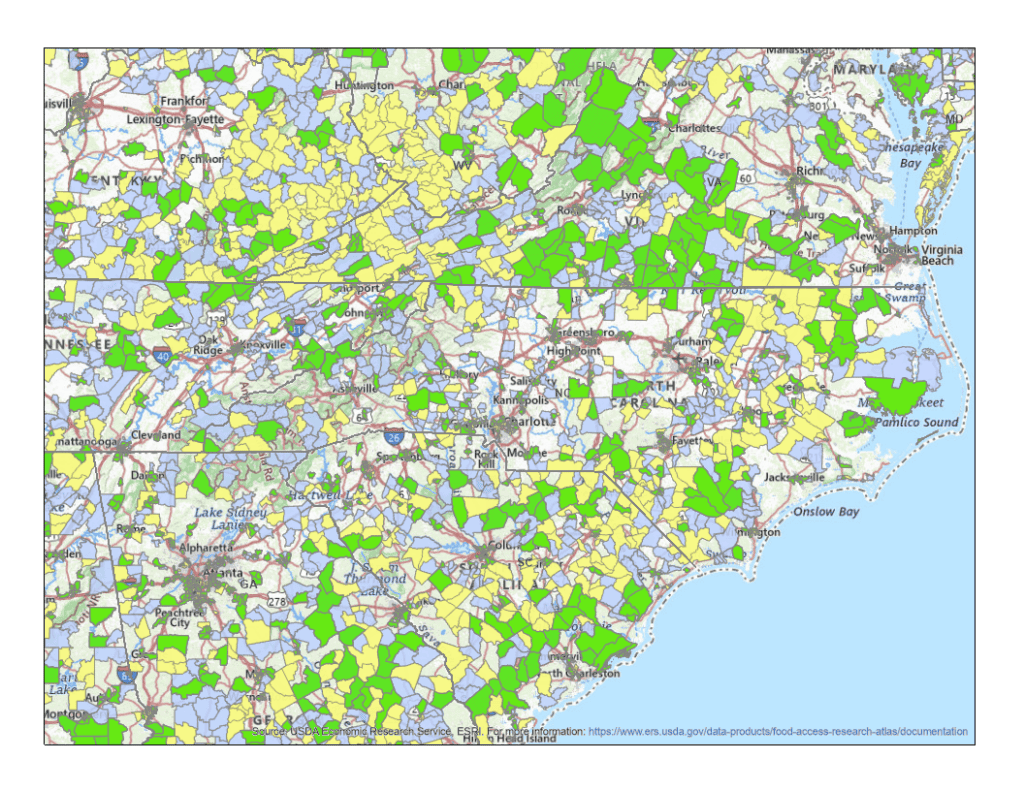
The USDA looks at census tracts, or county subdivisions with around 4,000 people, and deems areas that meet “low-income and low-access thresholds” as food deserts.
A low-income area is defined as having “a poverty rate of 20% or greater, or a median family income at or below 80% of the statewide or metropolitan area median family income.” Low-access is defined as “at least 500 persons and/or at least 33% of the population lives more than 1 mile from a supermarket (10 miles, in the case of rural census tracts).”
Food deserts can lead to unhealthy outcomes
According to N.C. State Extension, many areas that lack access to healthy food stores may simultaneously be food swamps, or areas with an abundance of fast food restaurants and smaller convenience stores that tend to carry ultra-processed food. This contributes to the fact that working-class people who live in low-access areas are more susceptible to malnutrition and obesity.
A study published in an August 2016 edition of the American Heart Association’s journal, Circulation, found a link between the density of healthy food stores around an individual’s home and subclinical atherosclerosis, or early stages of plaque formation in the arteries. Forsyth County, N.C. was one of the field sites that the researchers sampled in the study.
The study’s co-lead author Ella August explained the findings in a ScienceDaily article: “We found that healthy food stores within one mile of their home was the only significant factor that reduced or slowed the progression of calcium buildup in coronary arteries,” she said, adding that “Our results point to a need for greater awareness of the potential health threat posed by the scarcity of healthy grocery options in certain neighborhoods.”
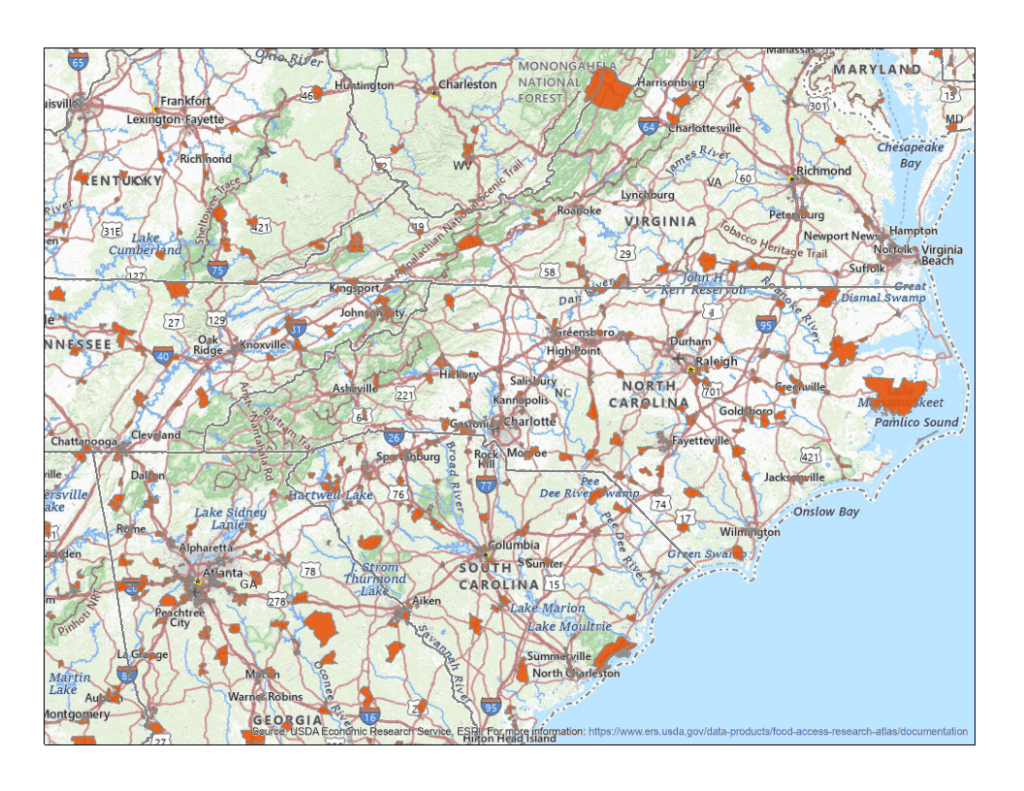
If you want to know where the state’s food deserts are located, you can view the USDA’s interactive Food Atlas Map. While N.C. has hundreds of food deserts, there are seven areas that are especially underserved.
1. Robeson County
With a 21.9% food insecurity index, Healthy Communities NC found that Robeson County had the highest level of food insecurity.
In 2021, the Robeson County Board of Commissioners signed a resolution to create a task force dedicated to addressing the systemic issues that are driving food insecurity. N.C. State University organized events in 2024 to address food deserts in Robeson, Bladen, and Columbus counties through its Visioning Our Food Future program.
Based on the research conducted by NCSU, the community-based program continues to increase access to healthy food in these counties and has created a “food system assessment and strategic plan.” This past April, NCSU Extension held another creative event to promote healthy lifestyles in Robeson Co. that involved creating strawberry smoothies by pedaling an indoor bike that powered the blender.
2. Cumberland County
Cumberland County has a 17.8% food insecurity rate. Out of the county’s 20 food deserts, 25% are in Fort Bragg, the largest Army installation by population.
According to CityView NC, the urban areas are food swamps, while the more rural areas are food deserts. The county’s 2024 Community Health Needs Assessment cited more than 92 fast-food restaurants per 100,000 residents, which is higher than the state average.
The Murchison Rd. area of Fayetteville has been considered a food desert since 2018 after the Walmart Marketplace closed down. According to city leaders, Walmart has also kept its lease on the building, which deters other supermarkets from moving in.
After winning a $100,000 grant as a part of the Healthiest Cities and Counties Challenge, local and county government officials are hoping to address food deserts like this. Through the grant, the county formed the Fort Bragg & Cumberland County Food Policy Council, which will implement policies recommended from assessments of the food landscape.
One recommendation came from Councilman Mario Benavente (District 3, Fayetteville), who proposed opening a co-op for the Murchison Rd. neighborhood so residents no longer have to commute to get groceries.
The public library is also addressing food deserts after recently launching the free Cumberland Cooks program that provides live cooking tutorials and samplings focused on cooking healthy, budget-friendly meals from local grocery stores. Nonprofit Er’Body Eatz hopes to encourage healthy lifestyles by offering farm-to-table meals, yoga lessons, and community gardens.
3. Edgecombe County
Edgecombe County has a food insecurity rate of 19%, making it the seventh-most severe food insecurity index in N.C. The Croatan Institute, which has partnered with the Healthy Food Access Mapping collaborative, analyzed data and found that only “20% of food retail locations sell fresh produce.”
University of North Carolina students interviewed residents in the region, including Edgecombe County resident Nell Burwell, who was concerned about the simultaneous lack of grocery stores and abundance of fried fast food. Ripe for Revival, a “pay-what-you-can” mobile market, helps address the issues surrounding the food swamp environment by bringing food essentials to Rocky Mount and Tarboro weekly.
Edgecombe County also participates in a statewide program called the Healthy Food Small Retailer Program (NC HFSRP), which provides government funding that corner stores can use to set up refrigeration, so they can stock fresh produce, meats, and dairy.
One qualitative study surveyed a focus group of area residents about the program. A local man was happy to easily access “healthier options” in one of the few stores in his town and was especially happy to be able to buy produce and alternatives to soda. An Edgecombe County woman was grateful that the corner store near her accepts SNAP/EBT, especially since her area is primarily lower-income.
However, affordability continues to be an issue. Wilma Void, a Nash County resident, compared prices of a pack of water bottles in her county versus Edgecombe. Void found that the same 24-pack she buys at Food Lion in Nash Co. for $1.99 is $2.49 at the Food Lion in neighboring Edgecombe County.
4. Halifax County
Halifax County has the second-worst food insecurity index in the state and a food insecurity rate of 20.1%. The Halifax County 2024 Community Health Needs Assessment cited food access and security as one of the top community needs after conducting an extensive analysis and survey of county residents.
Through the Roanoke Valley Community Health Initiative, the county hopes to support community gardens that promote healthy food. Multiple residents who participated in the focus group stated that high food prices, lack of nutrition education, and limited transportation options to get to supermarkets were major barriers to eating healthy food.
Ripe for Revival, the aforementioned mobile market, also serves Halifax County weekly. CEO Will Kornegay told WRAL that “40% of farmers’ crops are lost or left in the field,” and as a result, the food rots. He added that “one in eight families are food insecure,” a “paradox” he wishes to solve. The back of the mobile market now has a podcast studio that documents stories of people who live in food deserts.
The Healthy Food Access Mapping initiative also covers Halifax County and found that county residents “have the longest average travel time to a grocery store” at 22 minutes in the five-county region it covers. The County also participates in the NC HFSRP and was analyzed in the aforementioned study.
One area man interviewed in the study depends on rides to get groceries and said he was grateful to be only a 5-minute ride from a store where he could buy an apple. It previously took him half an hour to go to a store.
5. Forsyth County
Forsyth County has an overall food insecurity rate of 15.4%, but the county reports that Winston-Salem, the county seat, has 21 food deserts and is even “ranked seventh on a national list for food hardship.” As a result, Forsyth County started the “Healthy Communities” initiative to tackle the prevalence of food deserts.
Through the program, public gardens have produced more than 550 pounds of fruits and vegetables that have been donated to residents. As a part of the statewide program called “The Healthy Food Retail Designation,” several Forsyth County corner stores have also become certified as a “Healthy Store.”
Healthy Stores must carry “produce, whole grains, low-fat milk, items with protein, and water.” The stores must also honor SNAP/EBT and WIC.
6. Rutherford County
Rutherford County is located in the mountain region, and 18.6% of its residents face food insecurity. Fortunately, food insecurity has been on the decline in the county due to support from community organizations and food assistance programs.
But accessibility to grocery stores continues to be a problem in the rural area, as stores tend to be more spread out and there is a lack of reliable public transportation.
Data suggests that mobile markets and increased transportation options can help address this issue. Three-fourths of the county is covered by forests, while fruits and vegetables only make up 1.5% of the county’s crops. In 2023, the county’s Community Health Council hoped to offset this issue by providing grants to organizations that pledged a three-year commitment to grow a community garden.
7. Bladen County
Bladen County is a primarily agricultural area located in southeastern N.C. Despite peanuts being the county’s primary crop, 50% of the county’s census tracts are food deserts. With the county being the fourth-largest in land area, The Bladen Journal cites that residents often face difficulty commuting to the spread-out grocery stores.
While the county offers public transportation, you have to call to reserve a spot ahead of time, and the service only runs on weekday mornings and early afternoons. In 2024, NCSU researchers found that the county only had six grocery stores. They hope to increase access to healthy food through the Visioning Our Food Future program with farm-to-table initiatives, mobile food markets, and community gardens.
Food deserts also occur in urban neighborhoods
Several urban areas don’t rank as high overall in food insecurity, but have pockets of food deserts.
Charlotte’s Historic West End neighborhood has long been considered a food desert. Recently, CVS Health executives announced that they plan to invest $2 million into tackling the lack of access to healthy and affordable food.
One part of the investment is the West Side Wellness Collab, which will partner with food providers like Deep Roots CPS Farms, which already grows produce that it gives to seniors in the West End neighborhood.
Southeast Raleigh and Durham
Southeast Raleigh also faces a severe lack of grocery stores and healthy food options. According to Scalawag Magazine, the 27610 ZIP code, which is 64% Black, has 11 grocery stores for the area’s 78,475 residents.
There are several community-based initiatives that are trying to alleviate the issue, such as the Black Farmers Hub, Fertile Ground NC Co-Op, and Ripe for Revival.
According to Christ Central Church, Durham has four food deserts. The church created the Creation Care Ministry to address food insecurity issues through “urban farming and suburban gardening.”
A senior center in one of those food deserts stepped up to start a food pantry on their premises on Fayetteville St., with the help of the Durham Housing Authority and several partners. Community-centered grocery options also help tackle food deserts such as the Durham Co-op Market and the East Durham Market.
Duke Health screened patients in 2019 for “unmet health related social needs” and found food insecurity to be the number one issue. Since then, Duke Health announced that they will be partnering with local organizations to get healthy food into underserved communities across Wake and Durham counties.
The Durham County Board of Commissioners also approved a new project to create a 10-year plan to address food insecurity based on an initial analysis of production and distribution systems.
Greensboro and High Point
The Triad area faces increased food insecurity at “historic levels.” With the rising cost of groceries and changes to the SNAP program, recipients find their purchasing power declining and are increasingly turning to food pantries. Last year, Guilford County conducted a survey to ask residents about food insecurity issues in an attempt to address food deserts.
NC A&T University researchers also studied Guilford County to analyze factors that contribute to its prevalence of food deserts and found that “there were no significant designated lands for producing vegetables and fruits.” Moreover, with rising population growth, much of the remaining land is being developed for residential and commercial purposes.
Overall, the Greater High Point Food Alliance found that in 2025 there were seven food deserts in High Point and 17 in Greensboro. The organization hosts an annual Food Security Summit and provides grants to local groups who are directly tackling local food insecurity. Growdega, a mobile produce truck, is also addressing the issue by driving to High Point’s food deserts and especially helping SNAP/EBT recipients.
Statewide efforts to address food deserts and insecurity
- NC Institute of Medicine has outlined several goals as a part of the organization’s Healthy 2030 initiative, including increasing transportation options for rural and low-income communities, promoting nonprofit grocery stores in food deserts, and expanding “access to healthy foods in community-based settings such as schools and workplaces.”
- Nourish NC’s Backpack Program focuses on giving healthy food to children in food deserts.
- Students at UNC’s School of Government put together a public survey to better understand the issues that exacerbate food insecurity.
- United Healthcare will invest $100,000 in Ripe for Revival’s mobile markets to help tackle food deserts, with plans to expand the service to 11 markets that will serve over 30 sites weekly.
- National Gleaning Project partners with local gleaning organizations that send volunteers to “glean” or pick up excess crops that would otherwise rot and distribute them at no-cost markets.
For a list of some of the food banks in N.C., click on this link.
If you or a loved one is facing food insecurity and/or a lack of access to affordable grocery stores, call 211 to hear about resources such as local food pantries and soup kitchens.