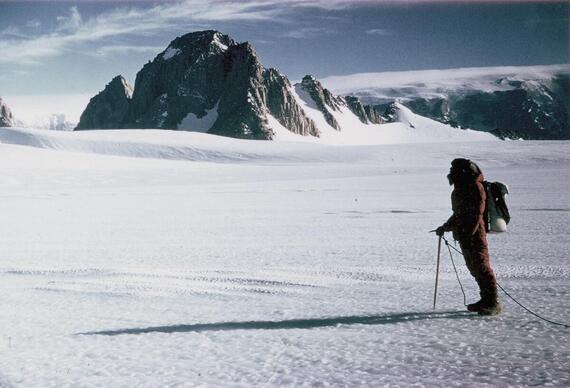
Wisconsin and Antarctica have more in common than just the cold winters, including a mountain range named for the state.
On first glance, there isn’t a lot that Wisconsin has in common with Antarctica, besides, maybe, the brutally cold winters. Dig a little deeper into the history and geography of the frozen continent, though, and some familiar names might pop up, as there are a few links between America’s Dairyland and Antarctica.
For more than a century, Antarctica has been explored and researched by scientists and explorers who have made scientific and geographic discoveries, including some who hail from Wisconsin or were funded by Wisconsin residents. They’ve left their mark by naming several of the continent’s features after themselves, or others, including some Wisconsin residents.
Between the mountain range named for the state, another range named for one of its most successful residents, and the numerous Wisconsin-based scientists who have gone on to research the continent, there are a shocking number of crazy connections that Wisconsin has to Antarctica.
What is Wisconsin’s connection to Antarctica?
One of the longest mountain ranges in the world, the Transantarctic Mountains run for 2,200 miles through Antarctica and separate East Antarctica from West Antarctica. Part of that lengthy range consists of the Horlick Mountains, a mountain group in the southern part of the range. The mountains were first discovered during Admiral Richard E. Byrd’s two expeditions to the continent, between 1933 and 1935, and run for 146 miles through the continent. The range was named for Racine, Wisc. resident and businessman William Horlick.
He’s not the only Wisconsin connection in the mountain range—the Horlick Mountains contain the Wisconsin Range. The range was first discovered and mapped by the United States Geological Survey, based on surveys and aerial photography taken by the United States Navy from 1959 until 1964. Altogether, the large mountain range covers approximately 3,300 square miles.
While it’s part of the Horlick Mountains, the Wisconsin Range’s name has nothing to do with the Racine resident. Instead, it was named by the United States Advisory Committee on Antarctic Names and is named in honor of the contributions the University of Wisconsin-Madison has made to Antarctic research.
In addition to the Wisconsin Range, the continent also features the Wisconsin Plateau, an ice-capped plateau in the Wisconsin Range, and the Wisconsin Islands, a group of islands located near the continent’s Trinity Peninsula, which were also named for the University of Wisconsin-Madison.
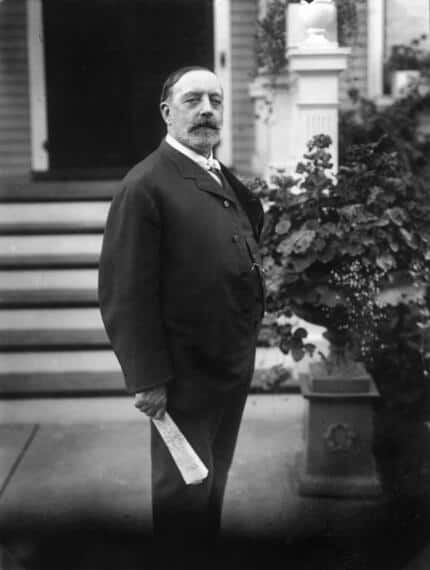
Who is William Horlick?
It makes sense if the Horlick Mountains sound familiar to Wisconsinites, especially Racine residents—they’re named for William Horlick, a food manufacturer who held the original patent for malted milk. Born in England, Horlick immigrated to the United States in 1869 and settled in Racine, Wisc. In Racine, Horlick started the Horlick Food Company with his brother, James, where they worked on creating a dried milk product, eventually creating malted milk. He served as the Horlick Food Company’s president from 1921, until he died in 1936.
Horlick wasn’t just one of the city’s prominent businessmen; he was also a philanthropist in Racine, gifting the city Memorial Hall, Island Park, Horlick Athletic Field, and a maternity ward wing at St. Luke’s Hospital. He was also a sponsor of the Racine Legion, a football team that played in the National Football League in the 1920s.
His philanthropy spread beyond Racine, though—eventually, to Antarctica. Although Horlick never traveled to Antarctica himself, he sponsored several expeditions taken by his friend, Byrd.
Why was a mountain range named for him?
It might seem odd that a mountain range in Antarctica was named for a Racine-based businessman living thousands of miles away. The mountain range, located near the South Pole in the Transantarctic Mountains, was discovered during the first two Byrd Antarctic Expeditions, between the years 1933 and 1935.
William Horlick was a supporter and funder of the expeditions, and in a show of gratitude, Byrd named the mountains for him, as well as a biplane used during the expedition. In addition to donating funds for the expeditions, Horlick also donated crates of Horlick’s Malted Milk to help feed the team of explorers.
Is there anything else named for Horlick?
While the mountain range in Antarctica is the largest thing named for Horlick, it wasn’t the only place that bears the malted milk patent holder’s name. Back in Wisconsin, Racine’s William Horlick High School is named for him.
The malted milk hot drink that the two brothers founded also shared the Horlick name until recently. The brand was first introduced in 1873, and Horlick’s was acquired in the United Kingdom by Aimia Foods in 2018 and acquired outside of the United Kingdom by Unilever in 2019.
What is the University of Wisconsin-Madison’s connection to Antarctica?
The research conducted by University of Wisconsin-Madison professors and students on Antarctica goes back decades and covers several different fields, including the study of glaciers and meteorology.
One of the earliest professors who pioneered studies on the continent was Dr. Werner Schwerdtfeger, who was already known for his Antarctic research before he started teaching at the university in 1963. A researcher of Antarctic meteorology, the field expanded throughout Schwerdtfeger’s tenure at the university. The school serves as the base for the Antarctic Meteorological Research and Data Center, which collects and archives data on the weather in Antarctica. The school is also home to the Antarctic Automatic Weather Stations Project, which operates and maintains more than 57 automated weather stations across the continent.
Several alumni and faculty members of the university have gone on expeditions to Antarctica as well, including former University of Wisconsin-Madison professor Charles Bentley, a glaciologist and geophysicist. The scientist, who was a professor emeritus at the university, went on an expedition across Antarctica in 1957, and has two Antarctic landmarks named for him: Mount Bentley and the Bentley Subglacial Trench.
How many Wisconsin scientists have worked in Antarctica?
Byrd wasn’t the only Wisconsin-connected person to make discoveries in Antarctica, and Horlick isn’t the only Wisconsin resident to have an Antarctic feature named for him. For decades, Wisconsin scientists, including groups from the University of Wisconsin-Madison, have been traveling to the continent and researching it. More than 37 different features of the continent, from islands to glaciers to mountain peaks, have been named for students and faculty members at the University of Wisconsin-Madison.
Is there any research currently being done on Antarctica by Wisconsin scientists?
For decades, students and faculty members at the University of Wisconsin-Madison have been researching Antarctica, and that’s still happening today. One of the most recent developments is the IceCube Neutrino Observatory. Located at the Amundsen-Scott South Pole Station, the observatory researches neutrinos, or minuscule particles with no electric charge and virtually no mass. By observing neutrinos, which work as a sort of telescope, the detector will help to monitor space from deep within Antarctic ice.
More than 350 people from 59 institutions across the world are collaborating on the observatory, but the University of Wisconsin-Madison is the lead institution and is responsible for the maintenance of the neutrino detector at the observatory.