Discover eight lesser-known facts about New Mexico’s Pueblo history, from ancient trade networks and archaeology to astronomy and tribal sovereignty.
New Mexico’s Pueblo communities have histories that stretch back centuries, with remarkable achievements in architecture, astronomy, agriculture, trade, and self-governance. While you’ve likely learned about Acoma’s famed Sky City, Taos Pueblo’s centuries of continuous habitation, the 1680 Pueblo Revolt, and the Three Sisters growing method, there’s considerably more to discover.
From archaeological evidence of ancient conflict and far-reaching trade networks to the science behind Chaco Canyon and the enduring symbols of tribal sovereignty, these lesser-known stories offer a deeper look at the people, places, and traditions that continue to shape New Mexico.
1. The Gallina mystery
Not every ancient community left behind a story of gradual migration or shifting agricultural practices. In northern New Mexico, the archaeological record of the Gallina people reveals something considerably more troubling.
The Gallina people lived in a remote region of what is now northern New Mexico between approximately 1100 and 1300 C.E. Archaeologists have documented unusual evidence of violence, including defensive settlement patterns, burned structures, and skeletal remains showing signs of violent injury. By the late 13th century, the region had been largely depopulated. What happened remains uncertain.
Researchers have considered warfare, internal conflict, and the possibility that surviving people migrated or were taken captive and incorporated into other communities. The archaeological evidence suggests that violence played a significant role in the region’s abandonment, but it does not provide a definitive explanation.
2. Spanish reconquest and Pueblo resistance
The Pueblo Revolt succeeded in driving Spanish colonizers out of New Mexico, but the victory didn’t mean the end of Spanish influence. In 1692, Spanish forces returned under Diego de Vargas, beginning the reconquest of the region. However, the relationship between Pueblo communities and Spanish authorities had shifted.
The years of Pueblo self-government—along with a well-maintained population that outnumbered the Spanish colonizers—had demonstrated the strength of resistance. Spanish authorities also faced the reality that maintaining control required cooperation with communities they had previously attempted to dominate. Following the reconquest, colonial policies shifted in some important ways. The encomienda system was not restored, and Spanish authorities made greater allowances for Pueblo religious practices, even as Catholic conversion and colonial control continued.
However, not every Pueblo community experienced the reconquest in the same way. Some resisted, while others negotiated or sought Spanish protection against competing regional threats. The history is more complicated than a simple return to the conditions that existed before 1680. The Pueblo Revolt did not permanently end colonization, but it fundamentally changed the relationship between Pueblo nations and the Spanish government.
3. Four canes of sovereignty
Santo Domingo Pueblo, now known as Kewa Pueblo, preserves four canes that represent 400 years of sovereignty. Under U.S. law, pueblos are sovereign, not ruled by the state. For the Kewa Pueblo, this sovereignty stretches beyond American rule.
Santo Domingo Pueblo traces its first cane of authority to 1598, when Spanish colonizers delivered canes on behalf of the Spanish crown. Mexico continued the practice after winning independence in 1821. In 1863, President Abraham Lincoln authorized a new set of silver-capped ebony canes. They were delivered to the Pueblos the following year as a sign that the United States, too, recognized their self-government.
Pueblos are represented by a tribal council, which controls how the land will be used; Santo Domingo oversees more than 96,000 acres. The canes show that this sovereignty predates American governance, representing a longstanding history of independence and resilience within the Pueblos.
4. DNA connection to Chaco Canyon
What if the story of an ancient community isn’t as disconnected from the present as researchers once believed?
A 2025 study examined ancient and contemporary DNA in collaboration with Picuris Pueblo. Researchers analyzed genetic material from 16 ancient individuals buried at Picuris and 13 living members of the community. The findings revealed genetic continuity between ancient and present-day Picuris people, as well as a close genetic relationship with individuals buried at Pueblo Bonito in Chaco Canyon. The collaboration prioritized tribal participation and control over genetic data, showing how modern scientific methods can complement Indigenous knowledge rather than simply replace it.
The study further provides scientific support for longstanding Picuris oral histories connecting the community to Chaco. Researchers also found no evidence of a pre-European population decline in the Picuris samples, challenging earlier interpretations of population collapse and migration in the region. The people of the area maintain a deep-rooted history, now further backed by science.
5. Ancient architecture aligned with the sky
Long before modern instruments made it possible to measure the movements of celestial bodies, ancestral Pueblo communities were observing the sky and incorporating astronomical knowledge into their architecture.
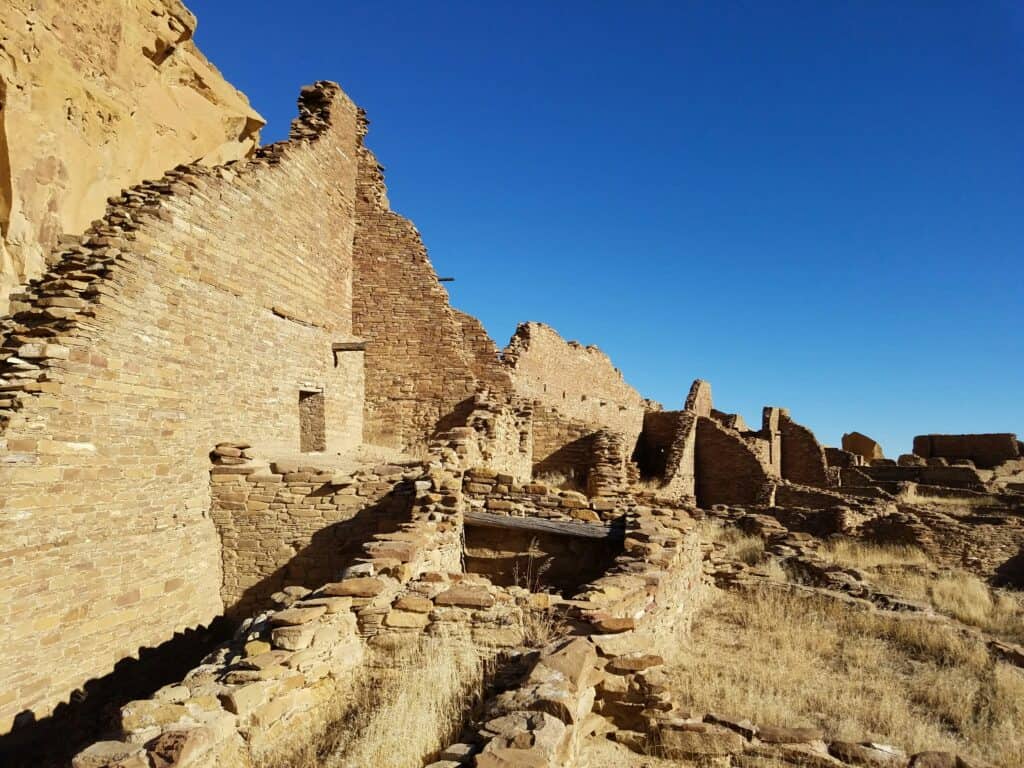
Between approximately 850 and 1250 C.E., Chaco Canyon became a major center of ancestral Pueblo life in northwestern New Mexico. Its monumental Great Houses, including Pueblo Bonito, demonstrate sophisticated planning, construction, and an understanding of cardinal directions. Archaeologists have identified deliberate north-south and east-west alignments in several structures, as well as relationships between buildings across the canyon.
One of the most famous examples is the Sun Dagger at Fajada Butte. Sunlight once passed through openings between sandstone slabs, creating moving beams of light across spiral petroglyphs. The patterns are associated with significant solar events, including solstices and equinoxes, and have become one of the best-known examples of archaeoastronomy in the Southwest. The precise purpose of every alignment remains a subject of archaeological discussion. Some researchers have also proposed connections to lunar cycles, including the 18.6-year lunar standstill, although those interpretations remain debated.
At Casa Rinconada, one of Chaco’s largest excavated great kivas, researchers have identified additional potential astronomical alignments. As research continues, more archaeoastronomy is uncovered, revealing a deeper understanding of celestial bodies than previously thought possible.
6. Pueblos don’t all speak the same language
New Mexico’s 19 federally recognized Pueblos share some cultural traditions, but each offers a diverse approach to community. One of the clearest examples of diversity is language.
The languages spoken among New Mexico’s Pueblos fall into three major linguistic groupings: Keresan, Tanoan, and Zuni. Keresan includes several distinct Pueblo language varieties, while Tanoan encompasses Tewa, Tiwa, and Towa. Zuni is its own language and is considered a language isolate, meaning linguists have not established a genealogical relationship between it and another known language family. The broader Pueblo world includes Hopi, whose language belongs to the Uto-Aztecan family. That brings the number of major language families represented across Pueblo peoples to four.
These languages are more than different ways of communicating. They carry cultural knowledge, place names, traditions passed between generations, and oral histories. Language preservation and revitalization remain important priorities for Pueblo communities today.
7. Ancient Pueblo trade networks reached into Mesoamerica
Ancient Pueblo communities weren’t isolated settlements tucked away in the desert. Archaeological discoveries show that their trade networks extended hundreds—and in some cases thousands—of miles across the Southwest and into Mesoamerica.
Excavations at Chaco Canyon and other ancestral Pueblo sites have uncovered materials that did not originate locally, including marine shells, copper bells, and scarlet macaw remains. Some of the macaws found at Chaco have been directly dated to between 900 and 975 C.E., providing evidence that long-distance trade routes evolved earlier than previously believed.
Turquoise was another important material. More than 60,000 pieces of turquoise have been recovered at Pueblo Bonito, suggesting that the stone played a significant role in ceremonial life and regional exchange. Researchers have also identified evidence of trade in cacao and other materials originating far beyond the northern Southwest. These discoveries challenge the idea that New Mexico was highly isolated, instead pointing to trade routes that spanned thousands of miles.
8. Pueblos are 19 distinct sovereign nations
There are 19 federally recognized Pueblos in New Mexico, and each is a sovereign nation with its own government, leadership, history, and unique cultural traditions. Although certain cultural connections are shared between the Pueblos, no two Pueblos are interchangeable. The languages, customs, political structures, and relationships with ancestral lands are distinct.
Today, Pueblo communities continue to protect their sovereignty while navigating issues that affect their lands and future generations. Water rights, land preservation, economic development, and language revitalization remain important areas of tribal advocacy. Organizations such as the All Pueblo Council of Governors provide a collective voice for Pueblo nations across New Mexico and Texas while respecting individual sovereignty.
Pueblo history isn’t something that ended with Spanish colonization, the Pueblo Revolt, or the abandonment of ancient settlements. The long-standing ability to maintain sovereignty, even through multiple colonization attempts, reveals that the Pueblos are composed of communities that will continue to preserve, adapt, and pass down traditions that have endured for centuries.