Anyone driving through Colorado knows the state has some unusual town names, including some that are sure to make you giggle.
If you’ve ever driven past a town on a highway and chuckled at its uncommon name, you’re not alone, especially in Colorado. The Centennial State has its fair share of peculiar town names, from ironically named municipalities to gross-sounding ghost towns.
Although these towns might have silly names, they were (for the most part) named with intention. Each town has its own unique history, or, when the history is lacking, wild theories that explain how and why it got its giggle-inducing name. Here are nine notable examples.
1. No Name
It’s not that the town of No Name, Colorado, has no name. It’s just that the name of this census-designated place is actually No Name. Located in Garfield County, No Name is home to 117 residents, according to the 2020 U.S. Census. There are several theories as to how the town, which is located near Glenwood Springs, got its unusual name, though none offer a concrete answer.
One theory says that when the Colorado Department of Transportation was looking to improve road signage along Interstate 70, workers saw that Exit 119 had no name, and wrote down exactly that. Another theory suggests that when residents filled out a questionnaire that asked for the town’s name, most respondents wrote “No Name,” thus giving the town its unusual name. Others suggest the town got its name from a nearby canyon and creek, neither of which had a name.
2. Dinosaur
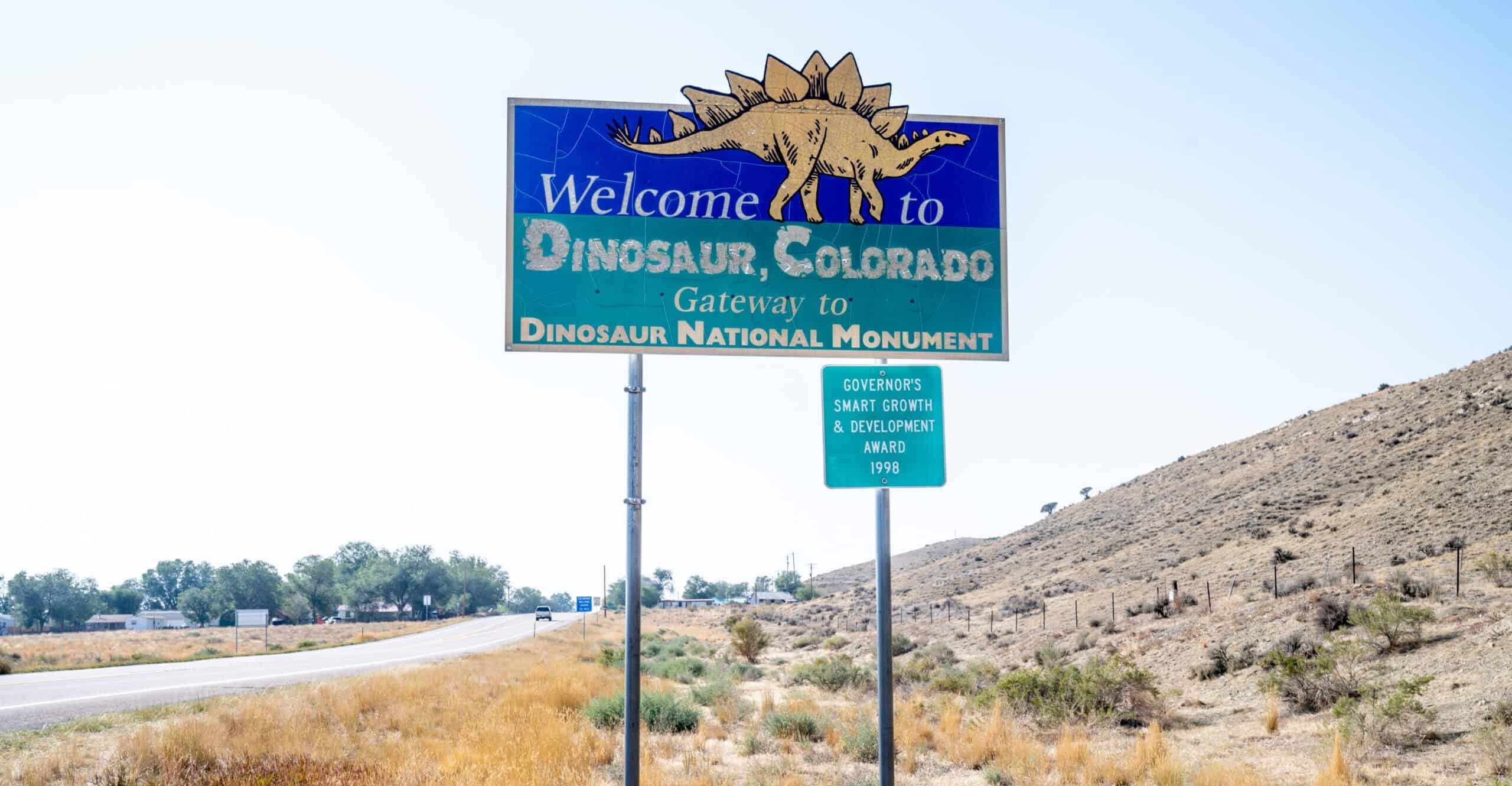
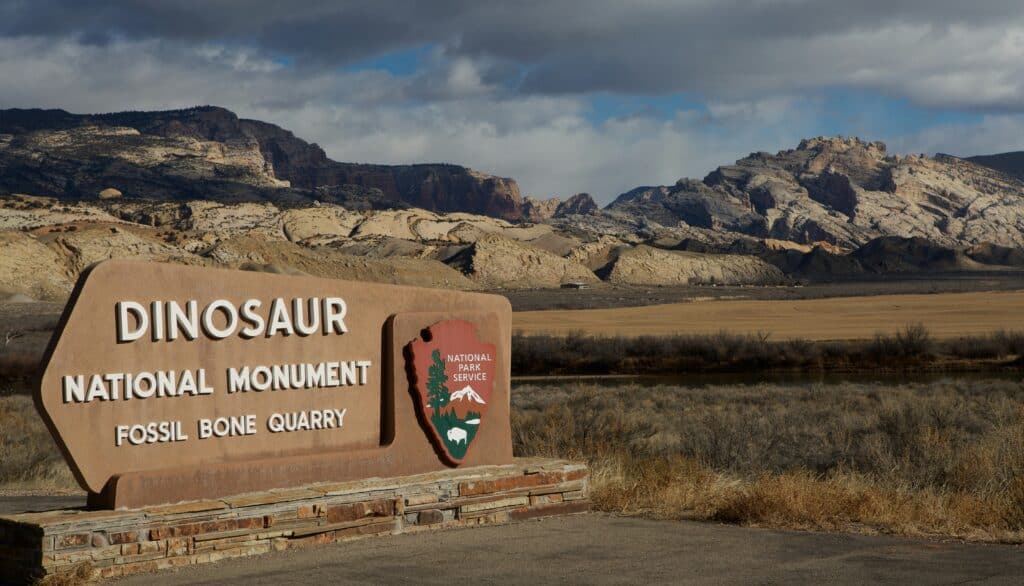
If you assumed that Dinosaur, Colorado, was named because a dinosaur was found there, well, you’re sort of right. The town is actually named for Dinosaur National Monument, which contains more than 800 paleontological sites and many dinosaur fossils. The town sits approximately two miles from the national monument’s entrance. To celebrate its prehistoric connection, Dinosaur renamed several of its streets after different dinosaurs, including Brontosaurus Boulevard and Stegosaurus Freeway.
Dinosaur wasn’t the town’s original name, and it wasn’t its second name either. The town was originally a homestead owned by Art and Fanny Baxter and became known as Baxter Flats. As Baxter Flats grew and more homesteads popped up in and around the town, it was then renamed Artesia because of the artesian well that was found on the Baxters’ property and served as a valued source of water. Artesia incorporated as a town in 1947 and saw an increase in residents during the oil boom that same decade. Finally, the town’s name was changed to Dinosaur in 1966 because of its proximity to Dinosaur National Monument.
3. Arriba
Arriba isn’t necessarily a giggle-inducing name on its own, but when you add in the context of the town, it’s definitely worth a chuckle or two. Arriba is a Spanish word meaning “up” or “above.” Colorado has many mountain towns, so naming a high-elevation town after the Spanish word for “up” makes sense; but Arriba, Colorado, sits east of the Rocky Mountains in the state’s flat plains.
It’s not certain why the small town, which has an elevation of 5,240 feet, was first named Arriba. According to the Town of Arriba, a railroad foreman named it in 1888 when the railroad began moving westward through the United States. But the town was founded by Charles Creel, who made money mining and anticipated that the steam-powered railroad would need a water stop in the area. He set up a tent on a parcel of land (now the site of Arriba’s oldest home), expecting the railroad to head westward in his direction. Notably, teetotaler Creel kept Arriba dry, so a rival built a saloon town next door, and the strip between them was called “No Man’s Land.”
4. Hygiene
The town of Hygiene, Colorado, wasn’t named for its cleanliness or pristine bathing facilities. Instead, it was named for a place in town that aimed to help ill people get better. In 1881, Rev. Jacob Stoner Flory of the Church of the Brethren opened up Hygiene House, a sanitarium for tuberculosis patients. Many people with the disease moved west for their health, seeking fresh air and more sunshine. The sanitarium operated for only eight years, but the name Hygiene stuck, and the unincorporated community still uses it today.
Hygiene was originally called Pella, but changed to the unusual name in 1881, after the Hygiene Home was opened. The name change became official two years later, when the town opened a post office. Today, Hygiene is a small, unincorporated community with a school, post office, historic church, and a few businesses.
5. Stoner
Colorado was one of the first two states to legalize recreational marijuana when voters passed Amendment 64 in 2012. So, it’s only fitting that the state also has a town called Stoner. Of course, Colorado’s reputation as a weed-friendly state isn’t why Stoner has its name, but it’s a pretty funny coincidence.
Stoner, which is located in Montezuma County, in southwestern Colorado, is an unincorporated community that takes its name from the nearby Stoner Creek, which itself was named for its rock-filled creekbed. But after the passage of Amendment 64, Stoner’s self-proclaimed mayor, Frank McDonald, said he hoped to see an increase in visitors to the small community.
6. Climax
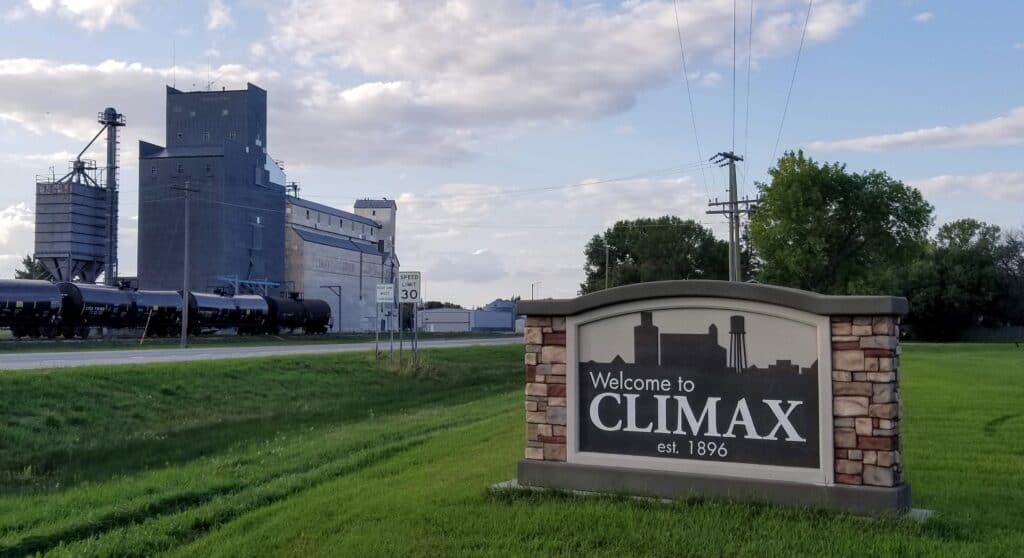
Some town names make passersby giggle because they’re a tad risqué—as is the case with Climax, Colorado, a former mining-company town in Lake County. The town is now a ghost town, razed more than six decades ago, but it was once home to the Climax mine, which still operates today. For decades, the mine provided much of the world’s supply of molybdenum, a hard metal with a high melting point often used to make heat-resistant steel.
There was no sexual innuendo involved in the naming of Climax. Instead, it was named for its intense elevation. The town sat near the summit, or highest point, of the Fremont Pass, an 11,318-foot mountain pass that goes through central Colorado.
7. Severance
No, Severance, Colorado, a home rule municipality in northern Colorado, wasn’t named for the extremely popular Apple TV show. It also wasn’t named for any separation from another municipality, the end of a relationship between communities, or any other meaning derived from the word. Instead, the area was named for David Severance, a pioneer settler who lived there. However, it wasn’t supposed to be named Severance at all.
When the town applied to have a post office created for the 50 families in his community, it was supposed to be named Tailholt, not Severance. But due to confusion, they named it after the person who applied for the post office, David Severance, and the community has carried his name since 1894. Severance had 7,683 residents at the 2020 census, and it has grown quickly since; the Census Bureau’s 2025 estimate tops 11,800.
8. Loveland
Loveland sounds like a romantic destination, and maybe it is for some, but it’s also a normal municipality in northern Colorado, with a population of more than 76,000. Located 46 miles north of Denver, it’s Colorado’s 14th most populous city and was named for William A.H. Loveland, president of the Colorado Central Railroad.
It’s not the only city in the country to bear the affectionate name—there are also Lovelands in New York, Oklahoma, Iowa, and Ohio, as well as Loveland Pass, also located in Colorado. Loveland leans into the name, too: The city’s nickname is The Sweetheart City, and it’s home to the Valentine Re-Mailing Program, where anyone can send a pre-addressed, pre-stamped card to Loveland so it can be officially resent to their valentine from The Sweetheart City.
9. Old Roach
Colorado has more than 1,500 ghost towns, including Old Roach. Residents didn’t leave the former company logging town because of its name, but it’s pretty unappealing and worth a few giggles. Old Roach, of course, wasn’t named for an elderly bug. Instead, it honors Henry Neale “Neal” Roach, president of the Otto Lumber Company.
Located near Colorado’s border with Wyoming, the town was first founded in the early 1920s. The Otto Lumber Company built the camp to house workers who cut timber into railroad ties. In 1938, the town was dismantled. What was once Old Roach is now a ghost town in the Roosevelt National Forest, an approximately 813,000-acre forest in northern Colorado.