Read about how Ford Motor Company furthered the concept of a living wage, even if its tactics were unconventional.
Newspaper headlines compared it to the Gold Rush. Administrators used it as an excuse to explore workers’ home lives. Some Detroiters wondered if it was nothing more than a publicity stunt, while others imagined a new era of prosperity for their families.
Regardless of how each of these groups interpreted Ford Motor Company’s famous Five-Dollar Day plan, one thing is certain: It left a lasting impact on perceptions of “living wages” while pushing Henry Ford’s production process and the Michigan auto industry even further into the public spotlight.
Promises of prosperity—with some strings attached
In the first week of 1914, Henry Ford and his iconic Ford Motor Company made a consequential announcement: Ford workers’ daily wages would be boosted to five dollars. This move, which more than doubled previous wages, became the talk of Detroit—and made headlines far outside the Motor City.
After all, never before had “ordinary” employees seemingly benefited so directly from the fortune of their organization’s founder, and the Five-Dollar Day was viewed as yet another way Ford helped shape the industry.
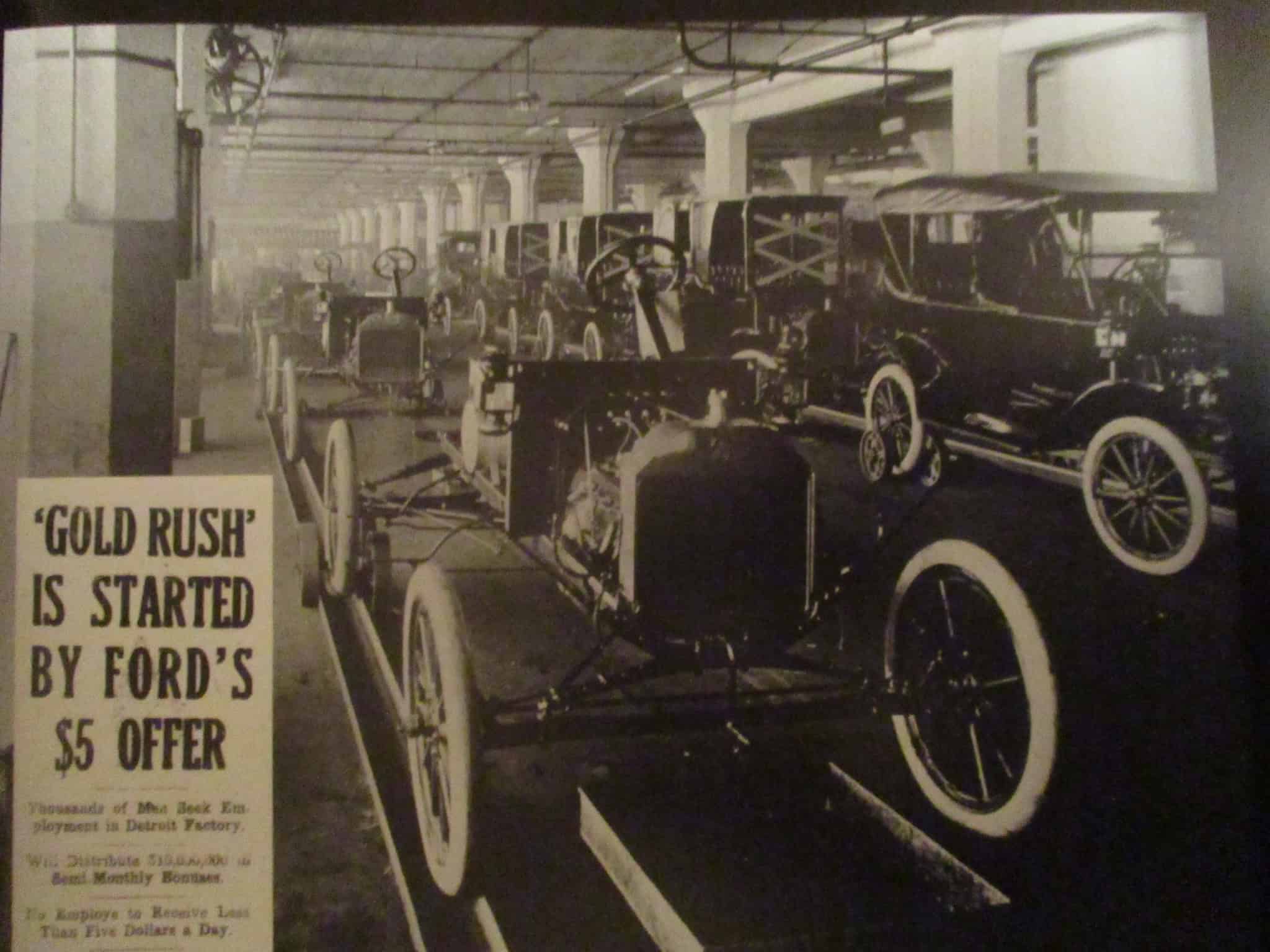
The story behind the Five-Dollar Day is largely intertwined with Henry Ford’s most famous innovation: the assembly line, which allowed workers to drastically speed up production of Model Ts and other vehicles. To make this happen, though, there was a human cost; expectations of ultra-quick work meant employees had to meet time limits and repeat the same task over and over every day.
The result? An employee roster that was unstable at best. Ford needed a way to boost employee retention—and, some argued at the time, generate some positive press—and the pay boost was born. Ford hoped the change would motivate workers to stay at the company, which would streamline operations for the entire assembly line.
But there were conditions attached to the income boost, which was actually structured as a bonus system instead of a true raise (hourly rates technically remained the same, but Ford would tack on a bonus for employees who met requirements during daily production, bringing their total payout to the equivalent of five dollars daily).
To qualify, workers had to meet a series of standards that extended beyond their on-site job performance: Ford wanted employees to maintain clean homes, avoid alcohol, build savings accounts, keep their houses free of boarders, and treat their families with respect—yes, “don’t abuse your family” was a condition on which employees qualified for the Five-Dollar Day deal.
This was a radical new approach to employment, to say the least, and Ford took things a step further by establishing a new branch of the company known as the Sociological Department.
It might sound shocking by modern standards, but the department was designed to monitor employees’ home lives and make sure they lived up to what Ford viewed as necessary requirements for representing the auto company during off-work hours. The way he saw it, workers with more stable home lives would also be more capable of focusing while building cars on the fast-paced assembly line.
A Detroit-based “gold rush”
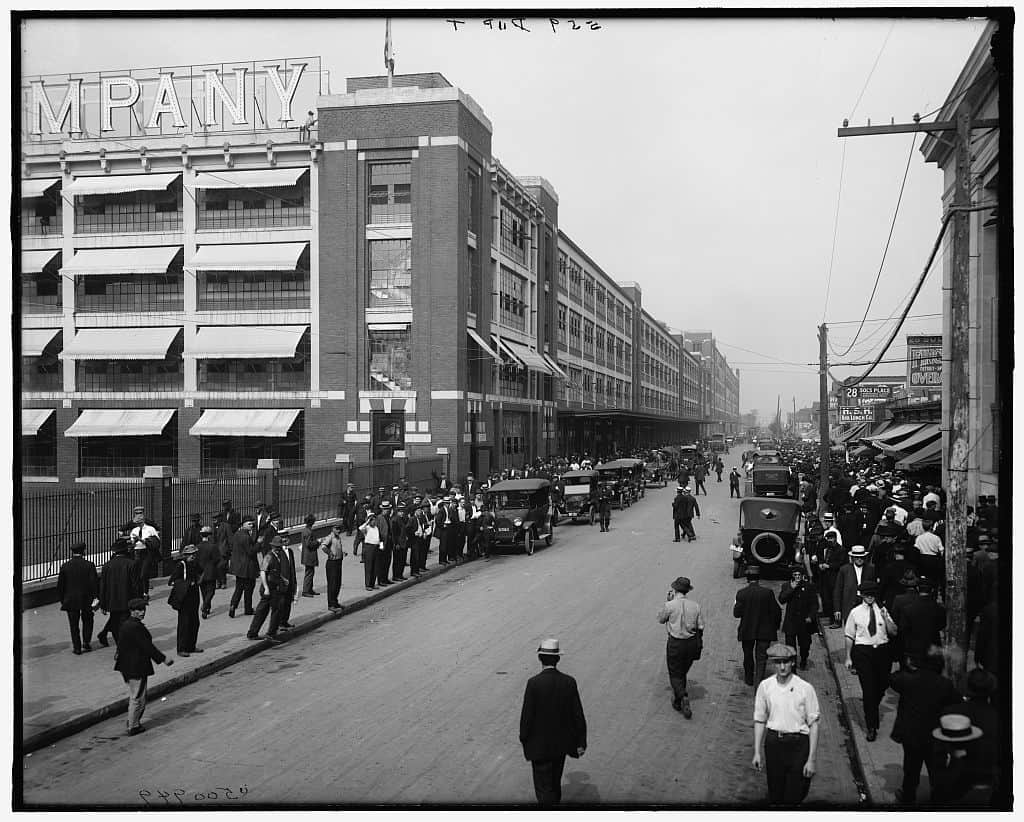
Of course, the promise of high wages drew in a slew of job applicants. According to a historical account by Matt Anderson, Curator of Transportation at the Henry Ford Museum in Dearborn, “thousands of applicants came to Detroit from all over the Midwest and entrenched themselves at the Ford’s gate” within mere days of the announcement.
“The company was overwhelmed, riots broke out, and the crowds were turned away with fire hoses in the icy January weather. Ford announced that it would only hire workers who had lived in Detroit for at least six months, and the situation slowly came under control,” Anderson wrote on the Henry Ford website.
By the early 1920s, some workers had grown frustrated with the Sociological Department’s intrusive methods, which included inspecting workers’ homes and issuing violations if living conditions or family relationships were deemed subpar. If violations were issued, employees had to correct them before receiving their full bonus amount.
As the ‘20s progressed, the Sociological Department slowly disbanded, likely due to employee pushback and the realization that interrogating workers outside the factory might not be the best way to build trust. Regardless, the Five-Dollar Day experiment represented a significant step toward prioritizing sufficient wages and employee wellness, even if its methodology is hard to understand from a modern perspective.
Other companies followed in Ford’s footsteps, and the idea of providing a “living wage” took center stage across the industry as years progressed. With higher wages, the expansion of the middle class was inevitable. As Anderson wrote in his account of the Five-Dollar Day, “Better wages, combined with the affordable goods produced by the assembly line, are cornerstones of the prosperity that has characterized American life for so many of the past 100 years.”