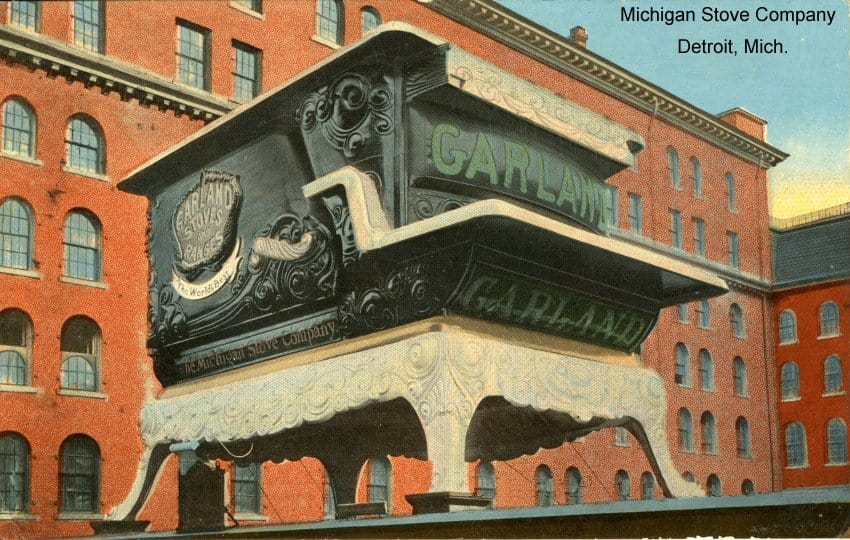
A gargantuan stove once stood tall over Michigan’s biggest city. Read about its long journey as a quirky (and record-breaking) Michigan landmark.
Detroit is famous for its booming automotive industry. Throughout the city’s history, cars have played a central role in everything from the economy to arts and culture, hence Detroit’s “Motor City” moniker. But before cars were the name of the game, a lesser-known (and possibly less exciting) industry reigned: stoves.
Yes, stoves—and this element of the city’s industry would ultimately result in the world’s largest stove making a home in the Motor City (or should we say Stove City?) itself.
The stove industry heats up
Did you know that Detroit was once responsible for producing a significant portion of the world’s stoves? During the 1880s and 1890s, ornate industrial and household stoves were growing in popularity and demand throughout the United States. Families looked to stoves as a source of heat and, of course, a means of cooking meals.
Michigan was in a unique position to produce stoves. Throughout the Upper Peninsula, iron mining thrived, and Great Lakes transportation routes allowed materials to be easily moved from northern mines to other parts of Michigan. Iron ore was the base material of many stoves, so newly founded stove manufacturers in the Detroit area felt like they’d hit the jackpot with such convenient access to the metal.
Three companies ruled the bustling world of stove production in this era: Detroit Stove Works, the Peninsular Stove Company, and the simply named Michigan Stove Company, which sat at the intersection of East Jefferson and Adair Street in Detroit. The Michigan Stove Company was a proud operation, boasting some 1,400 employees and reportedly producing an impressive 75,000 stoves every year.
The makings of a massive monument
Stoves of this era were decidedly different from the stoves we use today, featuring engravings and intricate designs with pretty embellishments. For some families, stoves doubled as decorative centerpieces instead of purely functional pieces. The Michigan Stove Co. prided itself on creating stoves that captured consumers’ attention under an assortment of brand names, including Garland.
Garland brand stoves weren’t cheap (some cost about $70, which translates to over $2,500 in today’s money). But they were admired by homemakers and businesspeople alike—so much so that in 1893, Garland unveiled a massive replica of its product during the Chicago World’s Fair.
For ease of design and transport, the huge stove was constructed out of wood instead of iron or steel, and stood a whopping 25 feet high when it was finally completed. It took multiple railroad cars to move the pieces of the stove to Chicago for the exhibition, where onlookers gawked and gazed at the out-of-this-world construction.
When the fair concluded, it was only logical that the giant Garland stove should return to its hometown of Detroit. It was first placed outside the Michigan Stove Co. factory, where it remained for two decades (even surviving a devastating factory fire, though it did sustain some damage in the incident).
But as company mergers shifted the stove industry during the 1920s, the enormous stove also moved around, ultimately landing near Belle Isle (while drawing in plenty of publicity for the company it represented).

A new home among the carnival rides
By the mid-1950s, the decline of stove production in Detroit was in full swing as families relied on more modern forms of heating and competition entered the marketplace. The oversized stove replica near Belle Isle was passed through a succession of owners, from a realty company to a local biscuit company. There were tentative plans to demolish the giant stove in 1965, but community members and businesses pushed back through loud public outcry, citing the stove’s status as a Detroit icon.
Their efforts worked: Walter Goodman, who ran the Michigan State Fair, accepted the stove as a gift later in 1965 with the aim of displaying it at the State Fairgrounds. The 9-hour, 25-mile journey from the Belle Isle area to the fairgrounds was dubbed “the Great Stove Project” and attracted helpers from local moving companies and construction groups who had fond childhood memories of the stove.
Onlookers gathered to watch the 15-ton piece wind through the streets of Metro Detroit, escorted by policemen and other spotters who ensured it arrived (relatively) unscathed at its proud new home.
In the decades that followed, the stove became a landmark at the fairgrounds, but it also sparked debate about whether its pricey upkeep was worth preserving history. Efforts to save the stove in the 1970s evolved into a fundraiser to keep it intact in the long term.
Advocates were successful in getting the stove moved off the fairgrounds, but it ultimately ended up on public display in a somewhat isolated section of land near the Renaissance Center. Without its prime fairgrounds location, it faded into obscurity. By the early 1980s, the fund designed to refurbish and sustain the stove had lost momentum, and there was simply not enough money left to keep it on display. The once-iconic stove ended up in a warehouse.
A final push to save the stove
In 1998, a monumental effort to restore and return the stove to its former home at the State Fairgrounds succeeded, though it took three years to complete the project. The fair was extra-busy that year, as old admirers and younger generations gathered to snap photos in front of the stove in between corn dogs and Ferris wheel rides.
But the economic crisis of 2008 took its toll on Detroit and Michigan as a whole. Budget cuts the following year led to the discontinuance of the Michigan State Fair, which meant public access to the giant Garland stove was largely restricted. In 2011, the stove met its final fate: A storm swept through the area and seemingly struck the stove with lightning, which led to a devastating fire. By the time anyone noticed, it was too late to save the landmark.
Today, the former record-holding stove is a mere memory in the minds of longtime Detroiters and Michigan historians. It might be gone, but its quirky history lives on—and perhaps, if a group of enthusiasts decides the time has come, a new version of the stove will make an appearance in the Motor City.