Learn the origin stories of seven unusual Utah town names, from Elmo to Virgin.
Our state has a reputation for being a little weird. These Utah town names don’t do anything to discourage that perception.
That being said, the entire United States is chock full of odd town names—our state kind of falls down the list when you take Ding Dong, Texas, Beer Bottle Crossing, Idaho, and Mormon Bar, California, into consideration. (Also, how did we not end up with that last town within our state borders? Maybe it was the “bar” part?).
Here’s a short list of Utah town names that will have you scratching your head—or snickering a little bit—in a good-natured way.
1. Beaver
Where: Beaver County, southwestern Utah
The Merriam-Webster definition of a beaver is a buck-toothed, sleek-coated rodent that inhabits forests and streams and builds its house from sticks. Ask the Urban Dictionary, and you’ll get, erm…a different answer.
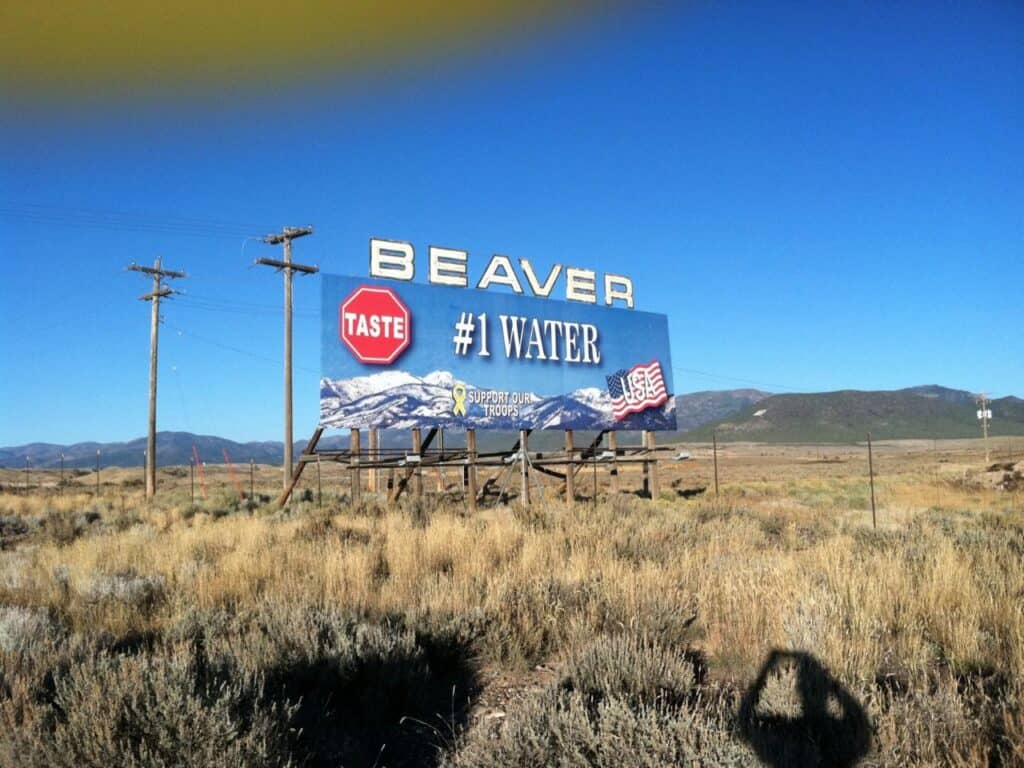
According to the Beaver County Tourism Office, Beaver the town is indeed named for the animal. Specifically, the North American Beaver, which thrived in this part of the state when LDS pioneers settled here in 1856. “Just like the beavers who built their homes along our waterways,” it notes, “the early settlers of Beaver built a strong foundation for the generations that followed.”
The beaver population dipped considerably around Beaver (the town) and Beaver (the river) during the fur-trading era. Though not at previous levels, there are still beavers living nearby, thanks to groups like Wild Aware Utah (which educates people on wild animal ecology in order to prevent unnecessary conflicts) and the Beaver Ecology and Relocation Collaborative.
2. Elmo
Where: Emery County, east-central Utah
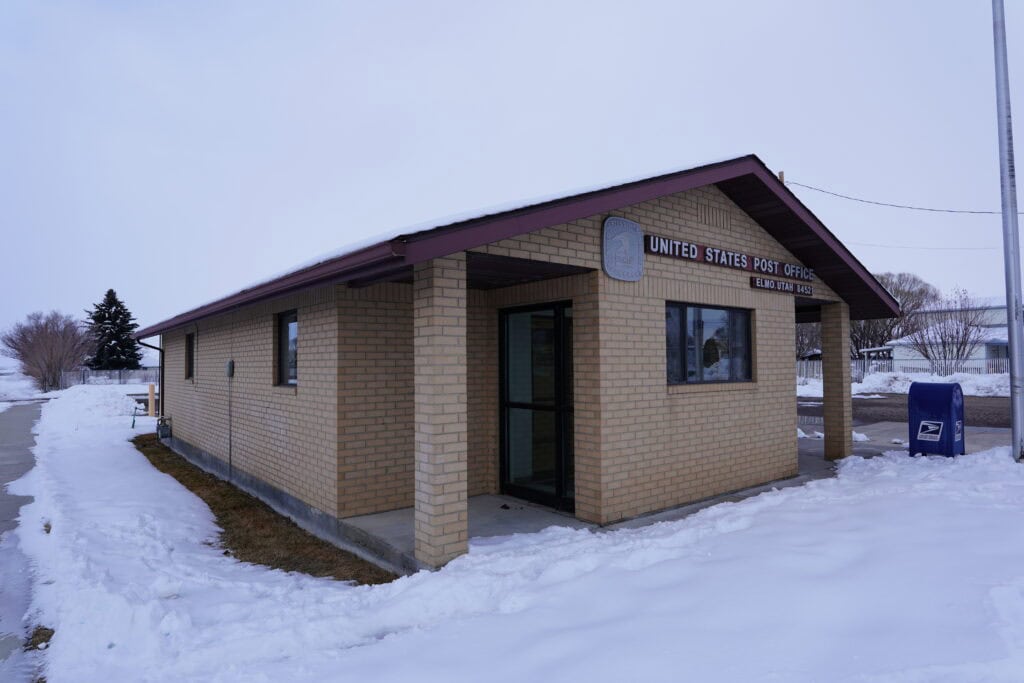
This name inevitably evokes a certain squeaky red Muppet who speaks of himself in the third person, but according to the Emery County website, the town’s name came from an acronym using the first letter of the last names of the first families to settle there in 1908: Erickson, Larsen, Mortensen, Oviatt. (The alternate theory is that it was named after Augusta Jane Evan’s 1866 antifeminist novel, “St. Elmo.”)
As the Utah Historical Society notes, Elmo boomed as a farm town in its early years, then lost a lot of its population during the mid-20th century as young people moved to cities in search of industrial jobs.
Elmo currently clocks about 400 residents, give or take, depending on the census year, and it truly is the picture of a quiet, rural farm town: a peek in the newspaper archives didn’t reveal anything more controversial than folks showing up on the delinquent tax list published in the pages of the “Emory County Progress.”
3. Eggnog
Where: Garfield County, southern Utah
Located at the bottom of the state near Glen Canyon and the Henry Mountains, Eggnog is an unincorporated area. “Salt Lake Magazine” reported it was established in 1979, theorizing that the name came from ranch laborers’ consumption of calorie-rich eggnog after working hard all day.
In 1995, David Swift, a former “Popcult” columnist for the “Jackson Hole News,” wrote the most substantial profile of Eggnog yet. “What I like about Eggnog is its relative nothingness, and the fact that it leads to more nothingness,” he wrote. “There is nothing man-made, really, save for the recently paved Burr Trail and the occasional Forest Service sign pointing out two tracks that lead to deer-killing spots.” He posited that Eggnog was “a copyright protection scheme” by Raven Maps, as “many a map-maker sprinkles in a handful of nonexistent features in order to ward off rip-off artists.” Only the residents of Eggnog (if they exist?) know the truth.
4. Hideout
Where: Wasatch County, northern Utah
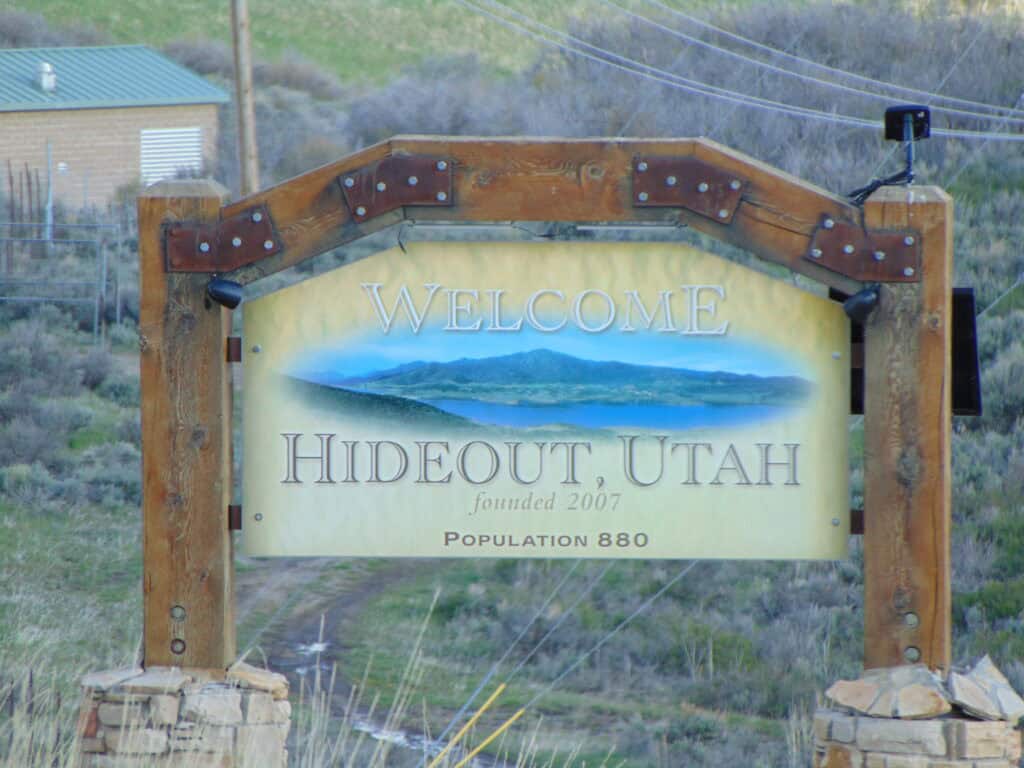
Unlike a lot of cities on this list, Hideout, Utah wasn’t founded during pioneer days; it’s a planned community that was incorporated in 2008. At that time, the majority of its 800-or-so residents lived in one development, the Todd Hollow Apartments. Located just outside Park City, the area has a simple, logical backstory behind its exciting-sounding name: It’s located near Hideout Canyon. That does give it a bit of a bad-boy halo effect, though; Hideout Canyon is allegedly named that because it was a favorite hiding place for cattle thieves.
Hideout is not far from a town that really is hiding—underwater. Beneath the surface of the nearby Jordanelle Reservoir is the town of Keetley, a former mining camp later renamed for Pony Express rider and mining supervisor Jack Keetley. It was submerged when Jordanelle Reservoir filled in the mid-1990s. During very dry summers, you can see the edges of some of the town’s former roads reappear.
5. La Verkin
Where: Washington County, southern Utah
As St. George News wrote in 2021, “La Verkin is an enduring mystery.” That is, no one really knows why it’s called La Verkin. “Some people say that it sounds like ‘beaver skin,’ and some of them say it sounds like ‘la virgin.’,” historian Steve Gifford told the outlet, adding that “The only problem with that is if you’re a Spanish-speaker at all, you would have called it Rio Virgin instead of ‘La’ or ‘the’ Virgin.”
The town sets its birth date as 1903, the year the post office opened. More recent historical milestones arrived in 2001, when the town declared itself an official “U.N.-free zone.” and in the spring of 2026, when the city adopted its first mascot, the La Verkin Gherkin, which is—you guessed it—a guy in a pickle suit.
6. Nibley
Where: Cache Valley, northern Utah
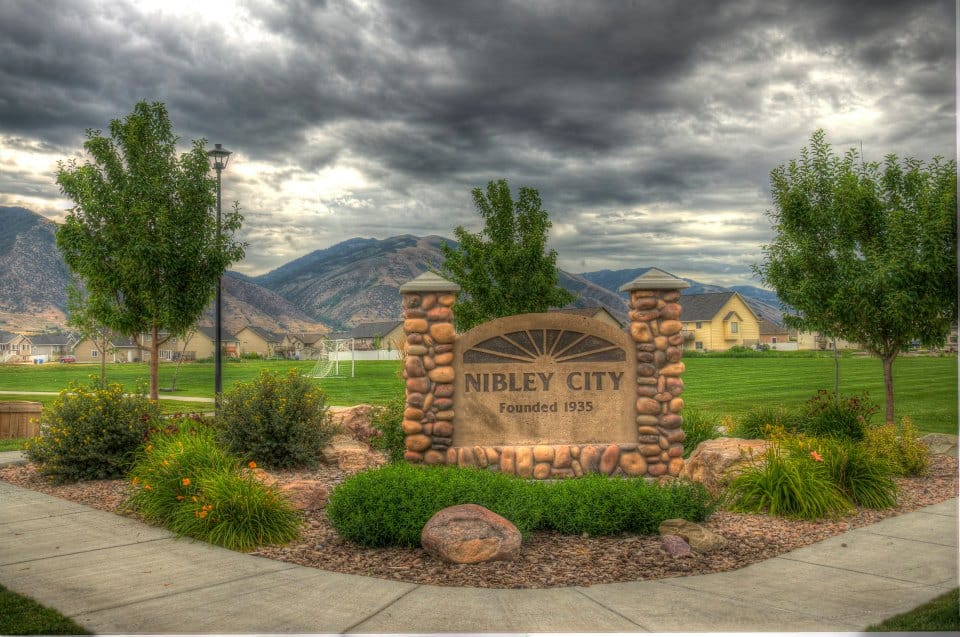
It sounds like a synonym for “snacky,” or maybe a cool name for a pet mouse, but Nibley the town is named after Charles W. Nibley, presiding bishop of The Church of Jesus Christ of Latter-day Saints from 1907 to 1925, who later served in the church’s First Presidency. Nibley was born in Scotland, but the name is actually British, originating in Gloucester. According to the North Nibley Parish Council—in England, not Utah—the name originally meant “a farm or settlement on a hilltop.”
There were plenty of farms in early Nibley, though today it’s more of a bedroom community that serves almost as a suburb to nearby Logan.
7. Virgin
Where: Washington County, southern Utah
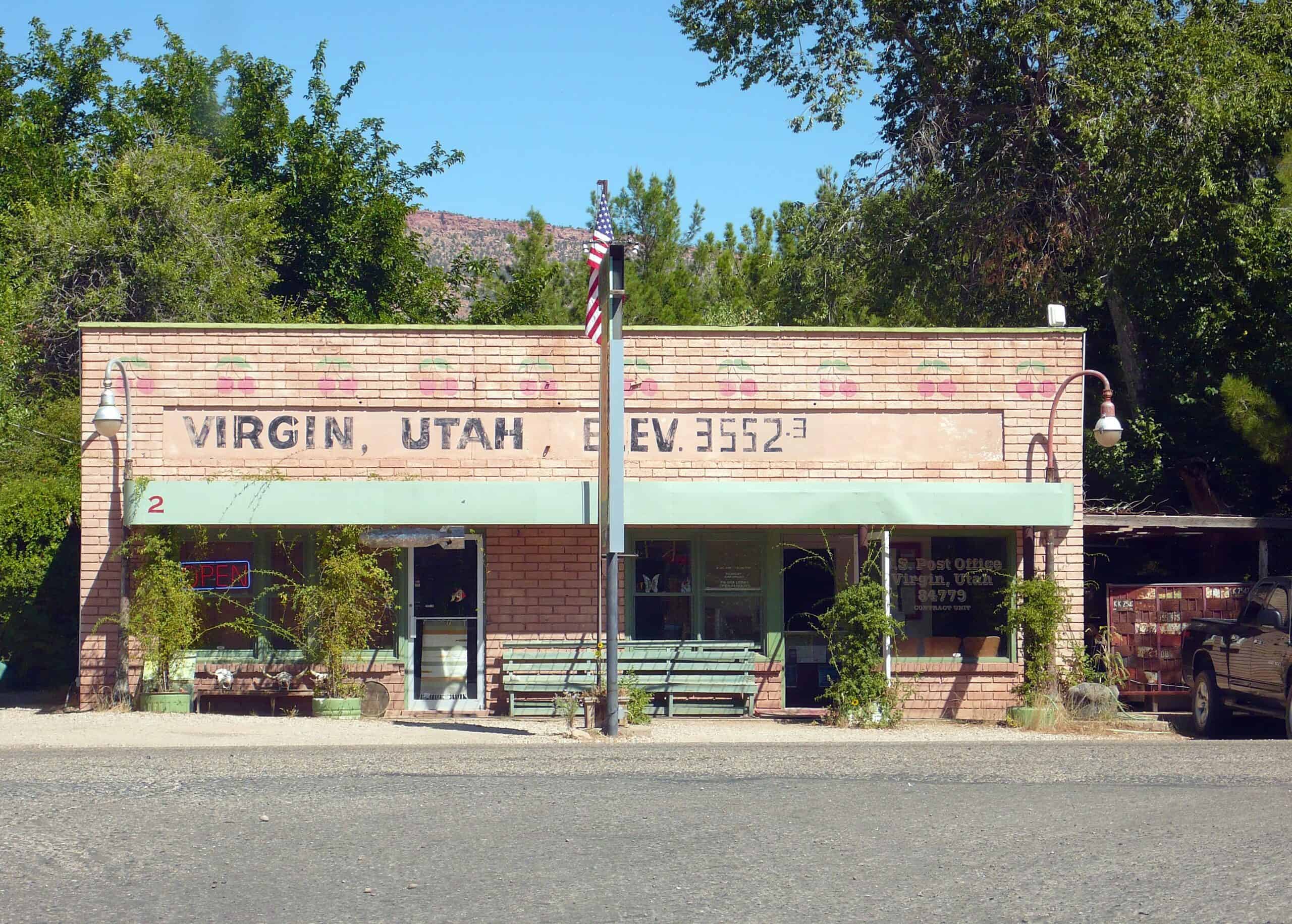
We saved the best for last, because this one plays into those ubiquitous, squeaky-clean Utah stereotypes. But just as La Verkin wasn’t named after a virgin—or The Virgin—Virgin, Utah probably wasn’t either.
Founded in 1858, the town’s named after … the Virgin River. As for the river, no one quite knows whether it was originally called Rio Virgen in honor of the Virgin Mary or named for explorer Thomas Virgin. (This is just what happens when a city’s been around for more than 150 years and its early residents include fur trappers and cowboys.)
Virgin made national news in 2000 after passing a law mandating all households keep and maintain a firearm. Though it’s fringy on firearms, it’s more mainstream on fireworks—it observed the state ban on them during the very dry summer of 2026. But that didn’t stop one rebellious so-and-so from shooting some off, resulting in a half-acre of fire damage.
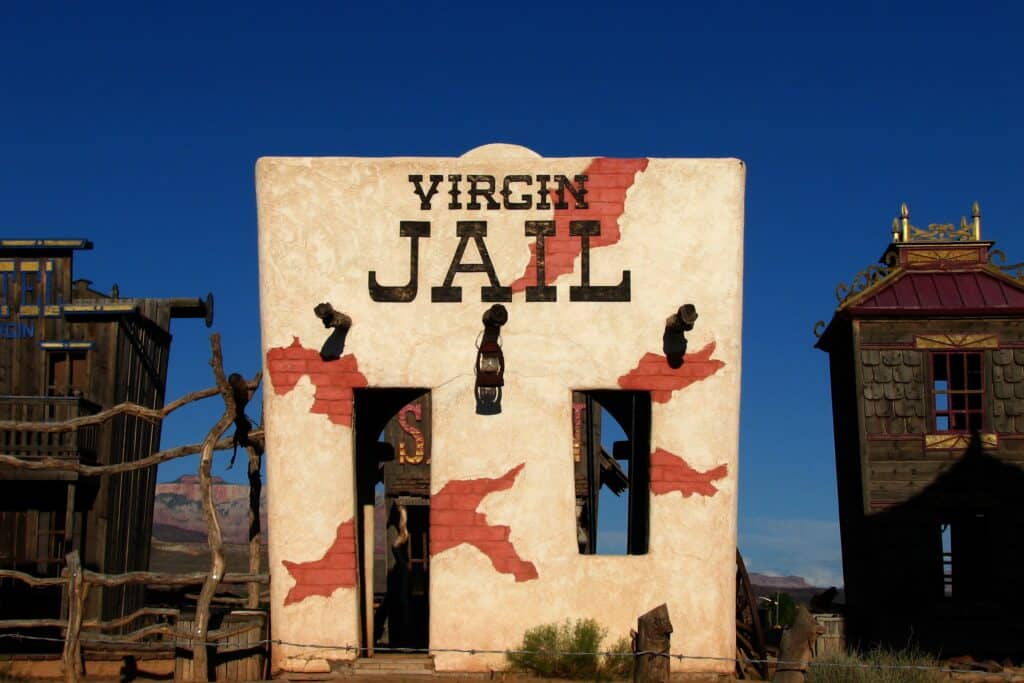
If you decide to visit Virgin, or nearby Zion National Park, be sure to make a stop at the Fort Zion roadside attraction, where you can get a photo of yourself locked up in a recreated version of the old Virgin Jail.