Chesapeake Bay holds plenty of fascinating history across its waters and shores, including several connections to pirates in the 17th and 18th centuries.
If the location of a place has “bay” in the name, chances are pretty good that it’s had at least one run-in with a pirate. It’s a lot easier for a ship to navigate the open waters as opposed to, say, Nebraska, a triple-landlocked state. But few locations have had as much pirate action as Chesapeake Bay.
From the very first documented pirate almost 400 years ago to ways you can experience the yo-ho-ho lifestyle today, here’s a look inside Chesapeake Bay’s pirate history.
What classifies as a pirate?
First, let’s define what we’re looking at here. The English word “pirate” comes from the Latin pirata, which translates to “sailor, corsair, sea robber.” That Latin derivation comes from the Greek peiratēs, which more broadly translates to “anyone who attempts something.”
That Greek etymology is a very broad definition, of course. Over time, it narrowed to describe someone who committed robbery or brigandage on land or sea. The original word dates back to around 1300 in English texts.
Today, pirates are a popular name among both professional and collegiate teams. Shout-out to the Hampton Pirates, who produced one of the most notable March Madness upsets in 2001. Piracy is also common in pilfering other copyrighted work, such as music and movies. And now, in the age of ordering packages to your house, you also have to be wary of porch pirates who can’t resist snagging a box or two.
Chesapeake Bay’s first pirate encounter
William Claiborne (sometimes spelled Clayborne) is widely recognized as Chesapeake Bay’s first pirate. He grew up in England before being offered a job as a land surveyor in a new colony across the Atlantic Ocean called Virginia. He first stepped on Virginian soil in October 1621, quickly becoming a popular colonist at Kent Island. He opened a fur trading post with the goal of provisioning and trading with locals from Virginia all the way up to Nova Scotia, helping expand the Kent Island settlement. From 1626 to 1634, he served as the Secretary of State for the Virginia Colony.
Expansion seemed like a simple enough plan, but while Claiborne was in London to secure additional funds, he discovered George Calvert (Lord Baltimore) was building a Catholic colony north of Virginia. A charter granted to the Calvert family said the land and cattle of Kent Island would move from being under Virginia to Maryland control.
This decision angered Claiborne so much that he ordered an attack and raid on a Maryland fur trading post. That first piracy occurred in 1635 on Palmer Island, today known as Garrett Island. Thomas Cornwallis, a Maryland commissioner, searched the Chesapeake Bay for illegal traders and took Claiborne’s pinnace, the Long Tayle, stationed in the Pocomoke Sound.
The first Naval battle in North American colonial history took place on April 23, 1635, with Claiborne’s men retreating. On May 10, 1635, Claiborne launched a second attack, this time defeating the Maryland colonists and leading to a stalemate. In the ensuing years, Kent Island exchanged control, and two of Claiborne’s men were tried and hanged for piracy.
Due to his many conflicts in Maryland and Virginia, by the end of his political career, Claiborne was largely ostracized by both governments. He retired in 1660 and lived out the remainder of his life on a 5,000-acre estate near the Pamunkey River, known as Romancoke. And no, despite the similar sounds and pirates’ propensity for a certain alcoholic beverage, Romancoke is unrelated to the rum and coke cocktail.
Notable pirates and piracy eras of Chesapeake Bay
Claiborne committed the first act of piracy in the Chesapeake Bay, but he’s hardly alone. The area was popular for pirates because of the abundance of trade ships and a government that was often willing to look the other way regarding attacks and plundering. Here are a few other legendary pirates and tales.
Blackbeard
You may not be familiar with the name Edward Teach, but if someone says “Blackbeard,” you’ll likely associate it with a pirate. Blackbeard has become quite romanticized and immortalized over the years and has been featured in many legends, from old pub tales to the “Pirates of the Caribbean” franchise.
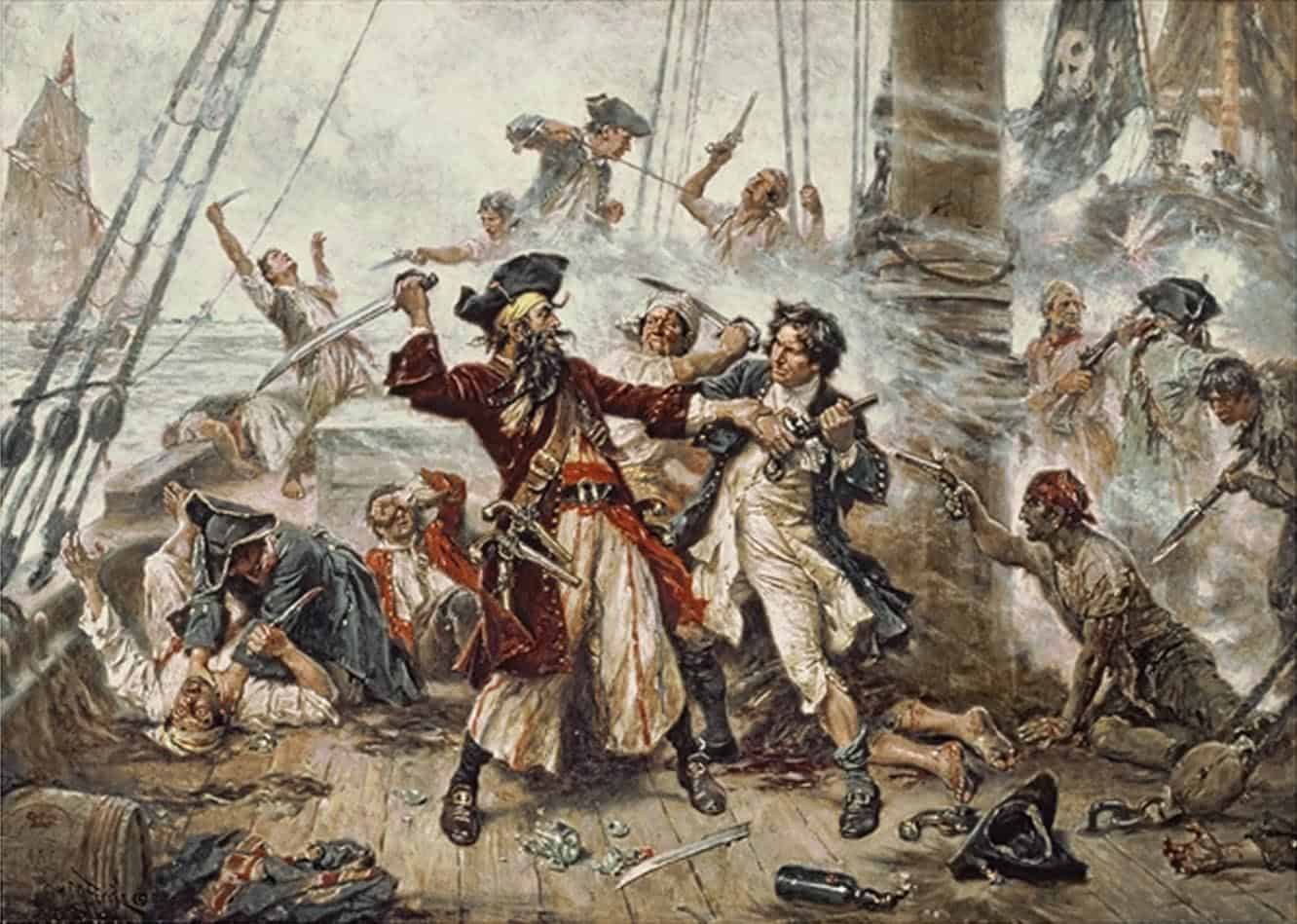
Many other pirates had no qualms about violent attacks that injured or killed their targets. Blackbeard generally opted for a different approach, relying on mental terror based on his appearance. As his name suggests, he sported a long, bushy, black beard. Before an attack, he would braid his beard and put lit fuses underneath his hat brim, creating a mysterious, intimidating presence. Of course, he still committed some atrocious acts of violence, but his appearance did a lot of work in striking fear into the hearts of his enemies.
Around 1716, Teach had joined the crew of Captain Benjamin Hornigold, a pirate who had been plundering New Providence’s waters. Hornigold gave Teach control of a sloop, and by early 1717, the duo was leading crews along the water. However, Hornigold got demoted toward the end of the year and retired from the pirate life, leaving Teach a ship called Revenge and a sloop. On November 28, 1717, Teach’s two ships went after a French merchant vessel near the coast of Saint Vincent. The ship was La Concorde, and Teach gave the captured crew access to a sloop from his fleet to sail toward Martinique. Meanwhile, Teach renamed La Concorde to Queen Anne’s Revenge, giving her a facelift with an additional 40 guns.
Throughout 1718, Teach, now at the self-appointed rank of Commodore, continued capturing and raiding other ships, including a blockade of the Charles Town port in the province of South Carolina. Eventually, word got out that Teach was in North Carolina, and Alexander Spotswood, then the governor of Virginia, made a proclamation that, among other things, pirates had to give up their arms and make themselves known to authorities. Lieutenant Robert Maynard led a crew that headed toward Teach.
A major battle ensued in Ocracoke Bay on November 21, 1718. Near the end of the battle, which had stretched into November 22, Teach and Maynard were squaring off, and Teach was about to deliver a fatal blow before one of Maynard’s men slashed Teach across the neck. That injured him enough that additional members of Maynard’s crew quickly surrounded and killed Teach. Per Maynard’s description, Teach’s body had been shot five times and had nearly 20 cuts. The crew removed Teach’s head and placed it on the bowsprit of his ship so he could collect the bounty reward. Blackbeard’s head, still intimidating even in death, was displayed at Chesapeake Bay for several years, launching three centuries of mystique alongside it.
Stede Bonnet
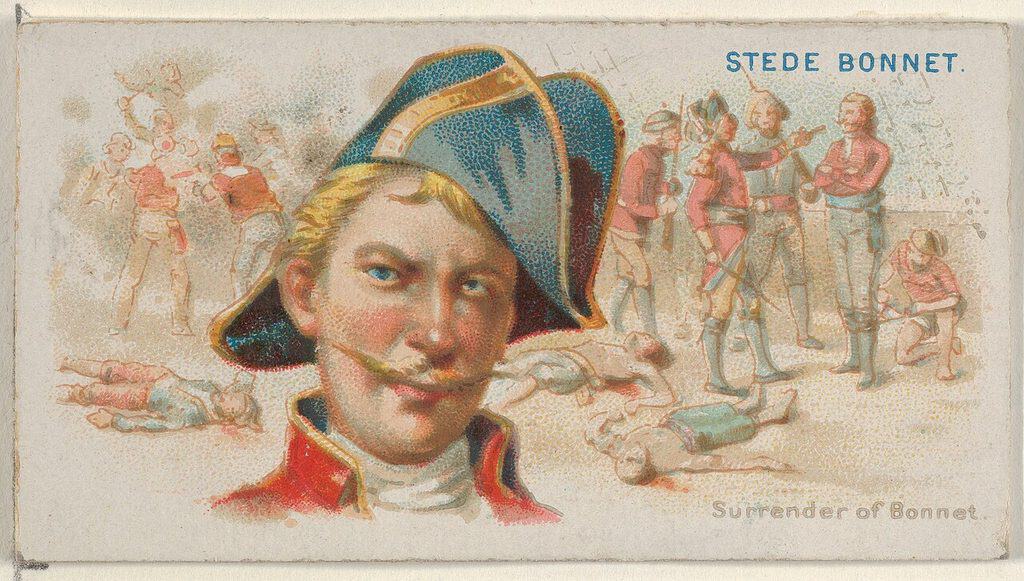
Known as the Gentleman Pirate, Stede Bonnet was born into a wealthy English family on Barbados. When his father died in 1694, Bonnet inherited the family estate. He went 23 years before deciding to become a pirate, a move that historian Robert C. Ritchie believes may have been an attempt to “recapture his more adventurous youth.” Whatever the case, Bonnet abandoned his wife, children, land, and money, and set out on the open seas.
Bonnet had spent time in the Barbados militia, achieving the rank of major, but he had very little sailing experience when he became a pirate. Rather than stealing a ship, Bonnet purchased one, named it Revenge because it sounded cool, and found a group of men to lead. While Bonnet himself was not a sailor, his crew was quite skilled, and they sailed to Virginia to raid commercial vessels.
Bonnet and his crew sailed to Honduras to use their newfound loot, and it was there that he crossed paths with Blackbeard. The latter pirate realized Bonnet was too prim and proper to be a captain, so he seized his ship and crew (with their consent) and welcomed Bonnet on his ship as a guest, though the new guest was likely living more as a prisoner.
Vowing revenge, Bonnet did eventually escape and retake control of his ship and crew, and he suddenly became much less gentlemanly. He abused his men, killed prisoners, and threatened violence on civilians. The South Carolina government put out a request to capture Bonnet, and in August of 1718, Colonel William Rhett took Bonnet in.
The wealthy Bonnet tried to blame all of his crimes on Blackbeard, but the state wasn’t having it. He was convicted of piracy and hanged on December 10, 1718. His total pirating era lasted less than two years.
Davis, Wafer, and Hinson
The comedian John Mulaney has an excellent bit about donating money to college. He spent $120,000 on tuition, or, as he says, “I gave you more money than the Civil War cost.” As the bit indicates (and as you may have guessed), college tuition has only gotten more expensive over the years. But back in the 1600s, universities were just getting started and were much cheaper. And three pirates played a part in making one college happen.
As Edward Davis, Lionel Delawafer, and John Hinson sailed down the Chesapeake Bay in a small boat in June 1688, they were stopped by the authorities. Upon searching the boat, three chests of silver plate and pieces of eight were discovered. Despite their claims of not being pirates, Davis and Delawafer had sailed with Captain John Cook to the South Seas five years earlier. In 1695, Delawafer wrote a book about that experience under the name Lionel Wafer.
The trio was imprisoned in a Jamestown jail. At the time, there was a general pardon from the king to pirates or privateers who voluntarily surrendered. Alas, the three prisoners had been arrested; they didn’t surrender. That technicality kept them in jail for close to a year as the government decided their fate.
Francis Nicholson became the governor of Virginia in late 1689. He ordered that the trio’s loot be sent to England, while Davis, Delawafer, and Hinson wanted the money to pay their debts, including the legal battles they were in the midst of. The men returned to London, and arguments continued into 1690 and 1691. Finally, in March 1692, a royal order agreed to return the fortune to the three men.
However, £300 of the loot was kept by the Crown. A portion was sent back to Virginia and was used to help found the College of William & Mary, which is the second-oldest institution of higher learning in the United States.
How the pirate spirit lives on today
While you probably won’t encounter any modern-day pirates out on Chesapeake Bay, that doesn’t mean you can’t have a terrrrrrrific experience acting like one. There are numerous avenues for taking pirate-themed boat rides around the area, such as the Chincoteague National Wildlife Refuge and Yorktown Sailing Charters. Raising pirate flags and shooting mock cannons is a lot more enjoyable without the threat of another ship attacking you.
Renaissance faires are also excellent opportunities to see if a pirate’s life is for you. The Virginia Renaissance Faire and Ravenwood Faire typically have a pirate-themed weekend during their runs. Troupes perform a variety of shows and acts, while costume contests encourage dressing up in your finest plundered attire. Note that you should not actually steal your outfit.
Maybe you’d prefer an entire area devoted to pirates. Pirate’s Cove Waterpark is one of Virginia’s coolest waterparks. It’s decked out with piratical decor, including a massive wooden splash bucket perched on a ship, complete with an accompanying parrot.
Whichever route you prefer to weigh anchor to experience a pirate’s way of life, don’t be afraid to say ahoy.
By the way, what’s a pirate’s favorite letter of the alphabet?
Did you guess “Rrrrrr?” No, it’s “The C.”