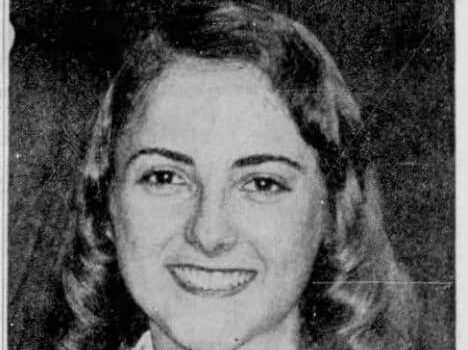
Betty Gail Brown was murdered in Lexington, Kentucky, in 1961. Her case remains unsolved.
Content warning: This article contains some graphic descriptions of murder.
It was particularly cold in Lexington, Kentucky, on the night of October 26, 1961. A local teenager, Betty Gail Brown, was getting ready to spend a few hours studying with friends at Forrer Hall on the Transylvania University campus. She had a biology exam coming up that she wanted to do well on, and she discussed it with her parents, Hargus Brown and Quincy Stanton Brown, over dinner that evening. Betty was the couple’s only child and diligently kept them informed of her plans.
Her mother, Quincy, was the sister of famous actor Harry Dean Stanton. Their family hailed from West Irvine. Her father, Hargus, was an insurance salesman who had been raised in Harlan County. The Browns were overjoyed—and mildly relieved—when Betty decided to live at home while studying at nearby Transylvania University. They felt it was better and safer for their daughter to remain in a familiar area as she navigated the uncertain web of early adulthood.
Before going to sleep that night, Quincy tucked a heating pad into Betty’s bed to make sure her daughter was comfortable and warm when she returned home in a few hours. Over on campus, Betty was speaking to the housemother of Forrer Hall to request permission to stay in the building past visiting hours, as she and her friends needed more time to go over the material for their exam. The housemother said yes, and Betty stayed until right before midnight.
After saying goodbye to her friends, Betty crossed the street and got into her car. She was getting ready to leave when another friend pulled up beside her, and Betty chatted with him and his date for a few minutes before saying she was heading home for the night. Her friend said he watched her in the rearview mirror briefly before turning into the parking lot for his dorm, and she continued down the road to her house. He’s the last known person to have seen Betty alive.
In a matter of hours, her body would be discovered in the front seat of her car parked outside of the Old Morrison Building. Betty had been strangled with her own bra by an unknown assailant. The Lexington Police Department immediately opened an investigation, chasing every lead they could dredge up, but they never solved the crime.
Sixty-five years later, Betty Gail Brown’s murder remains one of the most notorious and devastating cold cases in Kentucky history.
Initial investigation
When Quincy awoke in the early hours of October 27 and realized her daughter still wasn’t back from her study session, she knew something was wrong. She got into her car and headed for Transylvania University to look for Betty but returned home when she was unsuccessful in locating the 19-year-old. Hargus then took the car to check a few nearby restaurants Betty frequented while Quincy telephoned the housemother at Forrer Hall.
When the housemother informed Mrs. Brown that Betty had left before midnight, Quincy’s panic deepened. She contacted local hospitals to see if anyone had been admitted matching her daughter’s description, but no one had. Hargus decided to contact the Lexington Police Department to file a missing person’s report, and at 3 a.m., a responding officer discovered Betty’s lifeless body.
It was the beginning of what would become a fruitless effort to track down her killer and bring them to justice. The police department interviewed every male student and faculty member who was on campus that evening, administered polygraph tests, and logged hundreds of fingerprints. Several persons of interest received similar treatment, but there were never any tangible leads, and there was never any concrete evidence tying anyone to Betty’s murder.
Until one day, several years later, a local man confessed.
Confession of Alex Arnold Jr.
Alex Arnold Jr. was a drifter with substance abuse issues. He claimed to have stumbled across Betty Gail Brown as he was making his way to Gratz Park after leaving a nearby bar. Arnold said she was in her car with another woman, and when he asked the two if they had a light for his cigarette, the pair yelled at him until he left.
Instead of walking on to Gratz, Arnold experienced a fit of anger and yanked open one of the car’s doors, intending to attack the women. The unidentified individual allegedly fled as soon as this happened, but Betty wasn’t as fortunate. Arnold described to police how the Transylvania University sophomore fought for her life until he ultimately ended it.
The issue with his confession is that his memory was spotty at best, and there was no evidence to suggest that anyone else had been in the car with Betty that evening. The friend who stopped to speak with her didn’t see anyone else in the car, and no one else could provide concrete proof of what Arnold was suggesting. Despite this, he said he was “99% sure” he was the one who murdered Betty.
Arnold was brought to trial, and he continued to provide information to his attorney, Robert G. Lawson, whom he seemingly trusted. Lawson would go on to write “Who Killed Betty Gail Brown? Murder, Mistrial, and Mystery,” published by the University Press of Kentucky, about the experience. He detailed Betty’s life and death, as well as the extensive search to find her killer, whom he ended up representing in court.
It was during these court proceedings that Arnold began to waver in his confession, saying, “I didn’t kill her, but I’m not sure of that.” The defense debated whether he actually committed the crime or simply thought he had. Arnold had been abusing alcohol for over a decade by that point, and it greatly impacted his health. They argued that he saw the widespread coverage of Betty’s murder, connected himself to it for some psychological reason, and filled in the details from there.
His trial resulted in a hung jury—meaning they couldn’t reach a verdict—due to a lack of physical proof tying Arnold to the crime. He was never retried, and he died in 1980. The truth of what might have actually happened that night unfortunately died along with him.
The continued search for justice
Robert G. Lawson said that whether or not you think Alex Arnold Jr. is guilty of murdering Betty Gail Brown on October 26, 1961, is a simple matter of belief. Lawson knows there isn’t enough evidence, information, or motivation to ever definitively solve the case. It’s a heartbreaking reality for many families across Kentucky whose loved ones were brutally taken from them.
The Lexington Police Department, for their part, have never given up the search. They’ve said they’ll continue to follow any new leads as they become available, hoping to bring Betty’s family and friends some relief.
Betty was a kind, well-liked girl who had big ambitions and a bright future. She deserved to see them come to fruition.