Dive in and discover New York’s best natural swimming holes where you can cool off on a hot summer day.
When summer temperatures in New York get too hot to handle, crowded beaches and packed public pools aren’t your only options for a refreshing dip. There are swimming holes all across the Empire State, tucked beneath waterfalls, hidden in the woods, and nestled along popular hiking trails. Some are well-known spots that crowds flock to every summer, while others manage to remain a little more under the radar.
Whether you’re looking for a place to take a quick dip after a hike, a family-friendly spot to spend the afternoon, or a scenic escape from the city, these natural swimming holes are among the best spots in New York to beat the heat. Keep reading to learn more about each one.
Catskills
Fawn’s Leap
If you’re looking for a refreshing dip and an adrenaline rush, Fawn’s Leap definitely delivers. This 24-foot waterfall, located along Kaaterskill Creek, plunges into a deep, crystal-clear pool surrounded by rocky cliffs and forested slopes.
The pool below the falls reaches depths of about 12 to 15 feet, and the surrounding rock ledges have made Fawn’s Leap one of New York’s most well-known cliff-jumping destinations. Even if you’re not interested in taking the plunge yourself, the cool mountain water and scenic setting make Fawn’s Leap an ideal place to escape the summer heat.
Just keep in mind that the area often gets crowded on warm weekends, and jumping from the cliffs can be dangerous. Many visitors prefer to stick to swimming, wading, or simply relaxing beside the swimming hole.
Kaaterskill Falls
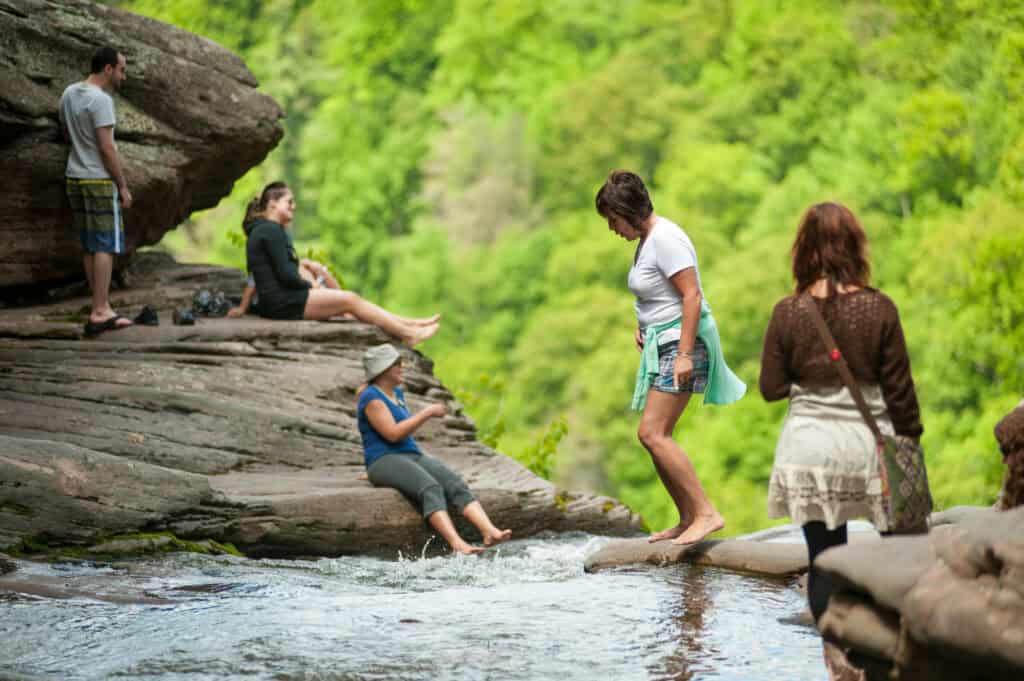
At 260 feet tall, Kaaterskill Falls is New York’s highest cascading waterfall—and one of the state’s most popular summer destinations. The iconic waterfall cascades down two dramatic tiers, creating a series of pools that draw hikers and swimmers looking to cool off on scorching summer days.
The hike from the Laurel House Parking Area is less than a mile long, and you’ll pass a viewpoint overlooking both the upper and lower sections of the falls on your walk.
Many people swim in both the upper and lower pools, though the experiences are quite different. The upper pool is larger, deeper, and framed by towering cliffs, while the lower pool is tucked into the gorge and feels more intimate. On hot summer weekends, both areas can become crowded, so plan accordingly.
While swimming at Kaaterskill Falls is common, it’s important to use caution. Local authorities and hiking organizations have warned visitors about the dangers of slippery rocks, strong currents, and steep drop-offs around the falls.
Peekamoose Blue Hole
Few swimming holes in New York are as famous—or as stunning—as Peekamoose Blue Hole. Tucked within the Catskill Forest Preserve, this natural pool was carved into the bedrock of Rondout Creek over centuries, creating a deep basin filled with crystal-clear water that glows in shades of blue and emerald green.
The water stays frigid year-round, so even on sweltering summer days, a swim here will cool you down quickly. Surrounded by forest and rocky ledges, it’s easy to see why the Blue Hole has become one of the Catskills’ most sought-after swimming destinations.
Its popularity has come at a cost, however. To help protect the area from overcrowding and environmental damage, visitors are now required to reserve a $10 permit in advance to access the Blue Hole and the surrounding Peekamoose Valley corridor.
Finger Lakes
Buttermilk Falls
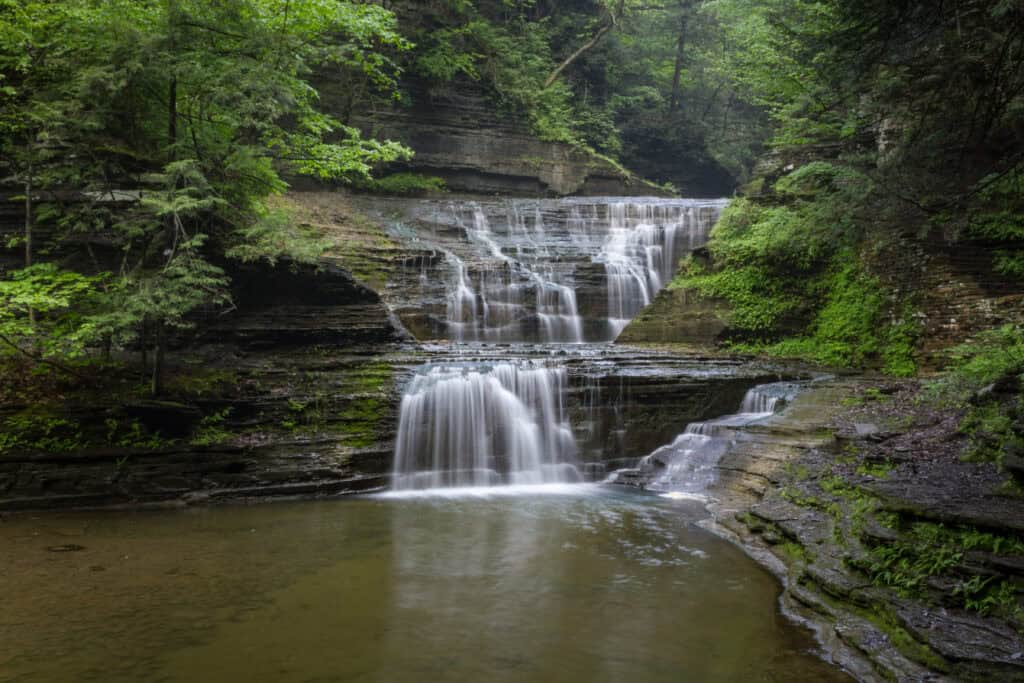
Buttermilk Falls State Park is home to one of the Finger Lakes’ most breathtaking places to cool off. The park’s namesake waterfall—a dramatic, 165-foot cascade—is the last and largest of the 10 waterfalls along Buttermilk Creek, which drops roughly 600 feet through the park on its way toward Cayuga Lake.
At the base of the falls, you’ll find a natural swimming area surrounded by steep gorge walls and lush greenery. Buttermilk Falls State Park is divided into two parts—upper and lower—and the lower section is where you’ll find Buttermilk Falls and the swimming hole, as well as playing fields and a campground. The upper portion has its own lake, plus hiking trails, picnic areas, and more playing fields.
Buttermilk Falls State Park charges a $10 vehicle entrance fee.
Enfield Falls
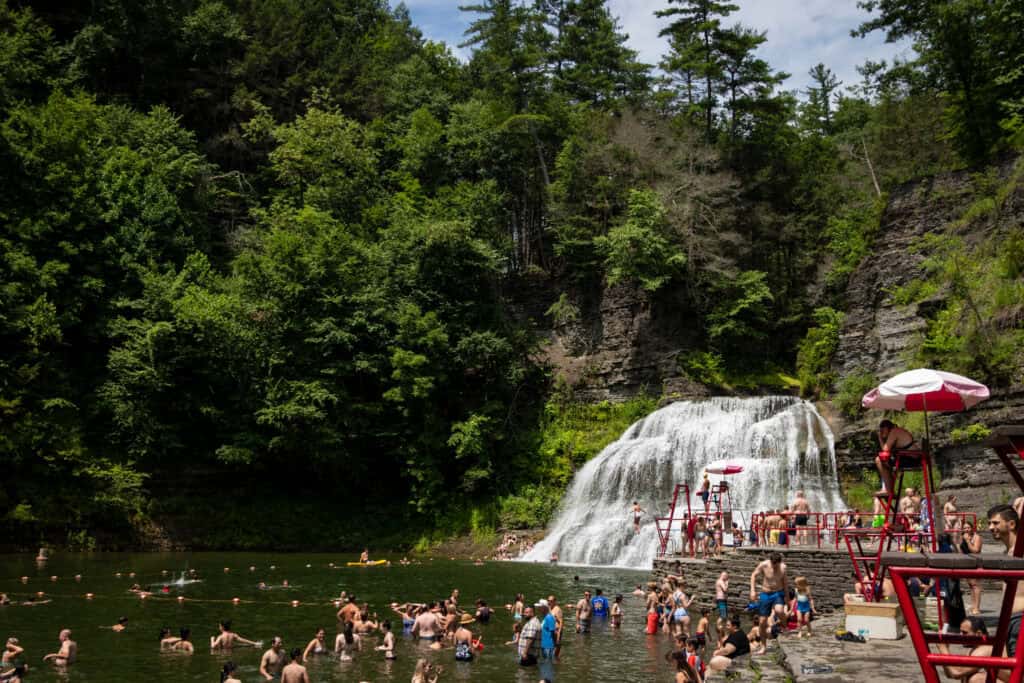
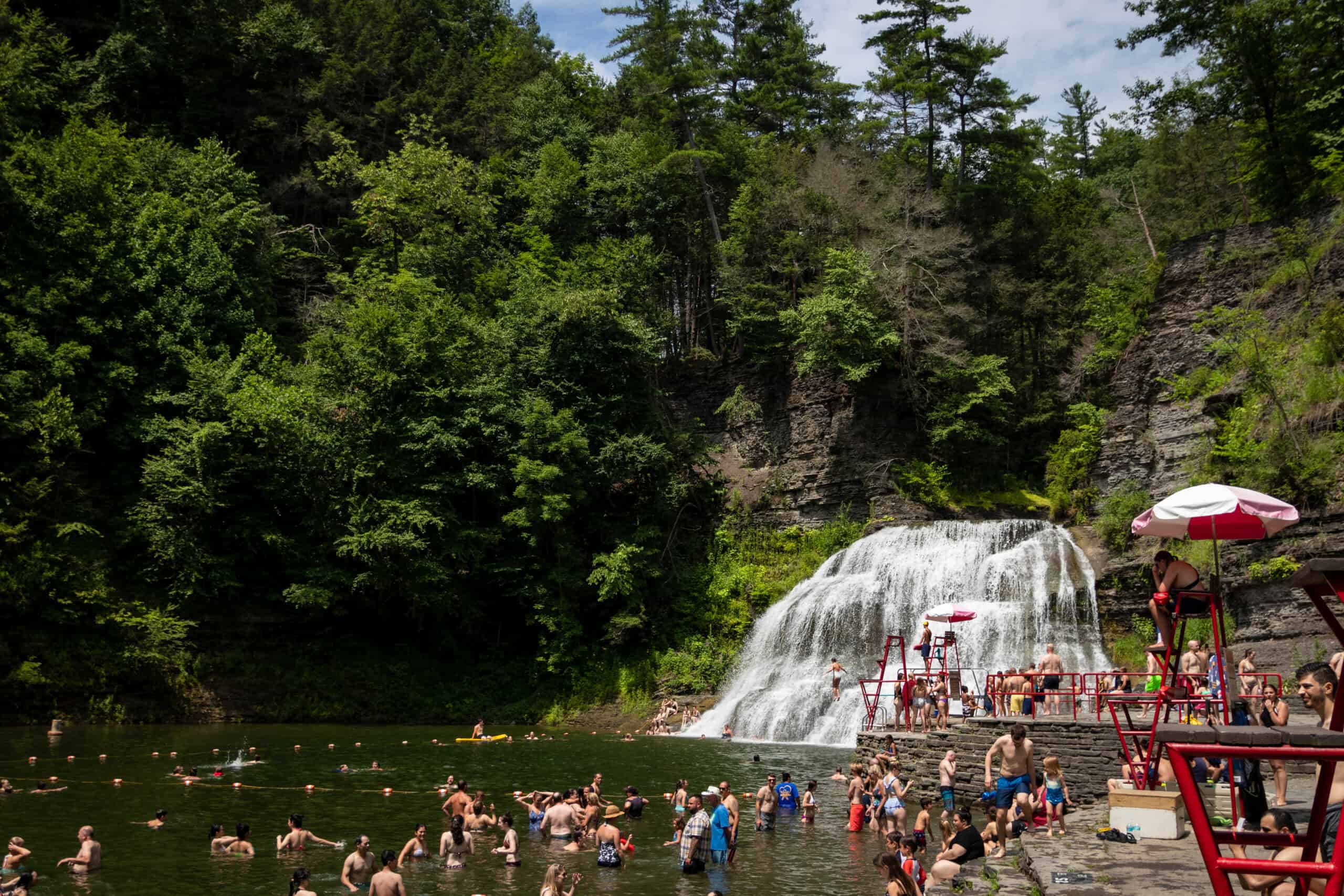
Among the many attractions at 1,100-acre Robert H. Treman State Park is one of New York’s best swimming holes. To reach it, follow the winding trails through the park’s gorge, Enfield Glen, until you reach Enfield Falls. (Enfield Falls Swimming Hole trail is by far the quickest and easiest option.)
Beneath the waterfall—one of 12 located within the gorge—is a stream-fed natural pool that’s popular with swimmers. So popular, in fact, that the pool has been subtly adapted with some manmade features to make it safer and more enjoyable, such as roped-off depth zones, stone steps, and a diving board in the deep end.
There is a $10 vehicle entry fee for Robert H. Treman State Park.
Grimes Glen Park
Grimes Glen Park is home to two 60-foot falls that you can reach by wandering upstream about a half mile from the parking area. Beneath the falls—simply referred to as first and second—is a shallow wading pool worth exploring.
You’ll probably get wet before you reach the pool, though, because there isn’t a designated path that leads to it. Rather, you end up walking through the water.
There is no vehicle or admission fee at Grimes Glen Park.
Hudson Valley
Split Rock
Spanning about 8,000 acres in the Hudson Valley, Mohonk Preserve is the ultimate outdoor playground. It’s home to rugged cliffs, dramatic gorges, scenic hiking trails, a lake, waterfalls, and one of New York’s best swimming holes.
Getting to the swimming hole is easy, which adds to its appeal. From the Coxing Trail Parking Lot, it’s a quick walk to Split Rock, a picture-perfect swimming area where an emerald-green pool sits between towering rock walls. At one end, a 12-foot waterfall tumbles into the water below.
Most of the pool is shallow enough for wading, with depths of about 3 to 4 feet, while the area closest to the waterfall reaches approximately 8 feet deep, ideal for those looking to take a proper swim.
You must pay a day-use fee to explore Mohonk Preserve and access Split Rock. The fee starts at $15 and increases to $25 depending on the day and how you plan to explore the area.
Western New York
Stony Brook State Park
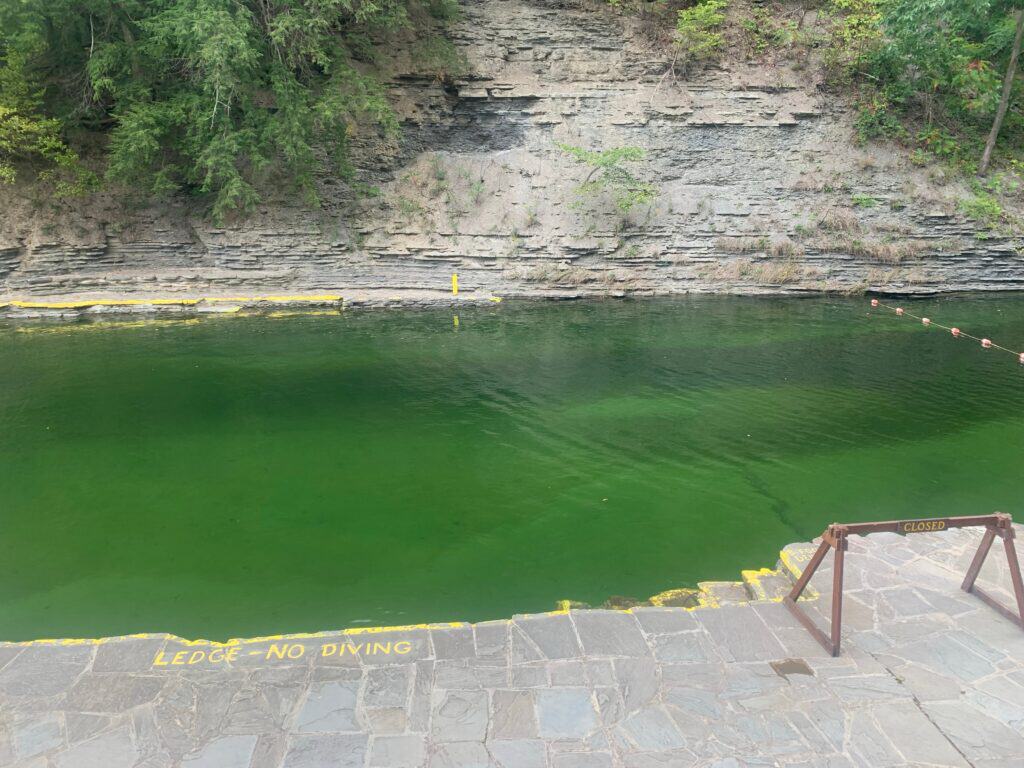
568-acre Stony Brook State Park is best known for its dramatic gorge, cascading waterfalls, and scenic hiking trails. After exploring the park’s sandstone canyon and passing several falls along the way, you can cool off in the park’s designated stream-fed swimming area near the entrance to the gorge.
While the waterfalls and plunge pools throughout the park may look inviting, swimming is only permitted in the designated swimming area. The park offers plenty of other amenities, including a picnic area with tables and grills, multiple athletic courts, playgrounds, and camping.
Note: As of May 2026, the swimming area at Stony Brook State Park is closed for repairs. You can call 585-335-8111 for updates on when it may reopen.
Bonus spot: Bear Slide
Not every place to cool off in New York is an actual swimming hole. In the 72,508-acre Lake George Wild Forest, you’ll find a unique water feature worth exploring. Bear Slide is a natural waterslide carved into the smooth rock of Buttermilk Brook. After a short uphill hike, you’re rewarded with a long stretch of sloping rock where water flows over the surface, creating a natural, large-scale slip-and-slide of sorts.
The water here isn’t deep enough for traditional swimming, but that’s not really the point. Visitors come to splash, wade, and slide down the rock formation before cooling off in the shallow pool below. If you do want to go for an actual swim, there are many bodies of water located throughout Lake George Wild Forest, including the forest’s namesake lake and several ponds and rivers.
There is no entrance or vehicle fee for Lake George Wild Forest.