From linguistic quirks to wild origins, New Mexico has some surprising town names. Read on to discover them.
New Mexico’s city and town names tend to be a melodious mix of English, Spanish, and Native languages, with iconic locales like Santa Fe and Albuquerque. Bugs Bunny made the latter famous by never remembering to turn left there, but some of New Mexico’s smaller towns have names that are funny all on their own.
From the quirky and surprising to the straight-up strange, there are some unusual town names spread across the Land of Enchantment. Here are the stories behind nine of them.
1. Chilili
New Mexicans probably already know this town name isn’t about anything hot and spicy; that would be spelled chile, of course! Chilili, a tiny town east of Albuquerque, gets its name from the Arroyo de Chilili and a nearby Native American pueblo the Spaniards noted in the late 16th century.
With fewer than 150 residents, Chilili is so small that many amenities, like hotels and restaurants, are actually in the neighboring town of Moriarty. Sherlock Holmes fans may get a chuckle out of that town name as well!
2. & 3. Dusty and Polvadera
The desert being a dusty place may seem like it goes without saying, but two New Mexico desert towns make it abundantly clear in their names. Dusty and Polvadera are actually two towns with very similar names, but in different languages.
Dusty is a tiny unincorporated community in the remote southwestern corner of Socorro County, named for its dusty roads. Nearby Polvadera is a historic farming village along the Rio Grande about 10 miles north of Socorro. Its name likely began as a Piro word, later reshaped to sound like the Spanish polvareda, meaning a cloud of dust. Polvadera also offers its own accommodation: the Cranehaven Bed and Breakfast, an independently run hotel featuring classic adobe architecture and a 32-acre desert property.
4. Nutt
Is there any town name in all of New Mexico that’s nuttier than Nutt? This southern New Mexico town, which is home to the Nutt Corner Bar and little else, has proudly described itself as the “middle of nowhere.”
Nutt doesn’t actually get its name from edible nuts like pistachios and pecans, though. The name comes from railroad official Henry Clay Nutt, who was on the board of directors for the Atchison, Topeka and Santa Fe Railway. He was partly responsible for the railway’s southern line, which the town of Nutt served as a depot.
5. & 6. Raton and Brilliant
Raton is a curious name in and of itself, as ratón is Spanish for “mouse.” As Roger Sanchez, curator of the Raton Museum, explains, “An early group of Spanish explorers spent the night on the mountains and had to build a ring of fires around themselves to keep the mice away because the mountains were loaded with mice.” However, there’s another nearby name that has even wilder origins.
Just northwest of Raton is the ghost town and former mining community once called Brilliant (or sometimes Brilliant II, after another failed mining town). But before Brilliant was a ghost town, the area had a different name. It was actually called Swastika, for what had been known as a good-luck symbol similar to the Navajo whirling log before the Nazis adopted it as a symbol. To avoid any Nazi associations, the town was renamed Brilliant in 1940 and kept the name until the town’s post office was dissolved in 1954.
7. Pie Town
When you roll into Pie Town, you may expect to choose between apple, pecan, or chicken pot you-know-what. This tiny unincorporated town does have pie available at local eateries like the Pie Town Pie Company, which offers pies ranging from apple and cherry to pizza and quiche. In fact, the town even holds a pie festival every year on the second Saturday in September. And happily for pie enthusiasts and quirky town-name fans, Pie Town actually did get its name from pies.
In the 1920s, a man named Clyde Norman opened a general store where he baked and sold dried fruit pies after he failed to make a success of a prospecting claim. The pies were such a hit that they became a landmark, and the general store, called Norman’s Place, flourished. As the surrounding area of New Mexico filled with homesteaders during the Great Depression, a town grew up around it, and it remains full of pie enthusiasts to this day.
8. Truth or Consequences
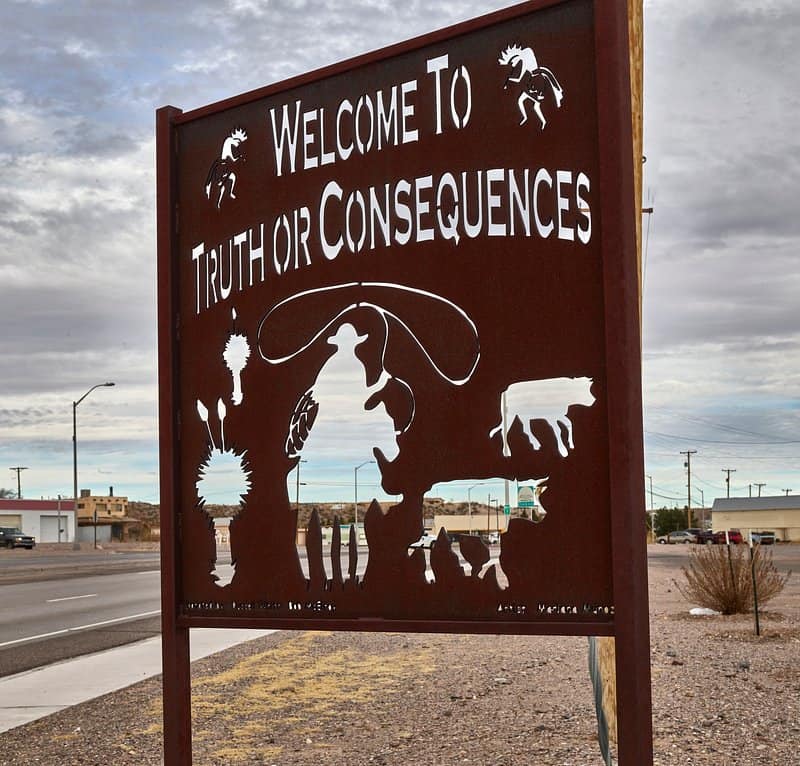
Perhaps the most famous of New Mexico’s strange and unusual town names, Truth or Consequences got its name from an unlikely place: a radio quiz show. In 1950, the radio show “Truth or Consequences” announced that its tenth-anniversary episode would air from the first town to name itself after the show. The New Mexican town of Hot Springs decided to go for it, and has been called Truth or Consequences ever since.
Today, the town is known for the film “Truth or Consequences, N.M.,” a 1997 thriller about a group of ex-cons. It’s also home to a lively arts district and the mineral hot springs that gave the town its former name and where visitors can still “take the waters” and enjoy a relaxing soak.
9. Weed
Recreational and medical cannabis is legal in New Mexico for those age 21 or older, but the little town of Weed in Otero County has nothing to do with marijuana—or even with garden weeds like dandelions. The tiny, remote community, which has fewer than 100 residents as of 2020, actually gets its name from 19th-century merchant William H. Weed, who opened a branch of his store in the newly founded town in the late 1800s.
These town names are all worthy of a little chuckle, but more than that, they’re all attached to cool, quirky towns in the Land of Enchantment. Enjoy exploring them—and be sure to save a slice from any trips to Pie Town!