With data centers on the rise in Virginia, here’s what you need to know about their potential impact.
Like many other parts of the country, Virginia is feeling the impacts of the AI boom. From large metros to rural towns, local communities throughout the commonwealth are grappling with new and proposed data center developments.
April 2026 data from the Pew Research Center showed 398 data centers operating in Virginia, with another 287 planned. This puts Virginia at the forefront of the national data center boom.
As a result, many Virginians are left wondering what the local impact will be. Here’s what you need to know, from water usage to potential bans.
Virginia’s data center lead is narrowing
Northern Virginia has often been called “Data Center Alley” due to its more than 250 data centers, the highest concentration in the world. As a result, a considerable portion of the world’s internet traffic is directed through the region’s data center network.
The collection of data centers pumps more than $1 billion in tax revenue into local government budgets, according to the Northern Virginia Regional Commission. The Virginia Economic Development Partnership, the commonwealth’s official economic development authority, estimates that data centers will generate over $3 billion in state and local tax revenue.
Despite the “Data Center Alley” moniker, Virginia is expected to lose its status as being the epicenter of data center development. Texas, perhaps unsurprisingly, is on track to surpass Virginia’s capacity because of new projects underway in the state. Soon, the Lone Star State will double Virginia’s data center capacity. It currently has 296 operational centers, with 170 more planned. Other states are also expected to surpass Virginia soon.
As some jurisdictions tighten restrictions, data centers are starting to be built in so-called “frontier markets,” meaning markets with little or no existing data center capacity.
More rural parts of the commonwealth fit the “frontier market” description, which is why jurisdictions with little to no zoning ordinances are proving attractive for developers. One such place is Wythe County, which has zero zoning ordinances outside of its two towns. As a result, the county is developing two major data centers.
One such center, Solis Arx, has taken the form of a 99-acre AI computing campus in Progress Park. It will be constructed in phases. According to the county, the center is expected to use less than 2,000 gallons of water per day, about what a restaurant or five to six houses use. The park’s current water availability is 1,500,000 gallons per day.
Solis Arx is said to be on the hook for the costs associated with power infrastructure expansion. The county also stressed that residential and business utility bills will be unaffected by the center. Additionally, the center’s noise level is limited to 65 decibels or less from the property line.
Botetourt County: Benefits and backlash
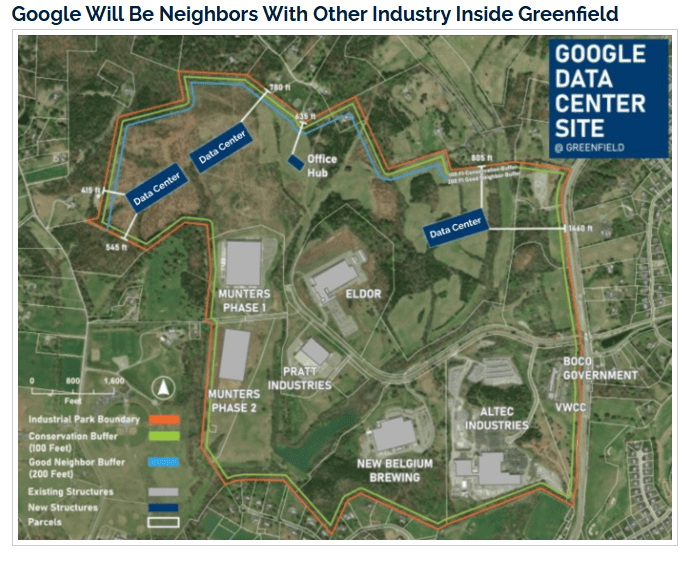
The Google Data Center Campus in Botetourt County is another notable example of the data center expansion into “frontier markets.”
The tech giant bought a 300-acre tract of land in the Greenfield industrial park from the county for a little over $14 million in 2025. To sweeten the deal, Google offered an additional $4 million in grant funding to help with various county projects, like the purchase of three ambulances and renovation of a rural library.
The company also announced in early October that it would be putting $10 million toward energy efficiency projects in the commonwealth: $9.5 million to the Virginia Community Action Partnership and $500,000 to Dillwyn-based FLIPP Inc. for workforce training. About $1.8 million of that will help roughly 80 homeowners near the Greenfield site.
However, the center’s development has drawn controversy among residents, with opponents protesting during the county’s public hearing on the 2026-27 budget earlier this year.
Botetourt residents also joined national protests in July by lining up along Route 220 with signs. Their primary complaint was a lack of transparency surrounding the project. Groups like the Piedmont Environmental Council in Warrenton and Charlottesville point to the environmental impacts of data centers as being cause for concern in the commonwealth.
The Google campus is expected to draw up to 2 million gallons of water a day from Carvins Cove Reservoir, eventually rising to as much as 8 million gallons a day.
The council’s primary concerns focus on the energy and water needed to run the centers, along with emissions like air and noise pollution. As such, it advocates for transparency on energy usage, water consumption, and emissions; state regulatory reviews; protections for residents and businesses; and incentives for clean energy and efficiency standards.
Regulation throughout Virginia
In September, Gov. Abigail Spanberger released what her office described as the country’s “most comprehensive and aggressive data center accountability effort” in the form of the “Data Center Accountability Framework.” The move was said to be an effort to boost transparency so that communities can have a voice in approvals. Protection against rising energy bills and enforcement of environmental standards were also cited as reasons behind the framework.
The framework was accompanied by Executive Order 22, serving as the enforcement mechanism.
Spanberger also created a new AI Task Force to address risks from the ongoing adoption of AI, including cybersecurity, workforce displacement, and data privacy. The move gained praise from Democratic lawmakers and environmental groups.
Speaker Don Scott described the move as a “moratorium on bad actors” in the industry, adding that developers who want to ignore locals and expect Virginians to pay higher bills aren’t welcome in the commonwealth.
The Chesapeake Bay Foundation’s policy manager, Jay Ford, noted that the framework will limit the impact data center expansion will have on the commonwealth’s bodies of water and land.
Earlier in the year, a statewide energy consumption tax on data centers was passed as part of the budget. Spanberger described the tax as a way to ensure data centers “pay their fair share.” Spanberger also joined a bipartisan group of governors to urge the country’s largest electric grid operator, PJM Interconnection, to ensure data centers pay for new capacity.
The governor also created a new cabinet-level position, chief energy officer, to help lower costs for Virginians. With rising electric bills, the “One Big Beautiful Bill,” and the war with Iran, Spanberger said the average family has seen a $1,000 jump in expenses.
Some jurisdictions are taking matters into their own hands; as Cardinal News reported, Front Royal indicated that data centers aren’t allowed in its industrial areas. Frederick County voted to prohibit data center development, the first Virginia locale to do so.
Other localities are considering responses, including Shenandoah County. Surprisingly, Spotsylvania County and Loudoun, two areas known for their data center concentration, are also pondering potential bans on new development, with Spotsylvania’s supervisors also voting in favor of a statewide moratorium.