The Texas skies will have vibrant views this summer. Learn which moons, meteor showers, and planets you’ll be able to spot during the night and early morning.
Look, up in the sky! It’s a bird! It’s a plane! No, it’s actually one of many celestial events hitting the atmosphere this Texas summer.
The Eta Aquarids, a meteor shower that’s a remnant of Halley’s Comet, peaked in early May and will continue throughout the month. That’s not the only stunning view we’ll have, however. Here are additional celestial events you can spot from Texas this summer, which we’re loosely defining as between Memorial Day and Labor Day.
May 31: Full Blue Moon
A blue moon seems like it would be pretty explanatory: The moon turns blue. Easy, right? Alas, that’s not quite the case. Though the moon has occasionally been a shade of blue (such as after notable volcanic explosions that sent dust into the atmosphere), this event generally just refers to a rarer occurrence. It’s also where the phrase “once in a blue moon” comes from.
Early American astronomers measured events using the tropical year—from one winter solstice to the next—instead of the calendar year. In a standard tropical year, there are 12 full moons, three during each season. Each of those moons has a name related to the calendar dates on which they fall, such as the Easter Moon or the Yule Moon.
However, the moon phases complete every 29.5 days, so about every 2.5 years, the tropical year contains 13 full moons. The 13th full moon is the Blue Moon, and it’s the third full moon of the season’s cycle. The last Blue Moon was on August 19, 2024, and we’ll have another one on May 31 this year.
The best time to watch this year’s Blue Moon is in the early twilight. You’ll likely be able to spot it the evening of May 30, though its peak is at 3:45 a.m. on May 31. Aim for a dark area with an open view of the eastern horizon for the best viewing experience. This time around, the Blue Moon is a micromoon, so it’ll be about 6 or 7% smaller than a typical full moon, though it will still shine quite brightly.
For a truly immersive experience, pair your viewing of this event with the song “Blue Moon,” popularized by The Marcels.
June 9: Venus and Jupiter Conjunction
Venus and Jupiter are the two brightest planets visible from Earth. And in early June, they’ll pass by each other in the sky, with Venus coming out from the sun’s glare as Jupiter heads toward it. These planets have passed by each other before, but it’s rare that they’ll be in such close proximity.
To wit, this event happened last year, though the planets will be just 1.6 degrees apart this time around. You’ll be able to see both planets for several days leading up to the event, with the closest proximity happening on June 9. Even better news: The conjunction is visible from every city on Earth. And despite Venus being about six times brighter than Jupiter, both will be bright in the night sky.
The best time to watch is about an hour after sunset, so between 9:15 and 9:30 p.m. in Texas. The planets will be bright enough that you won’t need any equipment like a telescope or binoculars. Simply look toward the west about an hour after the sun sets—though please wait for the sun to go down, since, you know, staring directly at the sun is not advisable in any setting.
July 30–31: Southern delta Aquariids and alpha Capricornids
Two meteor showers happening at once? What a fun combination! The Southern delta Aquariids (full period of activity from July 12–Aug. 23) and the alpha Capricornids (full period of activity from July 3–Aug. 15) are both peaking at the same time of year, on July 30 and July 31, per the American Meteor Society.
Alas, both of these showers will be pretty faint in the sky for Texans. The Southern delta Aquariids produce good rates and travel at a medium velocity of 25 miles per second, but they don’t typically leave persistent trains or fireballs. The alpha Capricornids are a slower meteor shower, traveling at a velocity of 14 miles per second, though they can produce a number of bright fireballs.
On a dark, clear night, you might be able to catch both of these showers in the sky. Unfortunately, the 2026 iteration of them falls shortly after a full moon on July 29, which blocks out a lot of celestial events from the naked eye. Because of that, you may see more of the delta Aquariids the week before its peak, when the moon isn’t as full. The best time to try and see the delta Aquariids is in the wee hours of the morning. The early bird gets the worm; in this case, the early bird might see some cool phenomena in the sky.
Aug. 12–13: Perseid Meteor Shower
The Perseid Meteor Shower is an annual event that originates from the 109P/Swift-Tuttle comet. Per NASA, this is the most popular meteor shower of the year. For you nomenclature enthusiasts, the radiant—where the Perseids appear to come from in the sky—is the constellation Perseus.
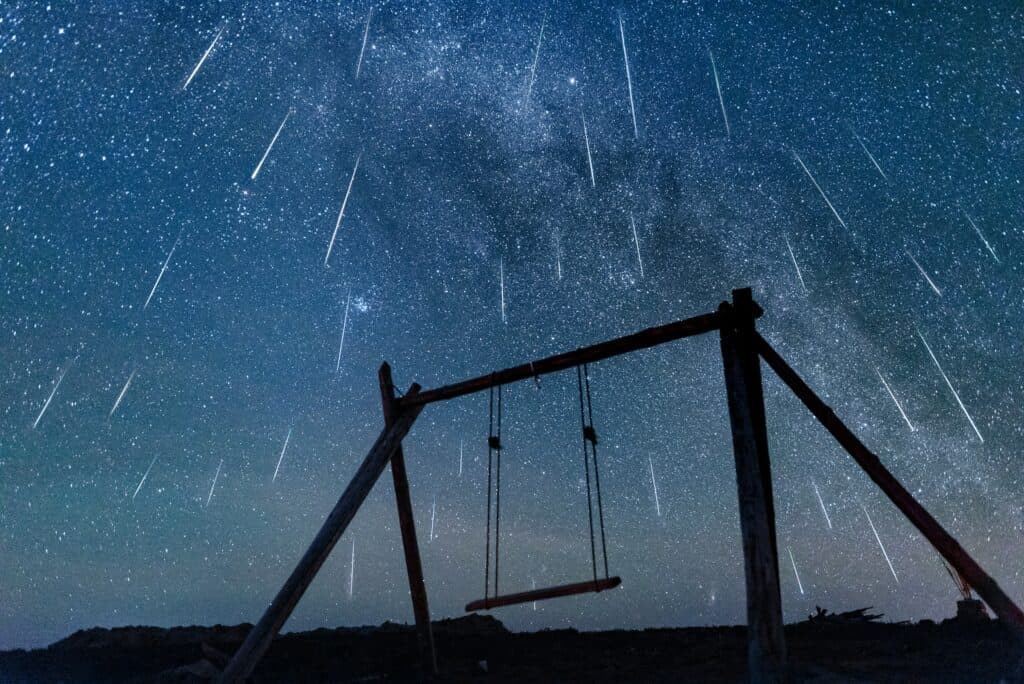
As a bonus, this year’s peak coincides with a new moon, meaning there won’t be another bright object in the sky taking focus away from the meteor shower. The Perseids are known for their fireballs and colorful trails of light. They’re also quite plentiful, reaching up to 50 to 100 meteors per hour.
The best time to watch is in the pre-dawn hours. Sometimes, you can see meteors as early as 10 p.m. Earth will pass through the entire meteor shower from about July 14 to September 1, though the peak is expected to be at 9:53 a.m. CDT on August 13. That means the mornings of August 12 and 13 will likely be the most prominent, though the shower could still be quite visible on August 14.
Throughout the Summer: Stargazing with Texas Parks & Wildlife
Texas skies are pretty to admire even when there isn’t a rare celestial occurrence. And Texas Parks & Wildlife has no shortage of events to help celebrate this natural beauty.
Throughout the summer, you can enjoy events like star parties with the San Antonio Astronomical Association or the San Antonio League of Sidewalk Astronomers. Or maybe you’d prefer to Marvel at the Moon at Blanco State Park. Perhaps you’d prefer learning about constellations or the planets? Night Sky at Bonham State Park and Let’s Stargaze in the Park—hosted by retired national park ranger and astronomer Larry Smith—offer fascinating facts about the solar system. (Side note: How do you organize a party in outer space? You planet!)
These events are often held at national or state parks. They’re typically free or require a small fee, with donations going toward improving the parks. A Texas State Parks Pass gets you admission into these parks at no additional cost, giving you plenty to explore.
Texans have some great opportunities for celestial events this summer. We’re wishing upon a shooting star that you get to see some of them.