Utah residents continue to fight back against data center development. Here are five chief concerns, from the health of Great Salt Lake to lack of public input.
This summer, Utah made national news when thousands of residents rose up against what was billed as the world’s largest AI data center, a project in Box Elder County’s remote Hansel Valley.
That massive hyperscale AI data center, Stratos, is spearheaded by Kevin O’Leary of “Shark Tank” fame. As the New York Times reported in June, the project had essentially been rubber-stamped by Gov. Spencer Cox and Utah State legislators without input from Box Elder County residents. The response was swift, fierce, and not without consequences for some politicians—it cost Utah State Senate President Stuart Adams the primary race, and two Box Elder County commissioners were ousted.
As The New York Times noted, what shocked O’Leary—and much of the country—was that despite his celebrity “and the politics of its opponents—most of them Republicans and members of the Church of Jesus Christ of Latter-day Saints,” there was a fierce and unrelenting backlash. Even “Saturday Night Live” took notice. James Austin Johnson portrayed O’Leary on Weekend Update, wisecracking that “All I want is to buy up 40,000 acres of God’s untouched splendor and replace it with a very loud computer that steals your job. Is it going to take up precious water? Absolutely. Is it going to provide a necessary service? Who’s to say?”
Utah already has dozens of data centers, some dating back decades. As of April 2026, the state was home to 48 active data centers, with at least seven more underway. (The Salt Lake Tribune put together this map to help residents track proposed data centers and those currently under construction.) However, according to a study by Utah State University, more than 75% of Utahns oppose the development of new data centers—here are some of the reasons why.
1. The health of Great Salt Lake
Utahns are acutely aware that the Great Salt Lake is in peril and that the lake’s health is deeply intertwined with their own; the exposed lakebed has been sending clouds of toxic dust into surrounding communities, and residents fear what might happen if the lake collapses entirely.
Data centers are notoriously thirsty, and Stratos is not the only proposed project that could potentially divert water from nearby watersheds, including the lake. The Tooele Valley Project, a 500-megawatt industrial data center and truck stop campus, would present another problem by discharging 250,000 gallons of concentrated brine wastewater into the southern end of the lake each day.
Again, Utahns made it clear they did not want data centers in their communities. Resident Terri Durfee testified during public hearings for the Tooele project. “We are being asked to accept industrial pollution in one of Utah’s most fragile ecosystems, during one of the most prolonged droughts in our state’s history,” she said.
2. Noise and heat
Data centers produce constant noise pollution due to generators, HVAC systems, and electrical transformers. And in Utah, that’s an even bigger problem. As KSL reported in August, while lawmakers approved a bill regulating water use by data centers, “the state doesn’t currently have regulations in place governing how much noise data centers can produce or how much heat they can emit.”
Channel 4 spoke with residents in West Jordan living near Aligned Data Center’s campus, who are already suffering. “They run [the generators] at random all the time,” said resident Steve Ready. “I’m a light sleeper, so it wakes me up in the middle of the night. 3 a.m., they’re running, it’s like a wind tunnel and sounds like airplanes circling my house.”
As for heat, the initial Stratos proposal, as Utah State University physics professor Robert Davies told Forbes, would generate the heat equivalent of “about 23 atom bombs’ worth of energy dumped into this local environment every single day,” raising local daytime temperatures by 5 degrees Fahrenheit and nighttime temperatures by up to 28 degrees.
3. Water use
In its data center study, Utah State University found that water use was a major concern among Utahns; nearly 90% of respondents cited it. As one of the driest states in the country, located in a bioregion experiencing severe drought, Utah has other reasons to fear the impacts of data centers on its water supply.
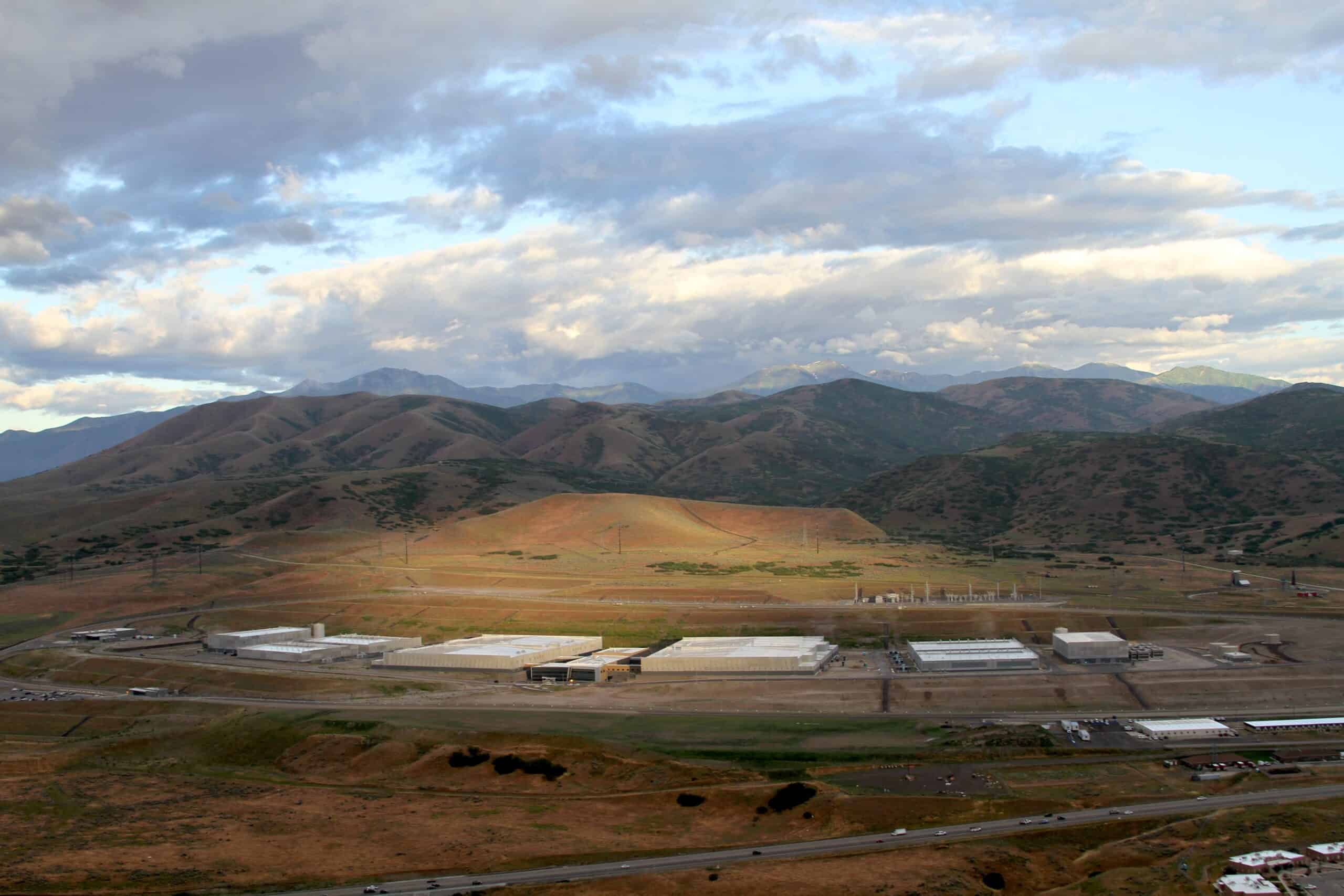
Though recently passed bills (including House Bills 76, 507 and 60) will regulate data center water use, existing centers are some of the state’s largest water consumers. As Grist.com recently reported, the NSA Data Center in Bluffdale consumed 126 million gallons of water over the course of 12 months; Aligned’s two data centers consumed 80 million gallons (West Valley) and 47.4 million gallons (West Jordan); eBay’s Data Center used 19.5 million gallons; and the Novva Data Center consumed 3 million.
As Grist noted, the NSA’s water use alone was “around 390 acre-feet, or enough water to meet the annual indoor needs of nearly 800 Utah households.”
4. Energy demands
As this August 2026 briefing paper from the Office of Legislative Research and General Counsel reports, Utah has 48 operating data centers, and the 10 largest account for nearly 80% of their total power capacity. The seven under construction will need about 2,600 megawatts more, more than double what the state’s data centers currently use. Roughly 2,350 megawatts of that comes from just three hyperscale projects. For perspective, Utah used an average of about 4 gigawatts of electricity statewide in 2025.
The Stratos project, by comparison, was proposed at up to 9 gigawatts, more than twice the entire state’s average demand. All of that power would come from natural gas drawn from the Ruby Pipeline, which runs 680 miles from Wyoming to Oregon through northern Utah. That reliance, Forbes noted, raises “urgent concerns about air quality.”
Utah Clean Energy, a nonprofit that advocates for clean energy, estimated that the original full-size project could raise Utah’s carbon emissions by 55% to 75%, potentially making it the largest single source of emissions in the state. At the high end of that estimate, its nitrogen oxide emissions would be roughly double the industrial total for all of Salt Lake County, about as much as Utah’s entire oil and gas industry produces in a year.
And that’s just one data center. Though the Utah Legislature is working to make sure the costs of energy aren’t passed on to consumers, the environmental impacts would be unavoidable.
5. Lack of public input
During the flurry of media coverage this summer, Forbes wrote that “communities are pushing back against AI data centers—over noise, water use, energy demands, and a development pace that often leaves residents with little say. Box Elder is all of that, multiplied to a scale that strains credulity.” Despite that, “when hundreds of residents showed up to protest, a county commissioner told them to ‘grow up’—and approved the project anyway.” Residents had to sue to put the brakes on the project.
O’Leary continues to push forward, even as the surrounding community pushes back. As KSL and other local news outlets reported, a third water permit was filed in October by O’Leary Digital Utah DC Sub I, LLC. It claims “water demands would be lower than historical agricultural uses on the property,” and “could result in additional water reaching the Great Salt Lake.”
Ben Abbott, the biologist who alerted Utahns to the imminent collapse of the Great Salt Lake and went on to found Grow the Flow, told KSL that “The short and the long of it is, they don’t tell us how they’re going to achieve power production of that magnitude with that little water. This would be a water-to-power ratio that is 10 to 100 times better than the top-performing facilities today. That’s if they’re using the reciprocating gas engines. If it’s the combined cycle gas turbine, this just isn’t in the realm of reality. There is not an example anywhere on the planet.”
As the Salt Lake Tribune reported, immediately after the permit was filed, hundreds of people submitted a Protest of Application at the Utah Division of Water Rights Protest Portal in opposition to what O’Leary is calling “Wonder Valley”—even though they had to pay $15 to do so.